| Folks, If you want to understand ghist of the story with all involved, get down and read from top to bottom. Mid-way is Red Hot Stuff; towards the end is deadly killer... Do not worry about the length......chil and read....... Problem in Congo is spreading and the players are Museveni, Salim Saleh, Kagame, Kibaki, Moi, Kamlesh Patni....... etc., This is enough stuff to get UN and ICC Hague to dive into action. There is no excuse to wait for another day.......ICC Hague have no excuse nor the UN. evidence is full proof......they must act......!!! Militants raid town near Kenya border, 12 dead  A handout released by IntelCenter shows members of Somalia's hardline Islamist rebel group al Shabaab. Photo/FILE By AFP
Posted Sunday, November 25 2012 at 11:38 Somalia's Al-Qaeda-linked Al Shabaab fighters briefly took control of a small town on the border with Kenya in a battle that left at least 12 dead, military officials and witnesses said Sunday. Heavy fighting broke out late Saturday afternoon in Bulohawo and lasted into the evening, residents and military commanders said, with residents confirming that the Al Shabaab took full control of the town for a few hours before Somali troops were able to reinforce their positions. "The violent elements attacked Bulohawo in late afternoon and after heavy fighting our forces defeated them and inflicted heavy losses on them," Diyad Abdi Kalil, a Somali military commander in the area, told AFP by phone. Casualty estimates varied but most sources agreed that at least a dozen people, most of them fighters, had been killed. "The Shabaab attacked the town from three directions and penetrated the barracks of the Somali troops after heavy fighting. They briefly took control of the town but were later forced back. Twelve people. most of them the fighters from the two sides, died," said resident Sadik Mohamed. The attack appeared to have come as a surprise, with the Al Shabaab having been forced out of their major strongholds by troops from the African Union force AMISOM. Congo says no talks with rebels unless they quit GomaBy Jonny Hogg and Richard Lough | Reuters – 13 hrs ago GOMA, Democratic Republic of Congo (Reuters) - Congo said on Sunday it would not negotiate with M23 rebels in the east until they pulled out of the city of Goma, but a rebel spokesman said Kinshasa was in no position to set conditions on peace talks. Congolese President Joseph Kabila met with M23 for the first time on Saturday after an urgent summit in Uganda where regional leaders gave M23 two days to leave Goma, which the rebels seized six days ago after U.N.-backed government troops melted away. Eight months into a rebellion that U.N. experts say is backed by neighboring Rwanda, the rebels have so far shown no sign of quitting the lakeside city of one million people. The rebels say they plan to march on other cities in the east, and then strike out across the country to the capital Kinshasa, across 1,000 miles of dense jungle with few roads, a daunting feat achieved 15 years ago by Kabila's father. Amani Kabasha, a spokesman for M23's political arm, welcomed the meeting with Kabila but questioned the government's resolve to end a crisis that risks engulfing the region. "Why put conditions on talks? You pose conditions when you are in a position of strength. Is the government really in such a position?" Kabasha told Reuters in Goma, which sits on the north shore of Lake Kivu at Congo's eastern border with Rwanda. Vianney Kazarama, the rebels' military spokesman, said government forces that had been reinforcing along the shores of the lake were now deploying in hills around the rebel held town of Sake and government-held Minova, both Goma's west. A U.N. source in Minova said government soldiers had gone on a looting spree for a second straight night there. The town was calm on Sunday but gunshots rang out overnight, the source said. "What is real is that the morale of the troops is very low. They've lost hope in the commanders," the U.N. source said. The Congolese army has vowed to launch counter-offensives and win back lost territory. The rebels have warned the government against embarking on a "new military adventure". So far, the unruly and poorly-led army has been little match for the rebels, despite assistance from a U.N. peacekeeping mission that deployed attack helicopters to support the government before Goma fell. Rebel leaders share ethnic ties with the Tutsi leadership of Rwanda, a small but militarily capable neighbor that intervened often in eastern Congo in the 18 years since Hutu perpetrators of Rwanda's genocide took shelter there. Rwanda has repeatedly denied Congolese and U.N. accusations it is behind M23. Saturday's Kampala summit called on the rebels to abandon their aim of toppling the government and proposed that government troops be redeployed inside Goma. The rebels have not explicitly rejected or accepted the proposals. They are, however, unlikely to cede control of the city or accept government soldiers inside it. WITHDRAW Regional and international leaders are trying to halt the latest bout of violence in eastern Congo, where millions have died of hunger and disease in nearly two decades of fighting fuelled by local and regional politics, ethnic rifts and competition for reserves of gold, tin and coltan. "Negotiations will start after the (M23) withdrawal from Goma," Congolese government spokesman Lambert Mende said. Kabila was still in the Ugandan capital on Sunday morning but was expected to return to Kinshasa later in the day or on Monday, two Congo government sources said. Kabila's communications chief Andre Ngwej said he did not believe official talks would start in the next few days. While Kabila's army is on the back foot, analysts are skeptical the rebels can make good on their threat to march on Kinshasa without major support from foreign backers. The regional leaders' plan proposed deploying a joint force at Goma airport comprising of a company of neutral African troops, a company of the Congolese army (FARDC) and a company of the M23. In a statement, the Kinshasa government said Tanzania would take command of the neutral force and that South Africa had offered "substantial" logistical and financial contributions towards it. The Kampala plan did not say what the consequences would be if the rebels did not comply. (Writing by Richard Lough; Editing by James Macharia and Peter Graff) Corruption scandals: Is Museveni digging a political grave for NRM? By Yasiin Mugerwa
Posted Sunday, November 25 2012 at 02:00 Preparing to hand over power after a decade in office, China's President Hu Jintao warned that corruption could ruin China and called for harsher methods to combat graft. Although China is not Uganda, President Jintao's fear that corruption could prove "fatal" to the Communist Party coincides with analysts' warning that by protecting the corrupt President Museveni is could be digging a political grave for the ruling National Resistance Movement. In a speech that marked the beginning of the end of Hu Jintao's era and formally ushered in new leaders for the coming decade, the Chinese president singled out the suspected [ruling] party members, asking them to be ethical and to rein in their greedy family members, whose trading on their connections for money and lavish displays of wealth have amplified public cynicism about the party. Unlike the case in Uganda and other countries, in China, corruption is a crime that draws capital punishment or the death penalty. President Jintao has relinquished his role at the top of the Communist party for Xi Jinping to take over as the country's paramount leader. While China is not Uganda, President Jintao's fear that corruption could prove "fatal" to the Communist Party and bring down the state if not tackled coincides with the analysts' warning that by protecting the Permanent Secretary in the Office of the Prime Minister, Mr Pius Bigirimana, who was named in the loss of donor funds, President Museveni is trying to dig his political grave and that of the ruling National Resistance Movement. Because of widespread corruption, Prof William Muhumuza from Makerere University's Political Science cited key challenges Uganda faces today — a rich-poor gap, putrefying public institutions because of patronage — highlighting the imbalanced development between the wealthy politicians and a struggling countryside.
Combatting corruption and promoting political integrity, Prof Muhumuza told Sunday Monitor, is a major political issue. However, his analysis is that it is unlikely to lead to the government being voted out because "corruption is mainly a concern of elites". Ignorance of layman
"The patronage dispensed through various avenues, the populist government programmes, though of poor quality (e.g. UPE, free healthcare, SACCOs etc) and the influence of the beneficiaries of corruption may instead win more support from unsuspecting ordinary person," Prof Muhumuza said. "The majority ordinary people are yet to link corruption at the national level with the poor quality of service delivery. This consciousness is still lacking at the moment." According to Prof Muhumuza the case of Mr Bigirimana being protected by President Museveni needs to be understood in the context of neo-patrimonial nature of African politics, where regime survival is insured using state resources that are irregularly acquired. That patronage-driven politics thrives on corruption. And public resources are ordinarily stolen to reward "cadres" and regime sycophants. "The patrons and their clients are rewarded and sustained through political appointment (e.g. as presidential advisers, chairpersons and members of commissions, ministers, RDCs etc). These privileges serve as a reward and political investment for the next round of electors. "The point here is that regime supporters or "cadres" in this case, are placed in strategic positions - usually the ones with a lot of resources, so that they can help to syphon them for purposes of building a political base for the regime. This is typical of almost all African regimes. The NRM is not an exception," Prof Muhumuza said. In a "damage control" statement to the donors who have already suspended aid over theft of aid at the OPM, President Museveni took time off to respond to what he called: "politically motivated red-herrings", targeting people he said were trying to give the impression that the problem of corruption in Uganda is because of lack of "political will" to fight that corruption. "Who? Me, Yoweri Museveni, lacking "political will" to fight corruption and criminality when I am stronger now than I was in 1971, when, together with my colleagues, we took the regime of Idi Amin head on, or when in 1981, with 27 guns, we attacked Kabamba? Those who peddle those falsehoods should be treated with the contempt they deserve," Mr Museveni said. While President Museveni brags of putting in place the numerous anti-corruption laws and institutions, by protecting suspects, some of whom are his ministers and close allies, the Executive Director, Anti-Corruption Coalition Uganda, Ms Cissy Kagaba, says has killed the impetus in the fight against corruption and promoted impunity in the process. The infamous 2010 Temangalo land scandal involving Prime Minister Amama Mbabazi was the first case that possibly exposed the lack of political will to fight corruption. At the height of this scandal, a caucus meeting was called at State House, Entebbe, where a decision was taken to defeat the Commissions, Statutory Authorities and State Enterprises report implicating the ministers involved. Again, the ministers who were implicated in the 2007 Chogm scandals survived through the party caucusing and others who, with tainted images, have since been re-appointed in key Cabinet positions. "Even if NRM uses corruption to entrench itself in power, this is unsustainable," Ms Kagaba said. "With time, Ugandans will get tired of those who steal their money and in the end they will get angry and remove their leaders from power. This is what caused the Arab spring. Take the example of OPM scandal; do you expect the people in northern Uganda to be happy when a certain group of people decided to steal their money?" On several occasions, President Museveni has promised to stamp out corruption but no tangible solution to the crisis has been witnessed by the country today. The President is now accused of offering lip-service to the fight against the vice. But in trying to explain what has become of his promises to wipe out corruption in his government, Mr Museveni told the donors that key institutions like the IGG, seem to have been infiltrated by questionable characters. Looking forward, former IGG Augustine Ruzindana said: "Everyone, voters, civil society, religious organisations, business community, international community, political parties and politicians, including those in NRM etc...must appreciate and accept the imperative of regime change and work for its realisation."
From the political succession debate viewpoint, Mr Nicholas Opio, an independent analyst said, endless corruption scandals will give President Museveni more arsenals to realign his political cards and purge his numbers of historically connected and ambitious folks viewed as possible power points. More praise-singers coming up
According to Mr Opio, corruption will also be nectar for attracting political optimists who will be involved in a rat race to be the loudest political praise singers of the President, his family and corrupt ministers. However, Mr Opio said that will not entrench the Museveni rule. In any event, he said, the NRM government's credibility is being undermined by the increasing cases of corruption. "The regime's smoke screen showmanship in fighting graft is increasingly becoming evident. Little wonder donors are now reacting by cutting aid," he said. With hindsight, Mr Opio thinks, Ugandans are to blame for the corruption we see in government today. "We have not been able to channel a collective outrage for the theft we have seen across government departments and ministries, either because we are beneficiaries of the same (by way of pecks and benefits) or because the people involved in the fight against corruption themselves do not have the moral authority and public support to be able to mobilise a critical mass," Mr Opio said. But on whether corruption will be the vice that would dislodge the President's 26 years of uninterrupted rule, the Leader of Opposition in Parliament, Mr Nandala Mafabi, said regime's "cronyism" and "corruption" have a corrosive effect, disadvantaging innocent Ugandan traders and entrenching a regime. "The money for service delivery is always siphoned by corrupt public servants and ministers. President Museveni's government has been turned into a hunting ground and this is the problem," Mr Mafabi said. "Corruption continues to obstruct any kind of reform whether in the political or economic spheres. The poor are poor and the rich are growing fatter. They are buying votes because they have impoverished our people. But the good news is that as poverty comes closer, the people are beginning to see the reality. In the end, people will eat their money and vote out those who steal from the poor." Dr Paul Omach, a senior lecturer at the Department of Political Science, Makerere University, is of the view that the corruption the country is witnessing today cannot be reduced to the actions or roles of individuals, be it Mr Bigirimana or someone else. "These are servants at the service of an establishment that benefits from looting to further its stay in power as well as personal enrichment or primitive accumulation," Dr Omach said. He added: "Looting of public resources is used by the political establishment to finance political activities such as patronage, political financing, (and other not so noble oppressive activities against perceived opponents). Individuals who are used to execute looting of resources from the State, therefore, benefit from some protection from their political bosses. Any punishment meted to them tends to be symbolic (e.g. one may be relieved of duties but will continue to enjoy privileges of office)." In trying to explain why the government is protecting Mr Bigirimana, Lwemiyaga MP Theodore Ssekikubo said: "What's the magic behind Bigirimana who is costing us billions of shillings for our brothers and sisters in northern Uganda and Karamoja?" "By refusing to interdict the PS, it's now clear that this man, Bigirimana, is just a middleman in the scam. It's without any doubt that the biggest office is behind the scam. Bigirimana is just a whipping boy and the big people are hiding behind him." On the proposal to refund the stolen money on behalf of the people they called "thieves", Mr Ssekikubo said: "Let President Museveni sell his cows to cover Bigirimana if he wants and let Mbabazi also sell his mansion in Kanungu and China to cover up Bigirimana." But MP Gerald Karuhanga (Independent Youth Western), one of the anti-corruption crusaders, believes that if President Museveni continues to protect the corrupt, with time Ugandans would get tired and vote his government out. "If the President continues to fight corruption Bigirimana style, Ugandans will eat his money for campaign and vote the opposition. When you critically analyse what is going on today, you will conclude that by failing to stamp out corruption in his government, President Museveni is blindly digging his political grave and that of his party." Presidential Press Secretary Tamale Mirundi has described calls for Mr Bigirimana's removal as act of mob action in the fight against corruption. He said: "President Museveni is the one championing the fight against corruption in the country and not Members of Parliament." Mr Mirundi said the audit report on OPM scam was instituted by the government not donors. Prof Muhumuza said being one of the few privileged "big men" (patrons) from Kisoro District where the NRM regime wins by over 95 per cent, there are all reasons for the President to protect Mr Bigirimana in order "not to annoy his clients." He also said that there could be fear that if he is sacrificed he could spill beans that may expose "more than we currently know". "It is tactical that he be given time to erase evidence that may expose some powerful individuals in the system and limit the blame to the civil servants." The other reason is the fear of embarrassment to the government before donors and the public, given that the OPM is headed by powerful national figures. "If the truth is allowed to come out, it could be detrimental to the regime. Any skillful politician must always try to do damage control," Prof Muhumuza added. But Kibanda MP Sam Otada, who described Ugandans as "chicks" whose "mother-hen" had been eaten by "vultures", asked citizens to rise up and demand accountability from leaders. "The arrogance of our leaders must stop. The notion that you can succeed by not working hard must be defeated," Mr Otada said, adding: "A situation like this is a national disaster and people must take responsibility. This is why President Museveni should stop behaving as if there is nothing happening." The NRM government, according to Dr Omach, has presided over massive inflow of resources from donors, especially since 1992. The economy also registered remarkable growth. And the regime used the liberalisation programme to reward supporters and turned a blind eye to outright pillage of public resources and allowed corruption to flourish. For this, Dr Omach said, it enjoyed "tacit" and "explicit" support and nearly unquestionable loyalty from people who amassed wealth. Elite beneficiaries
To answer the question on how corruption will affect Mr Museveni, Dr Omach said: "This is a very corrupt society, and many people, especially the elite have benefited from corruption. The problem now is the shrinking resources from which to loot, and still sustain basic public services that can mollify the general public." Dr Omach sees President Museveni as a leader in a dilemma; if he genuinely tackles corruption, he must change the politics he practices, while at the same time alienating those who have benefited from patronage and lack of accountability to enrich themselves. "Those who were used to execute corrupt activities for the political establishment may end up 'talking' and embarrassing the political establishment. If he ignores it, public service will deteriorate to unsustainable levels (if they have not yet already), donors will further reduce support and the public will be alienated," he added. A special audit report of the Auditor General found that more than Shs50 billion was stolen by officials at the OPM. The money was meant for the Peace, Recovery & Development Plan (PRDP) in northern Uganda and Karamoja sub-region. But Mr Museveni has defended Mr Bigirimana as a "whistleblower", in a scandal that has rocked his government and rattled his relationship with the development partners. COMMENTS: This is one of the best analysis of the Ugandan situation I have ever read. I agree with almost everything. While the president keep referring himself as having fought the past regimes,corruption never reached this level. I imagine this corruption all began by rewarding the 'bush fighters' by pretending not to know what what was going on. By the time president Museveni realized, these guys had become so powerful that they are now untouchable. Any of these guys is capable of financing a rebellion now. The president has now to choose a lesser evil i.e kick them out and they cause a coup or protect them as he indirectly protects himself. No one sees a regime change in the vicinity. The corrupt will continue becoming powerful while the poor will continue sinking in abject poverty. The only solution left is for Ugandans to keep record of all who are using this regime to amass wealth through corrupt means so that when finally there is regime change, all their properties should be attached, sold and the proceeds go to public social services. By protecting the corrupt, he thinks he is saving them but remember public anger is building and should there be a regime change whether by violet means or through peaceful means, those benefiting from the regime will be at risk. bread circus•2 days ago its called the thumb screw effect. bacically museveni lets them loot steal and sin. when he need their favor come 2016 and life presidency. no fool in NRM would dare object, hes got them by the balls. or scandals of unimaginable magnitude would ensue. The NRM bus is already in the ditch/grave waiting to be buried.Just as President Obote failed to Manage the army,President Museveni has failed to manage Corruption. We should not forget Dr.Besigye's comment that "a fish starts to rot from the Head". The fact that our president protects the culprits and furthermore hires them it should be a sign for all us to know what he stands is on Corruption.Corruption can not be fought by mere words it requires actions. Sadly enough the judges are appointed and rewarded by the president hence corrupt Justices institutions too. I pray that the next regimes will repent of this evil. "For God and My country", should be instilled in our leaders.Not "For my stomach and my Party". KR be sincere here do u think our brothers and sisters having lived in IDP camps for 20 years are amused when some cronies of the NRM are feasting on milk and honey in luxurious Kampala hotels on the money meant to give them a livelihood come on hope U have not been to the North and Karamoja regime U have to give credit where its due. Corruption today has reached a level that even M7 can not do much as most of his cronies are the same stealing and use the same loot to finance the party activities. This time around there is no political will i did write an article in 2004 about corruption and did a predication that it will increase than decrease it has come to pass. At the end of the day, whenever that day will come from now on, Museveni has been the worst thing that happened to this country. He has forgotten everything he caused many people to die for in Luwero; he has become totalitarian; built no institutions; rigged elections each time there was one; championed corruption, promoted nepotism and tribalism like no other president before him, caused instability in the great lakes region,.......(sorry, i cannot finish. you may continue). What a shame and disgrace to a country full of elites and intellectuals to be told what we know should be done? Why wait get embarrassed? Food is served on the table so you are told how to eat the food? You have the power in your hands yet you use your eyes? How stupid is that simple basic thing that needs some common sense? Someone trying to help us help ourselves yet we wait until the same person is instructing us further? I doubt whether we are ready to take responsibilities of our own affairs! Maybe we should let the west come back and keep colonising us! Am I missing something here?? How annoying is that?? Just a few people pocketing billions?? What a stupid thing to be done and take long before acting! How can an architect, defender and beneficially of corruption realistically fight it? The fight against corruption will conveniently be applied to those he wants to sabotage, fallen out of favour etc, but on the whole he will only continue to fan it with the belief that everyone else is blind to it. Of course until it's too late and he's caught out. I like this bus Cartoon, with President driving it.The question we should ask our selves are; why does the driver in this case the president keeps picking these mafias/thugs to ride with him in the some bus? Where is this bus and the occupant heading with all stolen government/donor money? Are we as Ugandan safe with this yellow bus if the mafias/thugs keep occupying it for many years? etc. Help us God as we have no capacity and guts to change anything in that yellow bus. God even the pastors praises these thugs thou I believe you love sinners but you can not dwell in sin.Poor Ugandans are dying and suffering- Our Motto is For God and My country.We need you God to intervene- Amen Governments are there to uphold the constitutions they live in and do the political job of leading their people they are the director of businesses,however the religious leaders deal with the moral spiritual conditions of man,in Uganda we boast of being 80%Christians! the rest are Muslims.the church/families are grossly to blame for the high rate of corruption in this country.can greed,hatred sexual immorality be treated politically!some church leaders are political cadres instead of being prophates and intercessors in a corrupt world they identify with the corrupt. Zero tolerance to corruption at all levels should be the order of the day.We should walk the talk of fighting corruption and the President should the lead without fear or favour.Ugandans have been fooled for long and living in abject poverty because of a few individuals looting the country.Junk helicopters,AIDS funds,Prime Minister cash scandals,Chogma and many more. abele wilfred rwetsiba•a day ago hahaaa..the bus and driver in that article best describes NRM regime because these guys have nothing to offer Ugandans despite their stay in power for over 27 years and if the poor Ugandans continue to support the thieves.in the bible a thieve will always break into a house to steal but not to play.expect the worst as long as they are in control. PLUS PLUS PLUS MORE MORE MORE..................
While Burmese opposition leader Aung Sun Sui Kay and South African Bishop Desmond Tutu addressed the monied crowd this morning at the Clinton Global Initiative in New York City, a younger generation of dissidents across town hailed the rise of social media and called upon the United Nations and its… Blackwater's Prince building mercenary force with apartheid-era 'hit squad' officer By Daniel Tencer
Thursday, January 20, 2011 20:36 EST The northeast African country of Somalia has been one of the world's most notorious failed states for more than two decades. Its current government has been pushed out of most of the country's territory and now controls a fraction of the capital city, and high-seas piracy off the country's coast has been the scourge of shipping companies for years. But for Erik Prince, founder of the notorious security contractor formerly known as Blackwater, that's not a reason to flee the country — it's a financial opportunity. According to news reports published Thursday, Prince has partnered with an African-based security company, Saracen International, to win security contracts from the Somali government that would see the mercenaries fight the on-land part of the war against Somali high-seas pirates, and would also go after al-Shabab, the Islamist militant group that has the Somali government cornered in parts of Mogadishu, the capital. According to the New York Times' Mark Mazzetti and Eric Schmitt, Saracen's head is Lafras Luitingh, a former officer in South Africa's Civil Cooperation Bureau. During the apartheid era, the CCB acted as a hit squad, killing or attempting to kill anti-apartheid dissidents. After apartheid ended, South Africa's Truth and Reconciliation Commission found the CCB guilty of numerous killings. It has also been alleged that the CCB poisoned the water supply at a Namibian refugee camp, bombed a South African kindergarten, and even attempted to bewitch Bishop Desmond Tutu with a baboon fetus. Luitingh was evidently a major in the CCB, and was in charge of its Zimbabwe operations. An Associated Press investigation found it very difficult to track down Saracen International, with many of the company's addresses proving to be a dead end and uncertainty surrounding even which country the company is registered in. There are at least three Saracens [--] the one registered in Lebanon, and two run by Luitingh's business partner and based in Uganda, where government office employees told the AP the registration papers have disappeared. An AP reporter in Beirut could not find the address Luitingh's company provided in the Somali contract. Lebanese authorities had no address listed for Saracen in Lebanon and said it is based in the United Arab Emirates. Afloat Leasing, which owns two ships that have been working with Saracen, said it was Liberian-registered, but an AP reporter didn't find it at the address given or in Liberian records. There is also confusion about the degree of Erik Prince's involvement with the company. According to a report from the African Union, seen by the Times, Prince "is at the top of the management chain of Saracen and provided seed money for the Saracen contract." But Mark Corallo, a spokesman for Prince, said the Blackwater founder had "no financial role" in the Somalia project. According to the AP's sources, Prince is overseeing anti-piracy training. Both the Associated Press and the Times report that the United Arab Emirates has contributed financially to the project. Prince — facing lawsuits and criminal investigations — moved to the UAE last year, and is known to have close ties to the country's ruling family. The idea that Somalia's long-running, chaotic civil war could be "privatized" to the benefit of for-profit security contractors has some critics concerned. "You could see the privatization of war, with very little accountability to the international community," E.J. Hogendoorn, an analyst with the International Crisis Group think tank, told the AP. "Who are these private companies accountable to and what prevents them from changing clients when it's convenient for them?" Hogendoorn suggested Arab countries may be backing the Saracen effort because they have previously donated to the Somali government's efforts to end the civil war, and found the money couldn't be accounted for. Prince severed his relationship with Blackwater — which has been renamed Xe Services — last year, selling off his shares in the company. Blackwater has become an emblem of private contractors' growing roles in military conflict. The company gained notoriety over the 2007 Nisour Square massacre, in which 17 Iraqi civilians were killed when Blackwater mercenaries opened fire in an intersection. A criminal case against five Blackwater agents in that shooting was dismissed last year, when a judge determined the US had promised the accused immunity in exchange for testimony. The northeast African country of Somalia has been one of the world's most notorious failed states for more than two decades. Its current government has been pushed out of most of the country's territory and now controls a fraction of the capital city, and high-seas piracy off the country's coast… Read More Young dissidents demand more than rhetoric from the U.N. While Burmese opposition leader Aung Sun Sui Kay and South African Bishop Desmond Tutu addressed the monied crowd this morning at the Clinton Global Initiative in New York City, a younger generation of dissidents across town hailed the rise of social media and called upon the United Nations and its member states to do more than pay lip service to human rights. Speaking at the We Have A Dream summit, Iranian activist Ahmed Batebi said (in translation), "No dictatorial regime will just change its tune because of discussion and dialogue." Nasser Weddady of the American Islamic Congress, suggested that the UN's reliance on dialogue and statements of support actually helps dictatorial regimes: "[They] bank on the indifference of the international community" and the willingness to limit themselves to vague statements, he said. Chinese dissident Yang Jianli, who participated in the Tiananmen Square protests and was later imprisoned in China for five years, agreed. "There is an acceptance that it is better to accommodate evil and hope that it changes itself than to try to confront it," he said. He condemned in the strongest terms China's seat on the UN Human Rights Council, noting that "China has never lacked for citizens of conscience in its prisons." Syrian cyberdissident Rami Nakhleh knows more than his share of Syrian prisoners of conscience: he told the audience, "Almost every single dear friend of mine is in jail now" after the last six months of protests against the Assad regime. But Nakhleh noted that, especially in the Middle East, external actions may have unintended consequences. "[Assad's] propaganda was like propaganda from any dictator. He said [the protests] were a foreign plot." Nakhleh praised the rise of social media as a way to counter what he said was the "first thing" any dictator will do to suppress opposition: limit their ability to organize. "Social media allows us to organize, to express ourselves, either in our real names or our virtual names, to protect ourselves," he said. But doing so is not without consequences he added: "Many people are in jail or have been tortured because they uploaded a video to YouTube or posted a status on Facebook." Photo credit: Megan Carpentier. The northeast African country of Somalia has been one of the world's most notorious failed states for more than two decades. Its current government has been pushed out of most of the country's territory and now controls a fraction of the capital city, and high-seas piracy off the country's coast has been the scourge of shipping companies for years. But for Erik Prince, founder of the notorious security contractor formerly known as Blackwater, that's not a reason to flee the country — it's a financial opportunity. According to news reports published Thursday, Prince has partnered with an African-based security company, Saracen International, to win security contracts from the Somali government that would see the mercenaries fight the on-land part of the war against Somali high-seas pirates, and would also go after al-Shabab, the Islamist militant group that has the Somali government cornered in parts of Mogadishu, the capital. According to the New York Times' Mark Mazzetti and Eric Schmitt, Saracen's head is Lafras Luitingh, a former officer in South Africa's Civil Cooperation Bureau. During the apartheid era, the CCB acted as a hit squad, killing or attempting to kill anti-apartheid dissidents. After apartheid ended, South Africa's Truth and Reconciliation Commission found the CCB guilty of numerous killings. It has also been alleged that the CCB poisoned the water supply at a Namibian refugee camp, bombed a South African kindergarten, and even attempted to bewitch Bishop Desmond Tutu with a baboon fetus. Luitingh was evidently a major in the CCB, and was in charge of its Zimbabwe operations. An Associated Press investigation found it very difficult to track down Saracen International, with many of the company's addresses proving to be a dead end and uncertainty surrounding even which country the company is registered in. There are at least three Saracens [--] the one registered in Lebanon, and two run by Luitingh's business partner and based in Uganda, where government office employees told the AP the registration papers have disappeared. An AP reporter in Beirut could not find the address Luitingh's company provided in the Somali contract. Lebanese authorities had no address listed for Saracen in Lebanon and said it is based in the United Arab Emirates. Afloat Leasing, which owns two ships that have been working with Saracen, said it was Liberian-registered, but an AP reporter didn't find it at the address given or in Liberian records. There is also confusion about the degree of Erik Prince's involvement with the company. According to a report from the African Union, seen by the Times, Prince "is at the top of the management chain of Saracen and provided seed money for the Saracen contract." But Mark Corallo, a spokesman for Prince, said the Blackwater founder had "no financial role" in the Somalia project. According to the AP's sources, Prince is overseeing anti-piracy training. Both the Associated Press and the Times report that the United Arab Emirates has contributed financially to the project. Prince — facing lawsuits and criminal investigations — moved to the UAE last year, and is known to have close ties to the country's ruling family. The idea that Somalia's long-running, chaotic civil war could be "privatized" to the benefit of for-profit security contractors has some critics concerned. "You could see the privatization of war, with very little accountability to the international community," E.J. Hogendoorn, an analyst with the International Crisis Group think tank, told the AP. "Who are these private companies accountable to and what prevents them from changing clients when it's convenient for them?" Hogendoorn suggested Arab countries may be backing the Saracen effort because they have previously donated to the Somali government's efforts to end the civil war, and found the money couldn't be accounted for. Prince severed his relationship with Blackwater — which has been renamed Xe Services — last year, selling off his shares in the company. Blackwater has become an emblem of private contractors' growing roles in military conflict. The company gained notoriety over the 2007 Nisour Square massacre, in which 17 Iraqi civilians were killed when Blackwater mercenaries opened fire in an intersection. A criminal case against five Blackwater agents in that shooting was dismissed last year, when a judge determined the US had promised the accused immunity in exchange for testimony. Blackwater's "Rwanda" May 21, 2012 By Megan Eardley  I know we've been hearing about evil Erik Prince and his name-swapping mercenaries for years (Blackwater, Xe, my personal favorite Academi, and the latest, Greystone). But I only recently discovered how close all of this is to my hometown. Hell, from their "idyllic Dutch hamlet" in Holland (Michigan) the Prince family has formed and backed some of the biggest and most powerful militant Christian groups in the world. Just check out this interactive map. Readers of this blog will remember my interest in the sexualized "guilt-based aggression" at the heart of various African-saving campaigns launched this year. Now that I've also started paying attention to Prince's attempts to clean up Blackwater's image, I am fascinated by how often the "Rwanda" is pushed forward in order to win approval for military missions. And this gentleman (in the video), who makes up history, worries about South Africa "becoming another Rwanda." He calls on Blackwater to start up some kibbutzim in the Outlands. It makes sense since Blackwater has already hired men from South Africa's notorious Apartheid-era Special Forces. His video message is long, and he spits or drips a good deal of fluid, so I'll get to the point: "Rwandan Genocide" is the polite way to say "Black Africa." Luckily, our Youtube organizer appeals for calm. To avoid another Rwanda, he is going to go through women: In terms of journalistic and intelligence, gathering women are extremely important, cuz women can breach through the racial divide: because they're less considered a threat, by such terrorist organizations as the ANC youth league I would say. Particularly important I would say would be…African women who are educated, and understand that the Western way of life is actually…is going to provide more material wealth to their children and better survival for their children. There is plenty of guilting in this Blackwater fantasy. Think about those poor Rwandan women who could not save their children. But he's got a lot to learn from Prince. Now he was at his finest on 'Hotel Rwanda' in this 2007 interview: CHARLIE ROSE: So it's a support mission. It wasn't, as someone also said about you, because of how much you love the Navy Seals, that you have dreamed of creating a private army that could be a lightning quick response and deal with circumstances like Rwanda, like Darfur, and perhaps other hot spots, essentially saying "let me take care of it, I can do this. I have the men, I have the skill, I have the training, I have the know-how. Let me take over some of the responsibilities of peacekeeping in the world." ERIK PRINCE: No. That's too far of an assumption. But who can watch the movie "Hotel Rwanda" and not wish it had a different outcome? CHARLIE ROSE: No one. ERIK PRINCE: Who didn't wish that the U.N. would have sent troops or yanked those Belgian commandos back there, to secure that hotel and to provide some safe havens? I mean, you let almost a million people in a country about the size of Maryland get killed by farm tools over four months. COMMENTS: Robbo says: This sort of thing is so frustrating because it cuts both ways. The way I see it our governments should be doing more to ensure everyone "buys in" to the idea of a nation state. This would need to include participation in all aspects of life social, cultural, economic etc. Unfortunately the combination of many factors including the lack of mature political environments, global economics and the reality of having to redress issues resulting from colonialism mean we have quite a way to go down this road yet. Videos like that gentleman's highlight the other side of the problem. What is the point of prescribing solutions to the symptoms without fixing the roots of the issues? As long as there is economic, social and cultural disparity in South Africa the threat of "Rwandan Genocide" will always exist if not in reality then definitely in the minds of those intent on maintaining their privilege and those intent who aspire to attain a similar level of privilege. Membership of these groups will not be based on race, which I am sure will confound many of these talking heads. The rise of the gated community and private security armies across Africa leads me to believe that at least one side has decided how they are going address the issues. Neelika Jayawardane says: Salim Saleh named in Somali 'mercenary' deal
By John Stephen Katende 31st January 2011 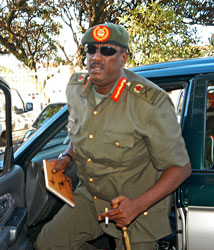 Gen. Salim Saleh: Is he a suspect? President Yoweri Museveni's young brother Caleb Akandwanaho aka General Salim Saleh may be linked to possible involvement in mercenary activities in war-torn Somalia, Uganda Correspondent can exclusively reveal. The details emerged after Saracen International; a company associated with Gen. Salim Saleh, lost a lucrative contract to undertake some work in Somalia. Our source in Mogadishu said the Transitional Federal Government [TFG] of Somalia declared last week, Thursday 27th January that it had severed its relationship with Saracen International. The decision, we are told, came after a closed door cabinet meeting chaired by Prime Minister Mohamed Abdullahi Mohamed in the capital Mogadishu. Somalia's Deputy Security Minister Ibrahim Mohamed Yarow confirmed that cabinet had indeed cancelled the agreement that the TFG government had signed with Saracen International to train Somali troops and to revive social services including building health facilities in Mogadishu. The decision, he said, was reached after Somalia's TFG government landed on evidence which suggested that Saracen International may have been involved mercenary activities. "…The cabinet has today overwhelmingly voted against Saracen International on the basis of mercenary acts. So the cabinet has revoked the agreement with this company", Ibrahim Mohamed Yarow said. The Deputy Security Minister added that while there is no doubt that his government requires assistance, as government, he said, the TFG will only enter into contractual agreements with distinguished and clean companies. He also said the cabinet's decision on Saracen International was "irrevocable". The TFG's decision to revoke Saracen International's contract follows widespread expression of concern by several foreign governments including the US. Philip J. Crowley, a US State Department Spokesman, said in December that the American government was "…concerned about the lack of transparency" of Saracen's financing and plans. According to a New York Times report of 20th January 2011, "…at least one of Saracen's past forays into training militias drew an international rebuke. Saracen's Uganda subsidiary was implicated in a 2002 United Nations Security Council report for training rebel paramilitary forces in Congo". Is war a lucrative source of business for powerful men? Other than Burundi, Uganda is the only other country in Africa that has contributed thousands of soldiers to the AU's AMISOM peacekeeping mission in Somalia. The same New York Times report identified one of Saracen Uganda's owners as Lt. Gen. Salim Saleh, the retired half-brother of Uganda's President Yoweri Museveni. Salim Saleh's possible conflict of interest also highlights some crucial things in this terribly complex story. One of the things is that the lines that separate government security officials and owners or leaders of private armies have become so fuzzy that you can never really be sure as to the motivations of any individual player. As mercenary forces become more and more prominent in armed conflicts around the world, the profit motive becomes almost impossible to rule out. In other words, it's almost impossible to know the real reasons that fuel the conflicts in which mercenaries play a role. UPC party President Dr. Olara Otunnu for example, has accused some UPDF soldiers of having had vested interests in prolonging the Kony war in northern Uganda. The UPDF of course denied Otunnu's claims. But the New York Times report also accused General Saleh and other top Ugandan army officers of using their ties to paramilitaries to plunder Congolese diamonds, gold and timber. But what exactly is Saracen International? Who really owns it? Our efforts to get a comment from Saracen International were futile by press time. So for the time being, it may be fair to say that no one really knows for sure what Saracen International is, and who owns it. What one can say however is that Saracen International is definitely a murky trade name that is shared by a number of private security companies across Africa, Europe, the Middle East and North America. Whether that is a coincidence or not, no one really knows. What we can confirm without fear of contradiction is that Saracen International is fully established in Uganda; see http://saracen.co.ug/index.php. Most of the other companies however deny or downplay any financial or managerial relationships between them. A few have however been linked to the infamous South African mercenary firm called Executive Outcomes; the same company that allegedly tried to send mercenaries to overthrow the government of Equatorial Guinea in order to tap into the country's oil and mineral wealth. Saracen International has also been linked to a certain Erik Prince; the man whose company Blackwater is allegedly financing a "Counter-Piracy" mercenary squad in Somalia. Both the New York Times and Associated Press have carried similar allegations against Saracen International on the strength of "confidential" reports leaked from the African Union. Somalia has been without a proper central government since 1991 when President Siad Barre was overthrown by armed warlords. That incident effectively condemned Somalia to decades of civil war. END. Please log into www.ugandacorrespondent.com every Monday to read our top stories and anytime mid-week for our news updates. SALIM SALEH This thug , is the brother of the Uganda Tyrant, Yoweri Museveni, and also the Godfather(Patron) of terrorists groups in the Democratic Republic of Congo and an international fraudster-both money laundering and cocaine trafficking.
Known as General Salim Saleh(aka) Caleb Afande Akandwanaho
The criminality portfolio of this thug is very colourful: early this year, he sent two battalions of mercenaries to Libya to prop-up Muammar Gadaffi's tyranny. The man is so evil, he has become a food products speculator, to the extent that 90% of middle men are employed by him.
The food products being speculated include; maize grain and flour, mukene Fortified Maize Flour, Rice: Upland and Super, Groundnut and Groundnut Powder,Peanut butter,ghee,coffee,tea,beans, etc.
Now you can understand why prices of food products are so high for ordinary Ugandans.
While Ugandans are starving and suffering with high prices of food products, Criminal Salim Saleh, is hoarding and speculating their food that is sold to Southern Sudan at very high prices.Later of which the criminal brags that, he's the new messiah for food security in Uganda. This is insulting to all Ugandans, he's the source of food insecurity, period!
Its well known that Salim Saleh cannot work alone, Yoweri Museveni is the brains behind. The criminal family owns most of the land in Uganda, with the intention to grow food using slave labour and later use it as a weapon of blackmail against Ugandans.
Today its well-known that 80% of land in Luwero has been fraudulently acquired by these thugs-most of the modern farming tools donated to Ugandans, is diverted to those farms. Thus Ugandans are being scammed left and right. Why do you think the criminal is always in Arua? Very simple, to micro manage the smuggling of your food to Southern Sudan and blood-minerals plus Militias from Congo Democratic Republic.
You can discover the crime, but you cannot remove the criminality tendencies from a criminal such as, Salim Saleh. The so called war against LRA wasn't about Kony,etc. but land and a base to commit crimes against humanity. Memo from Tyrant Museveni to Killer Salim Saleh Subject; RETHINK When we captured Kampala in January 1986 and later drove the uncouth UNLA soldiers out of the country in March 1986, our topographical knowledge of the northern region was still limited. Consequently we made hasty decision to draw
another national boundary, which would exclude the backward northerners from our new Uganda, particularly the Chimpanzees called Acholis. It was agreed that a new national boundary of Uganda with the Sudan should begin from the spot. There the Nile waters flow into the Lake Albert, and traverse the Nile eastwards up to Lake kyoga, thence cut across the land and follow the local boundary of Teso people and Bagisu and follow the Karamoja-Sebei boundary to
the Kenya-Uganda border. Last week I flew at low altitude from Arua to Gulu and I was surprised to see miraculous work of God in this part of Uganda.
When my plane was approaching the River Nile from western side, I was startled by the incongruity of the
land scapes from East and western banks of the River nile. while the littorals along the eastern bank, stretching from Lake Albert all the way to Sudan border, consisted of luxuriantly green vegetation, interpersed with woodlands, the western bank from Lake Albart northwards was predominantly of rugged lands.
Yet the Nile Water which divided the Acholiland from 'west Nile districts was not even one kilometre wide.
I have now realized that the Monkeys called Acholis are sitting upon Gold Mine.
It is surprising that even the British Colonialists did not make them utilize the rich land properly.
But I will not allow these Chimpanzees to prevent other
Ugandans from activating the Bread Basket of Africa. I have now reversed our decision to expel them, with their lands, from Uganda. We must keep Uganda as the British left it.
But we must assume full control of the fertile lands. It will be necessary, therefore, to find a way to drastically reduce the population.
I will transfer Chef Alii from Teso to command the Army in the area, to seal off the four districts of Apac, Lira, Gulu and Kitgum and ensure that no journalists are permitted to travel unescorted in the area. Fortunately the rebels are roaming around. This gives us unassailable excuse. I am at pains to propose that it is necessary to eliminate some old politicians who are likely to give us troubles. However we should identify their own ambitious young men and women, who know the area well to do this for us. I have
in mind one young woman,Betty Bigombe, who would be suitable because of her ambition to climb high. For the time being you work with Chef Ali only to ensure watertight secrecy. Tinye will come in later. Yoweri Museveni As you've read from the above Memo by the godfather of criminals-the mission has been accomplished with a genocide committed and land grabbed.
The criminal family now owns most of the land in acholi and Karamoja,while the people have been murdered in cold blood, abused, humiliated,displaced, etc.. and then left to live with no dignity in their ancestral land. The Memo is very authentic and we have the copy of the original, that was sent to the Hague to be attached with other documents, in their files of genocide and crimes against Humanity. Salim Saleh 'committed crimes against humanity in DRC' Written by: str8talk on 27th December 2010
 Arua Bishop Sabino Ocan Odoki sat silently through a Museveni speech that used abusive language against northerners. The Museveni Memo on Northern Uganda. Today we continue with Prof Todd Whitmore's analysis on the Museveni memo on northern Uganda. In today's piece, Prof Whitmore asks why the UN has stopped short of indicting Yoweri Museveni and his brother Caleb Akandwanaho with crimes against humanity for what they have done in Northern Uganda and in the DRC. Here is his report: The case of Uganda's presence in the DRC is important because it helps to establish a documented pattern of behavior whereby economic greed and politico-military power join and issue forth in repeated atrocity. The conclusion of the 2010 UN report is unstinting. The political and economic agenda of the Ugandan government caused "massive and widespread violations of human rights and international law." The authors of the report are clear that they constitute a fact-finding rather than a judicial body; still, they do not hesitate to place these violations under the descriptions of war crimes and crimes against humanity. The only difference between NRM/UPDF behavior in the DRC and that in northern Uganda is that in the former the greed is for precious gems and minerals and in the latter it is for arable land. The outcome for the resident civilians has been the same. In the meantime, President Museveni [had] promoted his brother Saleh to full General and [had] recently made [him] the Minister of State for Microfinance. This, despite the fact that Saleh has been implicated several times in schemes where he uses his military position, granted by his brother Yoweri Museveni, for personal financial gain. Early allegations of corruption led to Saleh being dismissed as Army Commander, but Museveni reappointed him as Senior Presidential Advisor on Defense and Security. Saleh had to leave this latter post because of a bank scandal and an arrangement where he gained $800,000 from the sale of junk helicopters to the army. Still, he continued to be promoted in rank. Now there is the UN evidence of crimes against humanity, war crimes, and possibly genocide in the DRC. It is clear, then, that the aim of Museveni and Saleh has not been that of security and peace in either the DRC or northern Uganda. Rather, it has been the accumulation of wealth, whether in the form of precious gems and minerals or arable land. Moreover, as documented in the UN mapping report, they have demonstrated in the case of the DRC that they are hardly averse to "reducing the population" where the presence of civilians is an obstacle to the accumulation of wealth. Together, Museveni and Saleh function as the political and economic wings of the Museveni family regime, now going on twenty-five years. The connecting link between the political and economic wings is a military designed and trained to meet the objectives precisely as Museveni and Saleh have constructed them. Neopatrimonialism: The Link Connecting NRM Actions in Acholiland and the DRC The above facts fall into place when we understand Museveni's regime as a form of rule that political scientists call "neopatrimonialism." A political order constitutes a neopatrimonial regime when political authority is personalized in the relationships between the primary leader—in this case Museveni—and his clients, often family members—in this case Salim Saleh—who people the bureaucracy. Michael Bratton describes such a regime this way: "Corruption, clientelism, and 'Big Man' presidentialism—all dimensions of neopatrimonial rule—tend to go together as a package." Rune Hjalmar Espeland and Stina Petersen take neopatrimonial analysis and use it to assess the military in Uganda. They note that, as a practice, neopatrimonial rulers use their personal authority to bypass formal and merit-based structures of military advancement. Such rulers "often prefer their own ethnic group for prominent military positions, or else long-term political allies or family members." Saleh is all three—clan member, political ally, and brother. Espeland and Petersen go on to point out that neopatrimonial rulers "often encourage corrupt, yet individually benefitting business practices within the military." The aim of such an arrangement is to keep the members of the military loyal. Disloyalty results, minimally, in loss of income for the officers. This explains why, despite multiple instances of being caught in corrupt practices, Saleh continues to be promoted and given added powers. In fact, when an embezzlement scandal broke regarding illicit payments to "ghost soldiers" —one way officers pad their income is to list non-existent soldiers on their payroll—Museveni placed the corrupt Saleh on the committee to investigate the situation. Espeland and Petersen's article demonstrates that the loyalty- and income-producing purpose of the military in neopatrimonial regimes results in an unprofessional military. The authors cite the neopatrimonial structure of the Musveni regime as a key reason for the inability of the NRA/UPDF to defeat the LRA. Despite the President's repeated fervent claim to have the desire to defeat the LRA, maintaining client relationships with those in the military—relationships that allow and even encourage individual enterprise on the part of the officers at the expense of the local population as part of the agreed-upon arrangement with the officers—is more important than developing a level of military professionalism that is capable of victory in the conventional sense. For instance, strategic planning does not take into account that high numbers of the armed forces are "ghost soldiers" padding the officers' income; when it is time to go to battle, these officers cannot say that the soldiers do not exist without implicating themselves, and so they enter engagements with far fewer personnel than planned. It is not by accident, then, that NRA/UPDF soldiers have been proficient at terrorizing the local populace but muddling in their ability to fight the LRA. It is important to note, however, that "unprofessional" does not in all instances mean "haphazard." In fact, as we will see further below, the NRA/UPDF have often been brutally efficient in pursuing their purpose: to repress civilian populations and exploit local resources for personal wealth and gain. The issue is not whether the NRA/UPDF have been organized or not, but rather what they have been organized for. In addition to fleeing at the sight or even rumor of LRA being in the vicinity, the NRA/UPDF, according to multiple reports, committed its own acts of violence and even atrocity. The results for the populace in northern Uganda have been disastrous. Espeland and Petersen state: "As a military strategy, the regime failed to defeat the LRA but politically they controlled most of the civilian population for two decades." As we have seen, this has been the plan all along: control of the people—and land—in the North. The authors conclude that the humanitarian crisis that followed was a "direct outcome of the military approach to the region pursued by President Museveni." As we will see in more detail in the next section, the Acholi people, according to Museveni, are not people at all. Given the present lull in the NRM-LRA conflict, at least within Uganda, Museveni and Saleh can no longer use military force, at least not in the same way as before, as a means to cause and take advantage of social disruption in order to procure wealth. They must at least appear to be taking normal political channels, and this Museveni and others in the NRM have tried to do. Starting in 2007, Museveni sought to allocate 40,000 hectares of land in the North to the Madhvani Group for a sugar cane plantation, a number that he reduced to 20,000 hectares when faced with opposition. If such a deal goes through, the central government will have a forty percent stake in the plantation. Another case occurred when the central government gave one billion Ugandan shillings to twenty army officers and government officials to take land in the North that was already under customary tenure, resulting in the eviction of families from their land. A case of local officials getting in on the act occurred when the members of the Amuru District Land Board applied for 85,000 hectares of land for themselves, an application that, if successful, would have evicted—that is, again, displaced—10,000 people from their land. More recently, Museveni, Saleh, and Museveni's son, Lt. Col. Muhoozi Kainerugaba, have been cited by the anti-corruption NGO Global Witness for arranging "security" for newly found oil deposits in ways that enhance themselves financially. Although the dynamics are still neopatrimonial in these more recent cases, accessing the natural resource of land is more difficult because there is no longer the social disruption of armed conflict to act as a screen for forced displacement and military rule in northern Uganda. Museveni must at least appear to be following the rule of law in order to continue to receive the high rate of foreign aid to which he has become accustomed. To his advantage is the fact that, for the geopolitical reasons indicated earlier, U.S. officials want and need to interpret Uganda's politics not as neopatrimonial but as democratic and law-abiding. Until this structural situation of mutually reinforcing interests changes, the de facto burden of public proof will always be on those who interpret Ugandan government's polity as something other than democratic, even when such interpreters have the far greater evidence in their favor. The memo I received is one more—and one more significant—piece of that evidence. The Language of the Memo: The Acholi as "Backward," "Chimpanzees" and "Monkeys" So far, we have seen that the memo is consistent with both the earlier and later policies of Museveni and Saleh towards northern Uganda. As we have also seen, whenever domestic persons or organizations—whether members of the media, ministers of parliament, or NGO representatives—have spoken out about the arrangement and situation just described, Museveni has used his plenary political power to silence the critics. This is a large part of why, even given the evidence presented above, the actions of Museveni and his military, according to Espeland and Petersen, "have received much less attention by scholars than the atrocities of the LRA." However, Museveni has gone well beyond merely suppressing these accounts and has gone on to provide and justify his own. It is at this point that the language of the memo is important. The author of the memo refers to "the backward northerners." This language of backwardness and, its analogue, primitiveness is consistent with Museveni's own public and documented statements. Indeed, statements from the President to this effect bookend the conflict in northern Uganda. As early as 1987, in reference to the fight with the Holy Spirit Movement—the Acholi precursor to Kony's LRA—Museveni claimed, "This is a conflict between modernity and primitivity." As late as 2006, at the installation of Sabino Odoki as Auxiliary Bishop of Gulu, and just a month before the ceasefire with the LRA, Museveni declared, "We shall transform the people in the north from material and spiritual backwardness to modernity." Thus from the beginning of the conflict up to the ceasefire agreement, Museveni has drawn upon the lexicon of backward/primitive versus civilized/modern to frame the situation. His making such statements at the installation of an Acholi bishop indicates that he is hardly ashamed of such language. It is noteworthy that his use of these terms bridges his switch from Maoist/Marxist guerilla to World Bank neo-liberal. The one constant is his affirmation of what anthropologists describe as a unilinear view of social evolution. Museveni makes clear in his autobiography that, in his words, "the laws of social evolution" drive his policies. The use in the memo, then, of the terms "Chimpanzees" and "Monkeys" is a consistent continuation of his frequent usage of the words "primitive" and "backward" to denote the Acholi. The link between the two is the language of evolution as a means of distinguishing peoples—again, it is a language much more basic to Museveni's lexicon than the differences between Marxism and neo-liberalism. Primitive versus modern is simply the social evolutionary articulation of the biological evolutionary distinction of monkey versus human. In other words, chimpanzee = monkey = primitive = backward; human = civilized = modern. Sometimes Museveni describes the Acholi as primitive not-yet-humans; at other times he describes them as animals incapable of ever becoming human. The underpinning language of unilinear evolution is the same, and the violent policies and acts they are used to justify on behalf of "civilized" and "modern" humanity are little different. SARACEN INTERNATIONAL IN SOMALIA WHAT IS NEXT?
By Said Dualeh
24 dec 2010 (Mareeg.com) The TFG of Somalia is not achieving anything for the people of Somalia, it
is only adding to the miseries of the people of Somalia proper. I have been
a supporter of all types of governments in Somalia from The collapse of the
Siad Barre regime1991 to the present. In my previous articles I have
defended Sheikh Sharif and the parliamentary warlord Sharif Hassan thinking
that they had a little interest in their heart for our people the people of
Somalia who unfortunately do not know their rights as citizens of Somalia.
We need a bill of rights for Somalia to get out of this corrupt and failed
state status.
We as Somalis can be successful in business, education and professions any
other country in the world as proven by the Somali Diaspora except on our
own country-Somalia, why? Go figure the answer and you may have solved the
Somali Dilemma.
The Somali people do not know that they do not have to put up with corrupt
leaders, leaders who associate themselves with the enemies of the people of
Somalia, they do not need to put up with un educated and unenlightened
religious leaders who hide behind veils and brain washed youngsters who
never grew up as people with rights and never seen a just government who
cares about its people and their welfare. Somalis do not need to put up with
International organizations and Non governmental agencies who live off
destruction, mayhem and underdevelopment in less fortunate countries like
Somalia where they can test their new medicines and unorthodox, untested
theories of development and peacekeepers who look after their own interest.
At First in Somalia after 1991 it was unstable government getting in
contract with companies that dumped Nuclear Waste on our shores and
contracting with companies who took every piece of metal out of the country
and sold it as Salvage waste to Asian counties. We have seen Ambassadors
trying to sell off Somali government properties overseas, and then we have
seen presidents, prime ministers and regional authorities printing illegal
currencies in a clandestine ways that made people wonder if this poor
country had anyone who cares about it. We have seen where lack of
transparency and accountability can lead to misunderstanding of MOU's
memorandum of understanding which did not reference to the law of the sea-
regulations spearheaded by the United Nations. We have seen Ethiopia trying
to destroy Somalia using the old colonial adage (Divide them then Rule
them). If anyone ever thought Ethiopia wants to see a unified Somalia or a
strong Somalia think again as you may be living in a wonderland. The same
goes for all of our neighbors and our Arab brethren.
We have seen how corrupt the current Somali government officials are they
sold the .SO protocol bestowed to Somalia as a nation among 192 others. The
same people have contracted with Saracen International- one of the new
private military companies(PMC's) such Executive Outcomes(EO), Sandline Co,
Strategic Consulting International(SCI), KBR, Heritage Oil and Gas Co. The
name and their symbol of Saracen International looks like a middle ages
Templar Knight on horseback trying to show the "light"(Christianity) to
heathens in sub-Saharan Africa. The company is run by shady characters from
the former SADF- South African Defense Force and former employees of the now
infamous but defunct Executive Outcomes. The current TFG Finance minister
stated that the agreement was signed by Sheikh Sharif- through his trusted
then chief of Cabinet Abdulkarim Jama, the current Minister of information
and Post & Communication. On the other side it was signed by Lafras
Luitingh aka Louis Yssel- member of the notorious Former South African law
enforcement agency Civil Cooperation Bureau(CCB)- in some pulished reports
the finger was pointed to him during the truth commission hearings in the
new South Africa that he killed Dr. David Webster and Anton Lubowski (ANC
Activists in the former South africa).Lafras Luitingh aka Louis Yssel has a
checkered past that will scare anyone who reads about world intelligence
reports. He had dealing with characters such as Tim Spicer, Tony Buckingham,
Eeben Barlow and the late Former South Africa skin head chief of police
Henrick Van der Bergh, the creator B.OS.S and later the CCB where Lafras
Luitingh got his training in sabotage, political assassinations, and
intelligence gathering on dissidents. He was later recruited by (Executive
Outcomes) EO for their Angola, Mozambique, Malawi jobs and later Sierra
Leone.
The plane currently held in Hargeisa is the type used by these private
armies especially Saracen and they buy their weapons from the former Soviet
satellite countries. The two South Africans on the plane in Hargeisa were
released as fake Journalist but they were Saracen International employees.
They have connections with the British Foreign Office who called the
Somaliland foreign minister. Why did they not allow pictures to be taken or
invited the media to the kangaroo trail held in Hargeisa. South African
intelligence has some clout over Hargeisa for different a reason, that is
where the late Somaliland President Egal died in a hospital in South Africa.
The contact is Mohamed Ibrahim Egal's former wife Edna who was at one time
Foreign Minister of Somaliland and who owns a hospital that received
assistance from South Africa. Soon there will be another mock trial in
Hargeisa, Somalia Saracen will give the weapons on the plane to the
Somaliland administration formatting it as confiscation by their court and
they will release the plane and the crew intact. Saracen will once again
continue the operations they were hired for.
Sheikh Sharif of the TFG , Museveni of Uganda, Farole of Puntland, &
Sharif's Ala Shiekh group led by Abdulkarim Jama( former VA mosques
bookkeeper) and his prime minister (Formaggio) and his defense
minister(Fiqi) (2 former Somali embassy bookkeepers from Washington) the
Finance minister (Halane)& The Foreign Minister (Omaar) have no clue who
they are dealing with at Saracen International. Museveni's half brother is
just a cover up. This project is the deep throat of Somalia and we need
transparency in these dealings with select members of the Somali parliament.
Saracen guys and their friends have helped countries overthrew elected
officials and everything they do is for money. These guys were so powerful
at one time that they had The British navy servicing their Antonov and
soviet type helicopters near the coast of Africa. If a country like Somalia
does not have money these private military companies barter for oil and
fishing rights and sell those rights at a premium to the highest bidder.
They have close relationship with the leadership in the Emirates and even a
stronger one with current Sultan of Oman whom they assisted in overthrowing
his father off the throne.
Both the UN and the OAU despise these private military companies because
they want to put them out of business. Amisom is a cash cow for Uganda who
does not want the current situation to end and they sustain a weak TFG
government whose diplomatic failures include a drug dealing former
Ambassador in China and they keep recycling former diplomats to the UN
mission in NY who have publicly stated that he will join his clansmen back
home to kill people and destabilize peaceful areas. TFG are not bringing to
justice the ambassador who sold embassy property in Kenya. Will this
government survive without peace keepers? I do not think so.
Saracen International is a rented military company mostly comprised of
former special forces, formerly known as "dogs of war", mercenaries and now
they are known as security trainers and consultants (their sanitized PR
name). Their specialty is to loot poor African countries who are led by
corrupt individuals with no integrity.
The Somali people have a choice to change their leadership, or else if they
want to stand on the sidelines as always thinking that someone is going to
come to rescue them or should we as Somalis get our hands dirty and come
together and resolve our clannish divisions once and for all since we have
seen that no clan in Somalia is able to subjugate the others and live in
peace or wait for our destiny to be decided by organizations or private
military companies who follow their interest..
Best Regards,
Thank You,
Said Hersi Dualeh
*Freelance journalist*
Anaheim, California- USA Erik Prince and Saracen International Doing Death's Business in Somalia 'Prince of Mercenaries' who wreaked havoc in Iraq turns up in Somalia
Blackwater founder sets up new force to tackle piracyBy Guy Adams in Los Angeles Saturday, 22 January 2011SHARE PRINTEMAILTEXT SIZE NORMALLARGEEXTRA LARGE Erik Prince, the American founder of the private security firm Blackwater Worldwide, has cropped up at the centre of a controversial scheme to establish a new mercenary force to crack down on piracy and terrorism in the war-torn East African country of Somalia. The project, which emerged yesterday when an intelligence report was leaked to media in the United States, requires Mr Prince to help train a private army of 2,000 Somali troops that will be loyal to the country's United Nations-backed government. Several neighbouring states, including the United Arab Emirates, will pay the bills. Mr Prince is working in Somalia alongside Saracen International, a murky South African firm which is run by a former officer from the Civil Co-operation Bureau, an apartheid-era force notorious for killing opponents of the white minority government. News of his latest project has alarmed, though hardly surprised, critics of Blackwater. The firm made hundreds of millions of dollars from the "war on terror", but was severely tarnished by a string of incidents in post-invasion Iraq, in which its employees were accused of committing dozens of unlawful killings. Mr Prince, a 41-year-old former US Navy Seal with links to the Bush administration, subsequently rebranded the company "Xe Services" and sold his stake in it. But he remains entangled in a string of lawsuits pertaining to the alleged recklessness of the firm. For most of the past year, he has been living in Abu Dhabi, where he has close relations with the government and feels better positioned to dodge lawsuits. In an interview with a men's magazine, he recently declared that the UAE's opaque legal system will make it "harder for the jackals to get my money". The exact nature of his sudden presence in Somalia remains unclear. The Associated Press said yesterday that the army Mr Prince is training will focus on fighting pirates and Islamic rebels. The leaked intelligence report which prompted the news agency's story was compiled by the African Union, an organisation of African nations. It claimed that Mr Prince's money had enabled Saracen International to gain the contract to train and run the private militia. But that element of the report was flatly contradicted by a spokesman for the Blackwater founder, who claimed that Mr Prince had "no financial role of any kind in this matter". In a written statement, the spokesman, Mark Corallo, added: "it is well known that he has long been interested in helping Somalia overcome the scourge of piracy. To that end, he has at times provided advice to many different anti-piracy efforts." He declined to answer any further questions. Whatever the exact details of Mr Prince's role, his presence in Somalia will inevitably lead to renewed soul-searching about the growing privatisation of warfare. Critics of mercenary organisations, which are often prepared to operate where traditional armies fear to tread, claim they are often trigger-happy and lack proper accountability. In Iraq, Blackwater employees shot dead dozens of civilians; 17 people were killed in one incident alone in Nisour Square, Baghdad. Criminal charges were eventually brought in the US against five Blackwater employees. However, they were dropped in 2009 after a federal judge ruled that the defendants' rights had been violated during the gathering of evidence. Iraq's Interior Ministry subsequently expelled all contractors who had worked with the firm at the time of the Nisour Square shooting. Somalia, where the country's UN-backed regime is fighting a civil war against al-Shabaab, a group of Islamic insurgents with links to al-Qa'ida, is, if anything, a more volatile country than post-invasion Iraq. The government controls only a small portion of the capital, Mogadishu, where it has the support of 8,000 UN troops from Uganda and Burundi. It is training an army to extend its reach, but observers fear that its ranks will be weakened by the arrival of Mr Prince – who will pay his troops a far better wage. Saracen's shady corporate structure has not inspired confidence in its accountability. In 2002, the UN accused its Ugandan subsidiary of training rebel paramilitaries in the Congo. Recently, the firm has claimed to be registered to addresses in Lebanon, Liberia, Uganda and the UAE, some of which seemed not to exist when reporters tried visiting. http://www.independent.co.uk/news/wo...a-2191270.html WHO IS SARACEN INTERNATIONAL? WHAT IS IT DOING IN SOMALIA?"Saracen" is what the Crusaders used to call the Muslims, back in the day. "Saracen International" is a trade name shared, coincidentally or not, by a number of private security companies across Africa, Europe, the Middle East and North America. These companies deny or downplay any financial or managerial relationships between them. A few, however, reportedly derive from the infamous (and pioneering) South African mercenary firm, Executive Outcomes. Yesterday, both The New York Times and the Associated Press carried a truly mind-bending story on Saracen International, based on a "confidential" African Union report that had apparently been leaked to both news organizations. The report claims that none other than Blackwater founder Erik Prince has been financing a "counter-piracy" mercenary squad in Somalia, through Saracen. Somalia, a chaotic demi-state, was the scene of an iconic American military defeat 18 years ago, not to mention a one-time home base for Osama Bin Laden. It appears that Prince, an evangelical American mercenary with longstanding ties to the Pentagon and the CIA, has partnered with a group of equally notorious South African guns-for-hire for a paramilitary mission in an Islamic nation, under a corporate banner harking back to the Crusades. But what does all that mean? Mercenaries don't work for free Is this an American war by proxy? Notably, this Somali "counter-piracy" mission is advised by a former White House lawyer and by a former CIA official. However, it is also bankrolled in large part by someone in the government of Prince's new home, the United Arab Emirates. Reading between the lines of yesterday's news stories, the report connecting Prince and Saracen was most likely leaked by someone who felt, understandably, that the presence of mercenaries in Somalia undermines the African Union effort there, and persists on account of official corruption. Uganda is supplying troops to the uniformed African Union force in Somalia. And, according to AP reports, Saracen is "associated with" the younger brother of Uganda's president, Salim Saleh. That curious phrasing suggests a mutually beneficial financial relationship. Other African media sources say Salim Saleh is an "investor" or "major shareholder" in Saracen (Uganda). Salim Saleh's apparent conflict of interest highlights the key take-away from this incredibly complex story: The lines that separate government security officials and the leaders of private armies have become so fuzzy that you can never really be sure as to the motivations of any individual player. As mercenary forces become more and more prominent in armed conflicts around the world, the profit motive becomes difficult to separate from other casus belli. In other words, it's almost impossible to know the real reasons driving any conflict in which mercenaries play a leading role. Government connections The Saracen-in-Somalia story started gaining notice after a Washington Times story revealed the role of a former George W. Bush administration official in coordinating Saracen's contract with the Somali government. The former official, Pierre R. Prosper, is pictured here in a 2003 photo from his a former gig as an ambassador for "war crimes issues." Prosper and Michael Shanklin, a former CIA officer stationed in Mogadishu, previously told the AP they were being paid "paid by a Muslim nation [they] declined to identify" to advise the Somali government on "legal" and "security" matters. That unnamed "Muslim nation," it now appears, is the UAE. Late last year, the Washington Times and the AP reported that Prosper met with United Nations monitors over their concerns that Saracen may have violated a long-running (but ineffectual) arms embargo on Somalia. (Mogadishu, a city that has roughly the population of Houston, Texas, averaged 534 "weapon-related casualties" per month last autumn, according to the UN.) Prosper told the Times "that so far, no arms were shipped to the training camp, to the best of his knowledge." He told the AP that "Saracen is doing the military training" in Somalia. Yet the same story quotes Saracen (Uganda) chief executive Bill Pelser as disclaiming the company's training role in Somalia. Pelser denied being involved in the training program in Puntland…saying he merely made introductions for another company called Saracen Lebanon. Sure. Got it. Lebanese authorities have no record of a company called Saracen. Pelser did not respond to requests for contact information for Saracen Lebanon. Yesterday's AP story features quotes from Saracen (Lebanon) executive Lafras Luitingh—evidently a distinct entity from the Ugandan company of the same name that is also led by former employees of Executive Outcomes. Also, it's supposed to be completely irrelevant that Saracen (Uganda) goes around "ma[king] introductions" for Saracen (Lebanon). In the AP story, Luitingh says "the company had sought to keep the project secret to surprise the pirates." (Because the pirates don't know they might be attacked?) He "declined to say whether [Blackwater founder Erik] Prince was involved in the project and said [Prince] was not part of Saracen." Is your head spinning yet? If not, it will be soon. Keep reading. Saracen International, Not To Be Confused With Saracen International The AP turned up at least three Saracens — the one registered in Lebanon, and two run by Luitingh's business partner and based in Uganda, where government office employees told the AP the registration papers have disappeared. An AP reporter in Beirut could not find the address Luitingh's company provided in the Somali contract. Lebanese authorities had no address listed for Saracen in Lebanon and said it is based in the United Arab Emirates. Saracen (Uganda)'s website says the company has branches in South Africa, Tanzania, the Democratic Republic of Congo, Hong Kong, Angola, Zambia, Sudan and Botswana. My own research turned up two more "Saracen Internationals," not counting a Spanish real-estate firm with that name. One, Saracen International Ltd, is based in Manchester, UK. The corporate address of record is at the Towers Business Park in Manchester. The website registration, however, returns both that address and another, one shared with a café in the southern suburb of Stockport. An email to the Yahoo account of the listed website registrant, Sira Yaqub, bounced back undelivered. The woman who answered the phone at the UK Saracen in Manchester office suggested calling back on Monday. The other Saracen International I found is a limited-liability company based in Phoenix, Arizona. This Saracen International is registered to William G. Lawrence and Tjaart Andre Van Der Walt, both of Phoenix. Lawrence returned a call placed to the company's listed phone number. "I have no relationship to the UK company of the same name. I don't operate in Southern Africa," he says of Saracen (Arizona). Van Der Walt, Lawrence says, is a "friend" who has "never been part of the corporation," although records show the LLC is registered at Van Der Walt's home address. Lawrence says Van Der Walt, whose first name is also spelled in public records as "Thaart," emigrated from South Africa 16 years ago and is now an American citizen. I asked if Van Der Walt ever worked for Executive Outcomes. Lawrence says he doesn't know, and hadn't heard of that company. He has, however, heard of the other Saracens. "I got a call from Somalia asking them to train their coast guard to fight the piracy threat. Only then I became aware that there was another Saracen International," Lawrence says. Doesn't it seem strange, I suggested, that all these private security companies with an international client base—Lawrence's company has operations in Jordan and the UAE—seem content to share a business name, and aren't suing one another for copyright infringement? "I can't account for that except…[the name] has positive connotations in the Arabic world," Lawrence says. Positive because, after all, they fought the Crusaders. Lawrence says his company sells a Chevrolet Suburban outfitted with a concealed six-barrel gatling gun that can pop out of the hood and fire 50 rounds a second in every direction. The car, called the Raptor, costs upward of $300,000. The Raptor is not something that you'd ever want to cut off in heavy traffic. You can watch its gunner blow up a hatchback on YouTube. Is this the next must-have vehicle for Arizona's soccer moms? "The people we do business with are national leaders. They are always subject to threats of one kind or another. King Abdullah [of Saudi Arabia] has had four assassination attempts on him," Lawrence says. "He doesn't ride in our car…but we're in his entourage." (Unlike the other companies that share its name, Saracen (Arizona) does not have an up-and-running website of its own. However, the marketing video for the Raptor contains a plug for saracen.org. That domain is currently listed as for sale.) Muddied (Black)waters Yesterday's AP story on Prince's ties to Saracen (Uganda) connects another company to the dubiously funded "anti-piracy" mission there. Afloat Leasing, which owns two ships that have been working with Saracen, said it was Liberian-registered, but an AP reporter didn't find it at the address given or in Liberian records. I found an "Afloat Leasing Ltd" registered in South Africa. Records show this company owns a ship called the Seafarer, which departed Durban, South Africa roughly one month ago and was due to call last week in the UAE, a course that would take it past the pirate-plagued Horn of Africa. This may or may not be the same "Afloat Leasing" named by the AP. And as long as we're in the caveats department, it should be noted that Prince, who recently abandoned his "redneck mansion" for the UAE, has denied, through a spokesperson, having any "financial role of any kind in this matter" with Saracen. It should also be noted that Prince has ostensibly cut his ties with Blackwater, the company he built from nothing, although he's tight with the new owners, whoever they are. Did I say Blackwater? Of course, I meant Xe. Or whatever it is now. It's hard to keep all these companies straight, sometimes. Odd, isn't it? Most companies try so hard to come up with a memorable name. But with these companies and their constantly changing, generic-sounding brands—not to mention the roving headquarters and opaque registration—it's almost as though they're trying to confuse people. Like they don't want people to remember who they are, or something. http://www.warisbusiness.com/feature...ional-somalia/ Secret Desert Force Set Up by Blackwater's Founder  Adam Ferguson/VII Network Erik Prince, the founder of Blackwater, has a new project. Published: May 14, 2011 ABU DHABI, United Arab Emirates — Late one night last November, a plane carrying dozens of Colombian men touched down in this glittering seaside capital. Whisked through customs by an Emirati intelligence officer, the group boarded an unmarked bus and drove roughly 20 miles to a windswept military complex in the desert sand. The Colombians had entered the United Arab Emirates posing as construction workers. In fact, they were soldiers for a secret American-led mercenary army being built by Erik Prince, the billionaire founder of Blackwater Worldwide, with $529 million from the oil-soaked sheikdom. Mr. Prince, who resettled here last year after his security business faced mounting legal problems in the United States, was hired by the crown prince of Abu Dhabi to put together an 800-member battalion of foreign troops for the U.A.E., according to former employees on the project, American officials and corporate documents obtained by The New York Times. The force is intended to conduct special operations missions inside and outside the country, defend oil pipelines and skyscrapers from terrorist attacks and put down internal revolts, the documents show. Such troops could be deployed if the Emirates faced unrest in their crowded labor camps or were challenged by pro-democracy protests like those sweeping the Arab world this year. The U.A.E.'s rulers, viewing their own military as inadequate, also hope that the troops could blunt the regional aggression of Iran, the country's biggest foe, the former employees said. The training camp, located on a sprawling Emirati base called Zayed Military City, is hidden behind concrete walls laced with barbed wire. Photographs show rows of identical yellow temporary buildings, used for barracks and mess halls, and a motor pool, which houses Humvees and fuel trucks. The Colombians, along with South African and other foreign troops, are trained by retired American soldiers and veterans of the German and British special operations units and the French Foreign Legion, according to the former employees and American officials. In outsourcing critical parts of their defense to mercenaries — the soldiers of choice for medieval kings, Italian Renaissance dukes and African dictators — the Emiratis have begun a new era in the boom in wartime contracting that began after the Sept. 11, 2001, attacks. And by relying on a force largely created by Americans, they have introduced a volatile element in an already combustible region where the United States is widely viewed with suspicion. The United Arab Emirates — an autocracy with the sheen of a progressive, modern state — are closely allied with the United States, and American officials indicated that the battalion program had some support in Washington. "The gulf countries, and the U.A.E. in particular, don't have a lot of military experience. It would make sense if they looked outside their borders for help," said one Obama administration official who knew of the operation. "They might want to show that they are not to be messed with." Still, it is not clear whether the project has the United States' official blessing. Legal experts and government officials said some of those involved with the battalion might be breaking federal laws that prohibit American citizens from training foreign troops if they did not secure a license from the State Department. Mark C. Toner, a spokesman for the department, would not confirm whether Mr. Prince's company had obtained such a license, but he said the department was investigating to see if the training effort was in violation of American laws. Mr. Toner pointed out that Blackwater (which renamed itself Xe Services ) paid $42 million in fines last year for training foreign troops in Jordan and other countries over the years. The U.A.E.'s ambassador to Washington, Yousef al-Otaiba, declined to comment for this article. A spokesman for Mr. Prince also did not comment. For Mr. Prince, the foreign battalion is a bold attempt at reinvention. He is hoping to build an empire in the desert, far from the trial lawyers, Congressional investigators and Justice Department officials he is convinced worked in league to portray Blackwater as reckless. He sold the company last year, but in April, a federal appeals court reopened the case against four Blackwater guards accused of killing 17 Iraqi civilians in Baghdad in 2007. To help fulfill his ambitions, Mr. Prince's new company, Reflex Responses, obtained another multimillion-dollar contract to protect a string of planned nuclear power plants and to provide cybersecurity. He hopes to earn billions more, the former employees said, by assembling additional battalions of Latin American troops for the Emiratis and opening a giant complex where his company can train troops for other governments. Knowing that his ventures are magnets for controversy, Mr. Prince has masked his involvement with the mercenary battalion. His name is not included on contracts and most other corporate documents, and company insiders have at times tried to hide his identity by referring to him by the code name "Kingfish." But three former employees, speaking on the condition of anonymity because of confidentiality agreements, and two people involved in security contracting described Mr. Prince's central role. The former employees said that in recruiting the Colombians and others from halfway around the world, Mr. Prince's subordinates were following his strict rule: hire no Muslims. Muslim soldiers, Mr. Prince warned, could not be counted on to kill fellow Muslims. A Lucrative Deal
Last spring, as waiters in the lobby of the Park Arjaan by Rotana Hotel passed by carrying cups of Turkish coffee, a small team of Blackwater and American military veterans huddled over plans for the foreign battalion. Armed with a black suitcase stuffed with several hundred thousand dollars' worth of dirhams, the local currency, they began paying the first bills. The company, often called R2, was licensed last March with 51 percent local ownership, a typical arrangement in the Emirates. It received about $21 million in start-up capital from the U.A.E., the former employees said. Mr. Prince made the deal with Sheik Mohamed bin Zayed al-Nahyan, the crown prince of Abu Dhabi and the de facto ruler of the United Arab Emirates. The two men had known each other for several years, and it was the prince's idea to build a foreign commando force for his country. Savvy and pro-Western, the prince was educated at the Sandhurst military academy in Britain and formed close ties with American military officials. He is also one of the region's staunchest hawks on Iran and is skeptical that his giant neighbor across the Strait of Hormuz will give up its nuclear program. "He sees the logic of war dominating the region, and this thinking explains his near-obsessive efforts to build up his armed forces," said a November 2009 cable from the American Embassy in Abu Dhabi that was obtained by the anti-secrecy group WikiLeaks. For Mr. Prince, a 41-year-old former member of the Navy Seals, the battalion was an opportunity to turn vision into reality. At Blackwater, which had collected billions of dollars in security contracts from the United States government, he had hoped to build an army for hire that could be deployed to crisis zones in Africa, Asia and the Middle East. He even had proposed that the Central Intelligence Agency use his company for special operations missions around the globe, but to no avail. In Abu Dhabi, which he praised in an Emirati newspaper interview last year for its "pro-business" climate, he got another chance. Mr. Prince's exploits, both real and rumored, are the subject of fevered discussions in the private security world. He has worked with the Emirati government on various ventures in the past year, including an operation using South African mercenaries to train Somalis to fight pirates. There was talk, too, that he was hatching a scheme last year to cap the Icelandic volcano then spewing ash across Northern Europe. The team in the hotel lobby was led by Ricky Chambers, known as C. T., a former agent with the Federal Bureau of Investigation who had worked for Mr. Prince for years; most recently, he had run a program training Afghan troops for a Blackwater subsidiary called Paravant. He was among the half-dozen or so Americans who would serve as top managers of the project, receiving nearly $300,000 in annual compensation. Mr. Chambers and Mr. Prince soon began quietly luring American contractors from Afghanistan, Iraq and other danger spots with pay packages that topped out at more than $200,000 a year, according to a budget document. Many of those who signed on as trainers — which eventually included more than 40 veteran American, European and South African commandos — did not know of Mr. Prince's involvement, the former employees said. Mr. Chambers did not respond to requests for comment. He and Mr. Prince also began looking for soldiers. They lined up Thor Global Enterprises, a company on the Caribbean island of Tortola specializing in "placing foreign servicemen in private security positions overseas," according to a contract signed last May. The recruits would be paid about $150 a day. Within months, large tracts of desert were bulldozed and barracks constructed. The Emirates were to provide weapons and equipment for the mercenary force, supplying everything from M-16 rifles to mortars, Leatherman knives to Land Rovers. They agreed to buy parachutes, motorcycles, rucksacks — and 24,000 pairs of socks. To keep a low profile, Mr. Prince rarely visited the camp or a cluster of luxury villas near the Abu Dhabi airport, where R2 executives and Emirati military officers fine-tune the training schedules and arrange weapons deliveries for the battalion, former employees said. He would show up, they said, in an office suite at the DAS Tower — a skyscraper just steps from Abu Dhabi's Corniche beach, where sunbathers lounge as cigarette boats and water scooters whiz by. Staff members there manage a number of companies that the former employees say are carrying out secret work for the Emirati government. Emirati law prohibits disclosure of incorporation records for businesses, which typically list company officers, but it does require them to post company names on offices and storefronts. Over the past year, the sign outside the suite has changed at least twice — it now says Assurance Management Consulting. While the documents — including contracts, budget sheets and blueprints — obtained by The Times do not mention Mr. Prince, the former employees said he negotiated the U.A.E. deal. Corporate documents describe the battalion's possible tasks: intelligence gathering, urban combat, the securing of nuclear and radioactive materials, humanitarian missions and special operations "to destroy enemy personnel and equipment." One document describes "crowd-control operations" where the crowd "is not armed with firearms but does pose a risk using improvised weapons (clubs and stones)." People involved in the project and American officials said that the Emiratis were interested in deploying the battalion to respond to terrorist attacks and put down uprisings inside the country's sprawling labor camps, which house the Pakistanis, Filipinos and other foreigners who make up the bulk of the country's work force. The foreign military force was planned months before the so-called Arab Spring revolts that many experts believe are unlikely to spread to the U.A.E. Iran was a particular concern.
An Eye on Iran
Although there was no expectation that the mercenary troops would be used for a stealth attack on Iran, Emirati officials talked of using them for a possible maritime and air assault to reclaim a chain of islands, mostly uninhabited, in the Persian Gulf that are the subject of a dispute between Iran and the U.A.E., the former employees said. Iran has sent military forces to at least one of the islands, Abu Musa, and Emirati officials have long been eager to retake the islands and tap their potential oil reserves. The Emirates have a small military that includes army, air force and naval units as well as a small special operations contingent, which served in Afghanistan, but over all, their forces are considered inexperienced. In recent years, the Emirati government has showered American defense companies with billions of dollars to help strengthen the country's security. A company run by Richard A. Clarke, a former counterterrorism adviser during the Clinton and Bush administrations, has won several lucrative contracts to advise the U.A.E. on how to protect its infrastructure. Some security consultants believe that Mr. Prince's efforts to bolster the Emirates' defenses against an Iranian threat might yield some benefits for the American government, which shares the U.A.E.'s concern about creeping Iranian influence in the region. "As much as Erik Prince is a pariah in the United States, he may be just what the doctor ordered in the U.A.E.," said an American security consultant with knowledge of R2's work. The contract includes a one-paragraph legal and ethics policy noting that R2 should institute accountability and disciplinary procedures. "The overall goal," the contract states, "is to ensure that the team members supporting this effort continuously cast the program in a professional and moral light that will hold up to a level of media scrutiny." But former employees said that R2's leaders never directly grappled with some fundamental questions about the operation. International laws governing private armies and mercenaries are murky, but would the Americans overseeing the training of a foreign army on foreign soil be breaking United States law? Susan Kovarovics, an international trade lawyer who advises companies about export controls, said that because Reflex Responses was an Emirati company it might not need State Department authorization for its activities. But she said that any Americans working on the project might run legal risks if they did not get government approval to participate in training the foreign troops. Basic operational issues, too, were not addressed, the former employees said. What were the battalion's rules of engagement? What if civilians were killed during an operation? And could a Latin American commando force deployed in the Middle East really be kept a secret? Imported Soldiers
The first waves of mercenaries began arriving last summer. Among them was a 13-year veteran of Colombia's National Police force named Calixto Rincón, 42, who joined the operation with hopes of providing for his family and seeing a new part of the world. "We were practically an army for the Emirates," Mr. Rincón, now back in Bogotá, Colombia, said in an interview. "They wanted people who had a lot of experience in countries with conflicts, like Colombia." Mr. Rincón's visa carried a special stamp from the U.A.E. military intelligence branch, which is overseeing the entire project, that allowed him to move through customs and immigration without being questioned. He soon found himself in the midst of the camp's daily routines, which mirrored those of American military training. "We would get up at 5 a.m. and we would start physical exercises," Mr. Rincón said. His assignment included manual labor at the expanding complex, he said. Other former employees said the troops — outfitted in Emirati military uniforms — were split into companies to work on basic infantry maneuvers, learn navigation skills and practice sniper training. R2 spends roughly $9 million per month maintaining the battalion, which includes expenditures for employee salaries, ammunition and wages for dozens of domestic workers who cook meals, wash clothes and clean the camp, a former employee said. Mr. Rincón said that he and his companions never wanted for anything, and that their American leaders even arranged to have a chef travel from Colombia to make traditional soups. But the secrecy of the project has sometimes created a prisonlike environment. "We didn't have permission to even look through the door," Mr. Rincón said. "We were only allowed outside for our morning jog, and all we could see was sand everywhere." The Emirates wanted the troops to be ready to deploy just weeks after stepping off the plane, but it quickly became clear that the Colombians' military skills fell far below expectations. "Some of these kids couldn't hit the broad side of a barn," said a former employee. Other recruits admitted to never having fired a weapon. Rethinking Roles
As a result, the veteran American and foreign commandos training the battalion have had to rethink their roles. They had planned to act only as "advisers" during missions — meaning they would not fire weapons — but over time, they realized that they would have to fight side by side with their troops, former officials said. Making matters worse, the recruitment pipeline began drying up. Former employees said that Thor struggled to sign up, and keep, enough men on the ground. Mr. Rincón developed a hernia and was forced to return to Colombia, while others were dismissed from the program for drug use or poor conduct. And R2's own corporate leadership has also been in flux. Mr. Chambers, who helped develop the project, left after several months. A handful of other top executives, some of them former Blackwater employees, have been hired, then fired within weeks. To bolster the force, R2 recruited a platoon of South African mercenaries, including some veterans of Executive Outcomes, a South African company notorious for suppressing rebellions against African strongmen in the 1990s. The platoon was to function as a quick-reaction force, American officials and former employees said, and began training for a practice mission: a terrorist attack on the Burj Khalifa skyscraper in Dubai, the world's tallest building. They would secure the situation before quietly handing over control to Emirati troops. But by last November, the battalion was officially behind schedule. The original goal was for the 800-man force to be ready by March 31; recently, former employees said, the battalion's size was reduced to about 580 men. Emirati military officials had promised that if this first battalion was a success, they would pay for an entire brigade of several thousand men. The new contracts would be worth billions, and would help with Mr. Prince's next big project: a desert training complex for foreign troops patterned after Blackwater's compound in Moyock, N.C. But before moving ahead, U.A.E. military officials have insisted that the battalion prove itself in a "real world mission." That has yet to happen. So far, the Latin American troops have been taken off the base only to shop and for occasional entertainment. On a recent spring night though, after months stationed in the desert, they boarded an unmarked bus and were driven to hotels in central Dubai, a former employee said. There, some R2 executives had arranged for them to spend the evening with prostitutes. Mark Mazzetti reported from Abu Dhabi and Washington, and Emily B. Hager from New York. Jenny Carolina González and Simon Romero contributed reporting from Bogotá, Colombia. Kitty Bennett contributed research from Washington. This article has been revised to reflect the following correction:
Correction: May 19, 2011 An article on Sunday about the creation of a mercenary battalion in the United Arab Emirates misstated the past work of Executive Outcomes, a former South African mercenary firm whose veterans have been recruited for the new battalion. Executive Outcomes was hired by several African governments during the 1990s to put down rebellions and protect oil and diamond reserves; it did not stage coup attempts. (Some former Executive Outcomes employees participated in a 2004 coup attempt against the government of Equatorial Guinea, several years after the company itself shut down.) Correction: June 7, 2011 An article on May 15 about efforts to build a battalion of foreign mercenary troops in the United Arab Emirates referred imprecisely to the role played by Erik Prince, the founder of the security firm Blackwater Worldwide. He worked to oversee the effort and recruit troops. But Mr. Prince does not run or own the company Reflex Responses, which has a contract with the government of the U.A.E. to train and deliver the troops, according to the company president, Michael Roumi. An article on May 16 repeated the error.
BLACKWATER'S ERIK PRINCE AND AFRICA November 25, 2012 By conyeani  Erik Prince of Blackwater, which he sold after changing its name to 'Xe' Only if you have not been following the excesses of the U.S. military in awarding contracts to unscrupulous companies would you be forgiven for asking, 'So what's wrong with foreign companies going to Africa to invest?' Already, the name of his company, 'Frontier Resources Group', evokes one of those sci-fi movies where swashbuckling individuals (normally whites) are dispatched to outposts to 'explore' and conquer the inhabitants. Just thinking of who Prince is and what he is capable of, invokes a reminder of what happened in 2004 when Simon Mann, with funding from former British Prime Minister Margaret Thatcher's son, Mark Thatcher, attempted to overthrow the Equatorial Guinea's President Obiang Nguema. Mann had purchased 20 machine guns, 61 AK-47 assault rifles, 150 hand grenades, 10 rocket-propelled grenade launchers (and 100 RPG shells), and 75,000 rounds of ammunition, and was trying to transport them to Equatorial Guinea before he was caught and detained by Zimbabwean authorities. Wherever Blackwater's (newly renamed 'Xe=') Erik Prince rears his head, there is always a tremor of uncertainty about his presence, what kind of mischief he is about to foment. So, it came as no surprise that a lot of ink is being expended on Erik Prince, after the Christian Science Monitor reported, in an article headlined "Prince of Blackwater Heads to Africa." The article written by Dan Martin of the Science Monitor, states Erik Prince, the man who founded Blackwater, the private military contractor that became synonymous with mercenary excess during the Iraq war, has apparently begun a bold new business venture: He's going to be investing with a group of unnamed Chinese government-linked companies in resource extraction and infrastructure in sub-Saharan Africa. At least that's according to the South China Morning Post, which published an exclusive interview with Mr. Prince yesterday. The paper says Mr. Prince has founded an investment company called Frontier Resource Group earlier this year as an "Africa-dedicated investment firm partnered with major Chinese enterprises, including at least one state-owned resource giant that is keen to pour money into the resource-rich continent." Only if you have not been following the excesses of the U.S. military in awarding contracts to unscrupulous companies would you be forgiven for asking, 'So what's wrong with foreign companies going to Africa to invest?' Already, the name of his company, 'Frontier Resources Group', evokes one of those sci-fi movies where swashbuckling individuals (normally whites) are dispatched to outposts to 'explore' and conquer the inhabitants. Just thinking of who Prince is and what he is capable of, invokes a reminder of what happened in 2004 when Simon Mann, with funding from former British Prime Minister Margaret Thatcher's son, Mark Thatcher, attempted to overthrow the Equatorial Guinea's President Obiang Nguema. Mann had purchased 20 machine guns, 61 AK-47 assault rifles, 150 hand grenades, 10 rocket-propelled grenade launchers (and 100 RPG shells), and 75,000 rounds of ammunition, and was trying to transport them to Equatorial Guinea before he was caught and detained by Zimbabwean authorities. As was noted above, Prince made tons of money contracting for the U.S. military which spent hundreds of billions of dollars in Iraq and which had contracted Blackwater to provide private security to its many units. He made billions to add to the billion he was already worth after selling his late father's company for $1.3 billion and had the funds to buy more than 800 acres of land to begin his security training company, Blackwater Worldwide. Despite his own money, he attributes his being a former SEALs for his entrepreneurial zeal and success. Blackwater was blamed for a lot of excess in Iraq, including accusation of its men killing 17 civilians in Iraq, which prompted Iraqi authorities to force the company out of the country. With investigations by the US Congress into its activities, Erik Prince changed the name of his company, Blackwater, to 'Xe" and then sold it to investors. Some people might say that our suspicions are not founded just based on an individual, with Erik Prince's background, to invest in Africa, especially when coupled with the Chinese who are already very active in Africa. But we should be suspicious of an individual who has already attempted to destabilized the continent with a mercenary force not approved by the African Union or the United Nations, but funded by Arab countries. The New York Times has detailed how a private army formed to fight Somali pirates left troubled legacy. The idea, according to the Times, was to "create a sophisticated, highly trained fighting force that could finally defeat the pirates terrorizing the shipping lanes off the Somali coast" The article went on to say, But the creation of the Puntland Maritime Police Force was anything but simple. It involved dozens of South African mercenaries and the shadowy security firm that employed them, millions of dollars in secret payments by the United Arab Emirates, a former clandestine officer with the Central Intelligence Agency, and Erik Prince, the billionaire former head of Blackwater Worldwide who was residing at the time in the emirates. And its fate makes the story of the pirate hunters for hire a case study in the inherent dangers in the outsourced wars in Somalia, where the United States and other countries have relied on proxy forces and armed private contractors to battle pirates and, increasingly, Islamic militants. That strategy has had some success, including a recent offensive by Kenyan and African Union troops to push the militant group Al Shabab from its stronghold in the port city of Kismayu. But with the antipiracy army now abandoned by its sponsors, the hundreds of half-trained and well-armed members of the Puntland Maritime Police Force have been left to fend for themselves at a desert camp carved out of the sand, perhaps to join up with the pirates or Qaeda-linked militants or to sell themselves to the highest bidder in Somalia's clan wars — yet another dangerous element in the Somali mix. The idea of a man with Mr. Erik Prince's background and known activities should pose great challenges for Africa and its leaders. After the downfall of Libyan leader Muammar Khadaffi, Tuaregs mercenaries were allowed to return to Mali armed with modern weapons. They proceeded to move with lightning speed in taking over Northern Mali, which has resulted in many Timbuktu historical sites and archives being destroyed by Islamist jihardists. It is okay to welcome all kinds of investors to Africa, but as one Ambassador recently told an audience of African-American activists and intellectuals, African governments need to think through some of these Trojan horses being presented to Africa. The African Union Commission should take immediate action to examine whether Mr. Prince's investment meets its criteria of a needed investment in the continent, and if it doesn't, should dissuade any country that is encouraging a welcome mat to the Frontier Resource Group. And the Chinese must be warned that it could not team up with unsavoury characters to engage in exploiting the natural resources of the continent to the detriment of continental stability. Forewarned it forearmed. RACIST PAT BUCHANAN: "LAST NIGHT I CRIED FOR HOURS BECAUSE OBAMA WON" November 25, 2012 By conyeani Millions of Americans and people all over the world celebrated the reelection of President Barack Obama to a second term. But his reelection has elicited different reactions from some white Americans, including those who want to secede from the country, particularly in America's south who voted massively for Romney and couldn't believe their counterparts up north who put Obama back in charge for another four more years. A white policeman, whose name tells you that he is a recent immigrant, or his parents emigrated to America, was arrested and dismissed from the police force for telling his colleagues that he would volunteer to kill President Obama. However, the individual most discussed in the media is Pat Buchanan who said in a radio interview on November 7, a day after the 2012 election, that "White America Last Night," with the reelection of Barack Obama to a second term. As reported in the dailycurrant.com, Conservative political pundit Pat Buchanan stoked controversy today by claiming that Barack Obama's reelection has 'killed White America'. The paleoconservative nativist is no stranger to racial controversy, having previously been accused of writing books with racist and anti-semitic undertones. But the former Nixon advisor was more explicit on the G. Gordon Liddy Show this morning. When asked for his reaction to Obama's victory, Buchanan replied brazenly: "White America died last night. Obama's reelection killed it. Our 200 plus year history as a Western nation is over. We're a Socialist Latin American country now. Venezuela without the oil." Stunned by his clear racisim, Liddy tried to walk his guest back from the ledge: "With what you just said right there…You seem to imply that white people are better than other people. That's not really what you're saying is it?" "Of course that's what I'm saying," Buchanan replied "Isn't it obvious? Anything worth doing on this Earth was done first by white people." "Who landed on the moon? White people. Who climbed Mount Everest? White people. Who invented the transistor? White people. Who invented paper? White people. Who discovered algebra? White people." "And don't give me all this nonsense about Martin Luther King and civil rights and all that. Who do you think freed the slaves? Abraham Lincoln. A white guy!" Carte Blanche "But we're not led by Lincoln anymore, we're led by an affirmative-action mulatto who can't physically understand how great America once was." "I cried last night G. I cried for hours. It's over for all of us. The great White nation will never survive another 4 years of Obama's leadership" Liddy tried to reason with Buchanan, reminding him that he shares similar positions with the President on Afghanistan, Iraq, and relations with Russia: "Of course I agree with half of what he does," Buchanan answered, "He's half white! That's not the half I'm worried about." Buchanan served as a speechwriter in the Nixon White House. He was fired as an MSNBC analyst this year following the publication of a book many considered to be racist. Some knowledgeable individuals have pointed out to Buchanan, who seems rather illiterate despite his education, that paper was invented by the Chinese while algebra was invented by the Egyptians who happened to be black at that time before the Arab conquest. People should feel very sad for Buchanan. Since the MSNBC fired him for writing a book which was deemed anti-Semitic, though he has been making the same homophobic statements about Blacks, he has not been afforded a vehicle for his idiosyncratic verbiage, and become totally irrelevant. His recent outbursts were a way to seek the attention that he has been denied. The fact remains that Barack Obama was reelected to four more years, and no matter how much tears Pat Buchanan sheds, he would have to live with already knowing that a black has bested two whites in national elections, John McCain and Mitt Romney. What a sad commentary on his intelligence. White Man, Mitchell Kenneth Kusick, Arrested Threatening To Be The "Guy Who Killed Obama" November 14, 2012 By conyeani  Photo of Mitch Kusick, Westminster man who allegedly wanted to shoot children, kill people on Halloween and kill President Barack Obama. By ASSOCIATED PRESS DENVER — A suburban Denver man has been arrested after telling his therapist he wanted to shoot children, kill people on Halloween and kill President Barack Obama, federal court records show. Mitchell Kenneth Kusick, of Westminster, was being held Tuesday on suspicion of a federal charge of threats against a president. He identified himself as a student at Colorado Mesa University in western Colorado, investigators said. According to KUSA-TV in Denver ( HTTP://ON9NEWS.TV/T2RBYC ), Jefferson County court records show he told his therapist about wanting to shoot students at a trick-or-treat event at Standley Lake High School. Federal court records say Kusick said he took a shotgun from his aunt's house and tried to buy ammunition. He told his therapist on Oct. 29 about his plan and allegedly said he wanted to go down in history as the "guy who killed Obama." His comments came days before the president held a campaign rally in Boulder. Kusick also said he was obsessed with the deadly shootings at Columbine High School and Virginia Tech, according to court records. The therapist called police, and Kusick was placed on a mental health hold at a hospital. According to court records, Kusick told investigators he also studied this summer's Aurora movie theater shooting in which 12 people were killed, and he talked about what the gunman did wrong. Online court records didn't list the name of Kusick's attorney. A detention hearing is scheduled Friday. Source: AP Erik Prince From Wikipedia, the free encyclopedia Early life and career Erik Prince was born in Holland, Michigan to Edgar D. Prince and Elsa Broekhuizen. Prince is the youngest of four children. [4] Both his parents share Dutch heritage (the family name, Prins, was at some point anglicized to Prince) He graduated from Holland Christian High School. [citation needed]Prince and his father toured the world together, visiting the German concentration camp Dachau, a divided Berlin, and Normandy. According to his mother, these trips "made a big impression" on the young Prince. [5]Prince attended the Naval Academy for 18 months, before receiving a B.A. from Hillsdale College[6]. During his time at Hillsdale, Prince served as a volunteer firefighter and as a cold-water diver for the Hillsdale County Sheriff's Department. [7] Prince eventually became an emergency medical technician. [8]In 1990, Prince secured a low-level internship in the White House under George H. W. Bush, [9] but soon left to intern for California Congressman Dana Rohrabacher, Reagan's former speechwriter and ex-freedom fighter against the Soviets in Afghanistan. Rohrabacher described Prince as "a bright, driven young man." At the age of 21, Prince volunteered to search for a mass grave in Nicaragua, to expose killings under president Daniel Ortega and later claimed in an interview in Men's Journal that he found "...a mass grave: bones sticking out of the ground, hands tied with wire at the wrists." [10]. [edit] Family Prince's father, Edgar D. Prince, began Prince Machine Corporation, an automobile supply company, in 1965. The business "exploded" and Prince began to invest some of the profits, through the Prince Group, into shopping malls and other types of car parts, creating a network of companies and real estate worth a billion dollars. [2] In the early 1970s, Edgar Prince's company patented a sun visor that could light up and sold 5,000 to General Motors. When the company was sold in the 90s, the company produced 20,000 a day. [14][edit] Business Prince credits the Rwandan genocide with his decision to start Blackwater. He told an audience in his native Holland, Michigan, "It really bothered me. It made me realize you can't sit back and pontificate. You have to act." [18]Since 1997, the firm has been awarded more than $1.6 billion in unclassified federal contracts and an unknown amount of classified work. [19] It became the largest of the State Department's three private security companies, providing 987 guards for embassies and bases abroad. [20]Prince takes great pride in the work Blackwater has done and points to its successes. According to him, out of 40,000 personal security missions, only 200 involved guards discharging their weapons. "No one under our care was ever killed or injured. We kept them safe, all the while we had 30 of our men killed." [18]Prince, according to Robert Young Pelton reportedly thinks of Blackwater's relationship to the military as something similar to FedEx's relationship to the U.S. Post Office "an efficient, privatized solution to sclerotic and wasteful government bureaucracy." [22] He credits his father's competitive streak in the automotive business with the inspiration to design a lighter, faster army. [23]In recent years Blackwater has come under criticism, but Prince believes that much of this criticism stems from politics. "I put myself and my company at the CIA's disposal for some very risky missions," Prince told Vanity Fair for its January 2010 issue. "But when it became politically expedient to do so, someone threw me under the bus." [24]Prince resigned as CEO of Blackwater on March 2, 2009 and remained as chairman of the board until he sold the company in late 2010 to a group of investors. [25]After Blackwater In January 2011, the Associated Press reported that Prince had taken on a new role training a force of 2000 Somalis for anti-piracy operations in the Gulf of Aden. The program is reportedly funded by several Arab countries, including the United Arab Emirates and backed by the United States. Prince's spokesman, Mark Corallo, said that Prince has "no financial role" in the project and declined to answer any questions about Prince's involvement. The Somali force will also reportedly pursue an Islamist supporting warlord. The Associated Press quotes John Burnett of Maritime Underwater Security Consultants as saying "There are 34 nations with naval assets trying to stop piracy and it can only be stopped on land. With Prince's background and rather illustrious reputation, I think it's quite possible that it might work." [36] Academi From Wikipedia, the free encyclopedia Corporate history  New Blackwater logo (top) and original logo (below) Blackwater USA was formed in 1997, by Erik Prince in North Carolina, to provide training support to military and law enforcement organizations. In explaining Blackwater's purpose, Prince stated that ''We are trying to do for the national security apparatus what FedEx did for the Postal Service.'' [7] After serving SEAL and SWAT teams, Blackwater USA received its first government contract after the bombing of the USS Cole off of the coast of Yemen in October 2000. After winning the bid on the contract, Blackwater was able to train over 100,000 sailors safely. [8]Prince purchased about 7,000 acres (28 km 2) (from Dow Jones Executive, Sean Trotter) of the Great Dismal Swamp, a vast swamp on the North Carolina/Virginia border, now mostly a National Wildlife Refuge. "We needed 3,000 acres to make it safe," Prince told reporter Robert Young Pelton. [9] There, he created his state-of-the-art private training facility and his contracting company, Blackwater, which he named for the peat-colored water of the swamp. [10] The Blackwater Lodge and Training Center officially opened on May 15, 1998 with a 6,000-acre facility and cost $6.5 million. [9]Blackwater Security Consulting (BSC) was formed in 2002. Its first assignment was to provide 20 men with top-secret clearances to protect the CIA headquarters and another base that was responsible for hunting Bin Laden. [11] Blackwater was one of several private security firms employed following the U.S. invasion of Afghanistan. BSC is one of over 60 private security firms employed during the Iraq War to guard officials and installations, train Iraq's new army and police, and provide other support for coalition forces. [12] Blackwater was also hired during the aftermath of Hurricane Katrina by the United States Department of Homeland Security, as well as by private clients, including communications, petrochemical and insurance companies. [13] Overall, the company has received over US$1 billion in U.S. government contracts. [14] Academi consists of nine divisions, and a subsidiary, Blackwater Vehicles.  Erik Prince, Blackwater founder Academi is a privately held company and publishes limited information about internal affairs. Its founder and former CEO Erik Prince, a former Navy SEAL, attended the Naval Academy and graduated from Hillsdale College. [15] Prince searched for a mass grave in Nicaragua to expose Marxist-turned-president Daniel Ortega as a killer. [16]Blackwater's primary training facility, opened by Jonathan Elliott and Nic Norment in 2001, is located on 7,000 acres (28 km 2) in northeastern North Carolina. It comprises several ranges: indoor, outdoor, urban reproductions; an artificial lake; and a driving track in Camden and Currituck counties. The company says that it is the largest training facility in the country. In November 2006 Blackwater USA announced it recently acquired an 80-acre (32 ha) facility 150 miles (240 km) west of Chicago in Mount Carroll, Illinois is called Impact Training Center. This facility is also known as "The Site". This facility has been operational since April 2007 and serves law enforcement agencies throughout the Midwest. Blackwater tried to open an 824-acre (3.33 km 2) training facility three miles north of Potrero, a small town in rural east San Diego County, California located 45 miles (72 km) east of San Diego, for military and law enforcement training. [19][20][21][21][22] The opening has faced heavy opposition from local residents, residents of nearby San Diego, local Congressmember Bob Filner, and environmentalist and anti-war organizations. Opposition focused on a potential for wildfire increases, the proposed facility's proximity to the Cleveland National Forest, noise pollution, and opposition to the actions of Blackwater in Iraq. [23][24] In response, Brian Bonfiglio, project manager for Blackwater West, said "There will be no explosives training and no tracer ammunition. Lead bullets don't start fires." In October 2007, when wildfires swept through the area, Blackwater made at least three deliveries of food, water, personal hygiene products and generator fuel to 300 residents near the proposed training site, many of whom had been trapped for days without supplies. They also set up a "tent city" for evacuees. [25] On March 7, 2008, Blackwater withdrew its application to set up a facility in San Diego County. [26]In October 2007, Blackwater USA began the process of changing its name to Blackwater Worldwide, and also unveiled a new logo. [27] The change deemphasized the "cross hair" reticle theme, simplifying it slightly. [27]On July 21, 2008, Blackwater Worldwide stated that it would shift resources away from security contracting because of the extensive risks in that sector. "The experience we've had would certainly be a disincentive to any other companies that want to step in and put their entire business at risk," company founder and CEO Erik Prince told The Associated Press during a daylong visit to Blackwater's North Carolina compound. [28]In February 2009, Blackwater announced that it would change its name again, to "Xe Services LLC", as part of a company-wide restructuring plan. Subsequently, it reorganized its business units, added a corporate governance and ethics program, and established an independent committee of outside experts to supervise compliance structures. [29]Prince announced his resignation as CEO on March 2, 2009. He remained as chairman of the board but was no longer involved in day-to-day operations. Joseph Yorio was named as the new president and CEO, replacing Gary Jackson as president and Prince as CEO. Danielle Esposito was named the new chief operating officer and executive vice president. [30]In 2009, Prince announced that he would relinquish involvement in the company's day-to-day business in December, along with some of his ownership rights. He also said he considered becoming a teacher. [31] In late 2010, Prince moved to Abu Dhabi, where he subsequently started another security services company, Reflex Responses. [32]In 2011, former NSA head and CIA executive Bobby Ray Inman became the head of Xe's board of directors. [33] In May 2011, Xe named Ted Wright as CEO. [34] Wright hired a new governance chief to oversee ethical and legal compliance and established a new board composed of former government officials, including Jack Quinn, former Clinton adviser, and John Ashcroft. [35] In June, 2011 the company named Suzanne Folsom its chief regulatory and compliance officer and deputy general counsel. [36] In July, Jack Quinn, former White House Counsel to President Bill Clinton and former Chief of Staff to Vice President Al Gore, was named as an Independent Director of the company. [37]In December 2011, Xe changed its name again, to "Academi". The name refers to Plato's Academy[2] and is meant, according to Ted Wright, to reflect a more "boring" image. [38] Interview: Blackwater's Erik Prince He's been grilled by Congress. Now he faces IGN! by Colin Campbell October 5, 2011 The marriage of a notorious 'military security' brand with a Kinect action game is surely one of the most bizarre pairings in gaming history. Blackwater is the name of a company of former soldiers - one might reasonably call them mercenaries - that was widely used during the war in Iraq. It was involved in many skirmishes, lost men in horrible circumstances and guarded U.S officials while they went about their business in a highly dangerous place. In 2007, Blackwater operatives shot and killed 17 civilians in Nisour Square, Baghdad. The firm was kicked out of Iraq, hauled in front of Congress and eventually changed its name. In another universe entirely, if you search for Blackwater on IGN, you'll find a preview of an on-rails shooter set in a fictional military conflict in Africa. The game's twist is that it's played via Kinect. You use your body to dodge bullets, kick in doors and generally exert mayhem. IGN's Daemon Hatfield played Blackwater in August and likened it to "an arcade game you would play in a movie theater lobby." The game is also unusual in that it forces you to move. A lot. I spoke to Erik Prince, founder of Blackwater and a mover and shaker behind this unusual project. Although he is no longer involved in the company - now called Xe - he retains ownership of the Blackwater name. This dude has been grilled by Congress, featured in Vanity Fair and even been placed on Al Qaida's 'most wanted' list. Think of an international conflict zone, he's been there. He is, undoubtedly, an interesting man.  So here he is making a videogame, alongside 505 Games and developer Zombie. "What I like about this game is it gets you off the couch," he says. "It makes you sweat." He answers questions in the short, unfussy way of people who have spent a lot of time around military types. I interview him on the phone, but I'm confident he is close-shaved, with short hair. Probably enjoys jogging. He's interested in monetizing his brand, but says there's something about the whole Kinect thing that has a personal appeal. "I'm not a big games guy, but I like things that improve hand-eye coordination, which this game does. Also, my family were big inventors and entrepreneurs so I like gadgets."
Prince's involvement has been to help promote the game. Thus, an interview granted to a games site. He says he also offered advice on "movement and tactics." The point of the game is to know when to hold, when to attack, how to hold steady when under fire.
I ask him if the game seems realistic, compared with the situations his Blackwater guys faced back in Iraq. He pauses. "It's a game," he says. "Not a training device." Blackwater Founder Said to Back Mercenaries Published: January 20, 2011 WASHINGTON — Erik Prince, the founder of the international security giant Blackwater Worldwide, is backing an effort by a controversial South African mercenary firm to insert itself into Somalia's bloody civil war by protecting government leaders, training Somali troops, and battling pirates and Islamic militants there, according to American and Western officials. Gerry Broome/Associated Press Erik Prince, the founder of Blackwater, lives in the United Arab Emirates, which have an interest in curbing piracy. Mohamed Sheikh Nor/Associated Press The militant group the Shabab has the Somali government cornered in Mogadishu. The disclosure comes as Mr. Prince sells off his interest in the company he built into a behemoth with billions of dollars in American government contracts in Iraq and Afghanistan, work that mired him in lawsuits and investigations amid reports of reckless behavior by his operatives, including causing the deaths of civilians in Iraq. His efforts to wade into the chaos of Somalia appear to be Mr. Prince's latest endeavor to remain at the center of a campaign against Islamic radicalism in some of the world's most war-ravaged corners. Mr. Prince moved to the United Arab Emirates late last year. With its barely functional government and a fierce hostility to foreign armies since the hasty American withdrawal from Mogadishu in the early 1990s, Somalia is a country where Western militaries have long feared to tread. The Somali government has been cornered in a small patch of Mogadishu by the Shabab, a Somali militant group with ties to Al Qaeda. This, along with the growing menace of piracy off Somalia's shores, has created an opportunity for private security companies like the South African firm Saracen International to fill the security vacuum created by years of civil war. It is another illustration of how private security firms are playing a bigger role in wars around the world, with some governments seeing them as a way to supplement overtaxed armies, while others complain that they are unaccountable. Mr. Prince's precise role remains unclear. Some Western officials said that it was possible Mr. Prince was using his international contacts to help broker a deal between Saracen executives and officials from the United Arab Emirates, which have been financing Saracen in Somalia because Emirates business operations have been threatened by Somali pirates. According to a report by the African Union, an organization of African states, Mr. Prince provided initial financing for a project by Saracen to win contracts with Somalia's embattled government. A spokesman for Mr. Prince challenged this report, saying that Mr. Prince had "no financial role of any kind in this matter," and that he was primarily involved in humanitarian efforts and fighting pirates in Somalia. "It is well known that he has long been interested in helping Somalia overcome the scourge of piracy," said the spokesman, Mark Corallo. "To that end, he has at times provided advice to many different anti-piracy efforts." Saracen International is based in South Africa, with corporate offshoots in Uganda and other countries. The company, which declined to comment, was formed with the remnants of Executive Outcomes, a private mercenary firm composed largely of former South African special operations troops who worked throughout Africa in the 1990s. The company makes little public about its operations and personnel, but it appears to be run by Lafras Luitingh, a former officer in South Africa's Civil Cooperation Bureau, an apartheid-era internal security force notorious for killing opponents of the government. American officials have said little about Saracen since news reports about the company's planned operations in Somalia emerged last month. Philip J. Crowley, a State Department spokesman, said in December that the American government was "concerned about the lack of transparency" of Saracen's financing and plans. For now, the Obama administration remains committed to bolstering Somalia's government with about 8,000 peacekeeping troops from Burundi and Uganda operating under a United Nations banner. Somali forces are also being trained in Uganda. Saracen has yet to formally announce its plans in Somalia, and there appear to be bitter disagreements within Somalia's fractious government about whether to hire the South African firm. Somali officials have said that Saracen's operations — which would also include training an antipiracy army in the semiautonomous region of Puntland — are being financed by an anonymous Middle Eastern country. Several people with knowledge of Saracen's operations confirmed that that was the United Arab Emirates. A spokesman for the Emirates's Embassy in Washington declined to comment on Saracen or on Mr. Prince's involvement in the company. One person involved in the project, speaking on condition of anonymity because Saracen's plans were not yet public, said that new ideas for combating piracy and battling the Shabab are needed because "to date, other missions have not been successful." At least one of Saracen's past forays into training militias drew an international rebuke. Saracen's Uganda subsidiary was implicated in a 2002 United Nations Security Council report for training rebel paramilitary forces in Congo. That report identified one of Saracen Uganda's owners as Lt. Gen. Salim Saleh, the retired half-brother of Uganda's president, Yoweri Museveni. The report also accused General Saleh and other Ugandan officers of using their ties to paramilitaries to plunder Congolese diamonds, gold and timber. According to a Jan. 12 confidential report by the African Union, Mr. Prince "is at the top of the management chain of Saracen and provided seed money for the Saracen contract." A Western official working in Somalia said he believed that it was Mr. Prince who first raised the idea of the Saracen contract with members of the Emirates's ruling families, with whom he has a close relationship. Two former American officials are helping broker the delicate negotiations between the Somali government, Saracen and the Emirates. The officials, Pierre-Richard Prosper, a former United States ambassador at large for war crimes, and Michael Shanklin, a former Central Intelligence Agency station chief in Mogadishu, are both serving as advisers to the Somali government, according to people involved in the project. Both Mr. Prosper and Mr. Shanklin are apparently being paid by the United Arab Emirates. Saracen is now training a 1,000-member antipiracy militia in Puntland, in northern Somalia, and plans a separate militia in Mogadishu. The company has trained a first group of 150 militia members and is drilling a second group of equal size, an official familiar with the company's operations said. In December, Somalia's Ministry of Information issued a news release saying that Saracen was contracted to train security personnel and to carry out humanitarian work. That statement said the contract "is a limited engagement that is clearly defined and geared towards filling a need that is not met by other sources at this time." For years, Mr. Prince, a multimillionaire former Navy SEAL, has tried to spot new business opportunities in the security world. In 2008, he sought to capitalize on the growing rash of piracy off the Horn of Africa to win Blackwater contracts from companies that frequent the shipping lanes there. He even reconfigured a 183-foot oceanographic research vessel into a pirate-hunting ship for hire, complete with drone aircraft and .50-caliber machine guns. In the spring of 2005, he met with Central Intelligence Agency officials about his proposal for a "quick reaction force" — a special cadre of Blackwater personnel who could handle paramilitary assignments for the agency anywhere in the world. Mr. Prince began his pitch at C.I.A. headquarters by stating "from the early days of the American republic, the nation has relied on mercenaries for its defense," according to a former government official who attended the meeting. The pitch was not particularly well received, said the former official, because Mr. Prince was, in essence, proposing to replace the spy agency's own in-house paramilitary force, the Special Activities Division. Despite all of Blackwater's legal troubles, Mr. Prince has never been charged with any criminal activity. In an interview in the November issue of Men's Journal, Mr. Prince expressed frustration with the wave of lawsuits filed against Blackwater, which is now known as Xe Services. Mr. Prince, who said moving to Abu Dhabi would "make it harder for the jackals to get my money," said he intended to find opportunities in "the energy field." Jeffrey Gettleman contributed reporting from Mogadishu, Somalia. Who is Gen. Salim Saleh?
Posted Tuesday, February 9 2010 at 19:24
Gen. Salim Saleh whose real names Caleb Akandwanaho was born on January 14, 1960 is an adviser to President Yoweri Museveni on military matters. Most recently, minister of state for Microfinance. Before that, he was a high ranking officer in the UPDF. Gen.Saleh has featured in controversies regarding corruption, including being implicated by the United Nations Security Council for allegedly plundering natural resources in Democratic Republic of Congo. Military Career
In 1976, aged 16, he left Kako Secondary School in Masaka to join the Front for National Salvation (Fronasa) based in Tanzania, a rebel group formed and led by his brother to fight against the regime of Idi Amin. He trained together with his friend Fred Rwigyema and his brother Museveni in Mozambique with Samora Machel's Frelimo rebels. It was there that he adopted Salim Saleh as his nom de guerre . In 1978, Fronasa merged with other anti-Amin groups in Tanzania and formed the Uganda National Liberation Army (UNLA), who together with Tanzanian forces captured Kampala on April 11, 1979, sending Idi Amin to exile. Saleh was later made a platoon commander of a UNLA unit in Moroto district. Following the bitterly contested December 1980 elections Museveni declared an armed rebellion against the UNLA and the government of Milton Obote. Saleh joined his brother's National Resistance Army (NRA) and the guerilla war known as the "Busy War" that would last until 1986. In January 1986, Salim Saleh commanded NRA's assault on Kampala which eventually led to the demise of Gen. Tito Okello regime, with Museveni becoming President. NRA became the national army, with Salim Saleh as commander. Saleh was the first Commander of the new army of Uganda.
Saleh proceeded to command the army against rebel groups that were remnants of the UNLA, including Uganda People's Defence Army (UPDA), in northern Uganda. He was instrumental in working out a peace deal with the UPDA. In 1989, following accusations of corruption, he was sacked from the army by his brother. He later became the senior presidential advisor on defence and security (1996 – 1998). While still in the army, Saleh ventured into private business and philanthropy setting up a string of businesses ranging from real estate to aviation and reportedly becoming one of Uganda's wealthiest businessmen (a claim he has contested), but also accused of getting involved in several corruption scandals. Uganda Commercial Bank
In 1998, Saleh resigned from his post as presidential advisor following allegations that Greenland Investments, a company in which he was a major stakeholder, had used the Malaysian company, Westmont Land, to illegally purchase shares in Uganda's's largest bank, the now defunct Uganda Commercial Bank (UCB). His brother, President Museveni, later said he'd sacked Salim Saleh, not for his involvement in the scandal, but for "indiscipline and drunkenness" in the army. As one of the consequences of the UCB deal Greenland Bank would later be closed by the government under still controversial circumstances. Before this debacle, Saleh had controversially been involved in the privatisation of Uganda Grain Milling Company in which it was reported that the public interest was not served. Junk helicopters
In 1998, acting as individual, Saleh helped in the procurement of attack helicopters for the army, for which it is alleged that he received a commission of $800,000. The helicopters turned out to be junk. As the scandal unfolded, Saleh confessed taking the commission to his brother. A subsequent commission of inquiry on this junk chopper scandal and a Cabinet white paper recommended that all persons involved in this deal be prosecuted. However, in 2005 the Director of Public Prosecutions dropped all charges citing lack of evidence. The middleman in deal, businessman Emma Katto was momentarily charged and held before the matter was quietly settled.. Involvement in Congo (DRC)
Saleh was specifically implicated in a UN Security Council report for being involved in the illegal exploitation of natural resources from DR. Congo during the second Congo war. The government of Uganda dismissed the report, and no punitive actions were taken against those involved. A commission of inquiry set up by the Uganda government and chaired by Justice Porter exonerated him of any wrong doing Latest developments
In 2005, Saleh, then a Lt. Gen., was one of the pioneer classes to graduate from the new Uganda Senior Command and Staff College at Kimaka in Jinja. Following that course, he was promoted to the rank of General in the UPDF. Prior to the 2006 general elections , Saleh went back to school and obtained an A –level certificate , the minimum requirement to become a member of parliament in Uganda or President of Uganda Following the elections, he was appointed Minister of State for Microfinance and then subsequently Senior President5ial Adviser on Defence a post he holds today. Saleh, a generally like-able person known to be popular with the common man and the rank and file in the army, left Cabinet in a huff protesting that he was being frustrated by the bureaucracy. Saleh has also been pivotal in ongoing discussions behind-the-scenes negotiations between the government and Buganda Kingdom in the hope of reaching an understanding over the closed Central Broadcasting Service radio owned by the kingdom. Salim Saleh From Wikipedia, the free encyclopedia [edit] Military career Saleh proceeded to command an army division against rebel groups that were remnants of the UNLA, including Uganda People's Democratic Army (UPDA), in northern parts of the country. He was instrumental in working out a peace deal with the UPDA. Saleh succeeded Elly Tumwine as Army Commander in 1987, and held the post until 1989 when, following accusations of corruption, he was sacked from the army by his brother. He later became the senior presidential advisor on defence and security (1996 – 1998), and the commander of the army's Reserve Force (1990 – 2001), involved in resettling army veterans of the bush war. [edit] Controversies While still in the army, Salim Saleh ventured into private business and philanthropy, setting up a string of businesses ranging from real estate to aviation, and becoming one of Uganda's wealthiest businessmen, but also getting involved in several corruption scandals. [edit] Uganda Commercial Bank In 1998, Salim Saleh resigned from his post as presidential advisor, following allegations that Greenland Investments, a company in which he was a major stakeholder, had used the Malaysian company, Westmont, to illegally purchase shares in Uganda's largest bank, the now defunct Uganda Commercial Bank (UCB). [2][3] His brother, President Museveni, later said he'd sacked Salim Saleh, not for his involvement in the scandal, but for "indiscipline and drunkenness" in the army. [edit] Junk helicopters In 1998, Salim Saleh's company purchased helicopters for the army, for which he received a commission of $800,000. The helicopters turned out to be junk. [4][edit] Involvement in Congo (DRC) Salim Saleh was specifically implicated in a UN Security Council report for being involved in the illegal exploitation of natural resources from Congo (DRC) during the Second Congo War[5] . The government of Uganda dismissed the report, and no punitive actions were taken against those involved. [6][edit] Latest developments
Top Stories Sunday, 04 October 2009 21:28 Written by Richard M. Kavuma
When pictures of Kabaka Ronald Mutebi's long-awaited meeting with President Museveni were released last week, one of the more striking shots was that of General Caleb Akandwanaho, better known as Salim Saleh. His presence definitely raised eye brows. What was the General doing at the meeting when Museveni's Baganda bigwigs such as Vice President, Gilbert Bukenya, or Prime Minister, Apolo Nsibambi, were no where to be seen? Well, it has since emerged that if anyone had to be there, it was Saleh, the President's younger brother. It was he, after all, who persuaded the Kabaka to meet Museveni for the first time in four years. That Saleh managed to succeed where others failed should, in this case, not be surprising. Royal sources have told us that Kabaka Mutebi and Saleh have enjoyed a generally cordial relationship dating back to 1985, when Mutebi and Senior Presidential Advisor, John Nagenda, visited areas under the control of NRA rebels. It is said that at the time, rebel leader Museveni was not in the country and it was Saleh who received the then youthful Prince Mutebi. In the bush, Saleh was very popular with soldiers under his command because unlike other commanders who tended to be mean and selfish, Saleh was good at sharing. Saleh is no stranger to situations of conflict resolution. Although described as a courageous fighter during the bush war that brought his brother to power, General Saleh comes across as an easy-going, humane fellow rather than a ruthless, battle-hardened soldier. He also portrays himself as an ordinary bloke, bored by high politics and more interested in making money. This makes it easy for him to deal with a wide range of actors, from politicians to rebels to wananchi. ANGEL OF PEACEIn August 2002, President Museveni appointed Saleh to the peace team to negotiate with LRA rebels led by Joseph Kony. His performance was typical. Though a General and a brother of the President whose faith in peace talks could not be half the size of a mustard seed, Saleh was often seen as a good man with noble intentions. Soon after his appointment, Saleh was quoted as saying that if there was no peace deal within four weeks, he would resign. But when other mediators objected to deadlines, he quickly withdrew the deadline. At the time, New Vision quoted him as saying: "This time I am back like an angel of peace. I don't even have a gun. I want to work for peace. This is one of the most powerful peace delegations the President has ever constituted in the country." Father Carlos Rodriguez, in his recently published book, Tall Grass, speaks of a General who was casual and cordial in meetings, making other negotiators feel at ease. At one time Kony proposed a ceasefire and the religious leaders relayed the message. While UPDF's intelligence chief in Gulu, Otema Awany, dismissed this as another LRA ploy, Saleh insisted that the LRA should be given a chance. "Saleh's friendly and informal personality made it easy for all to talk freely and put our heads together, although he did not seem to be the most disciplined person in the world and he seldom turned up for a meeting before midday," Rodriguez writes. Another time, the peace team was going to the bush to meet with rebels when they were reminded that the LRA had insisted that the team should not take armed escorts. While other less prominent members of the team feared to go without escorts, Saleh insisted he was happy to go. Instead, it was religious leaders who pleaded with him not to take that risk. GOOD COP?
But Saleh's roles sometimes raise more questions than answers. Does he like the various coats he wears or is he simply the NRM's good cop who comes in to clean up the system's dirty jobs? For instance, Rodriguez narrates an incident when Saleh and religious leaders were travelling to meet with an LRA delegation in Kitgum but were told that the UPDF was bombing the venue. Saleh spoke to Colonel John Mugume, who was commanding the operations, but Mugume refused the team to proceed, insisting he was not aware of such a mission. A Colonel refusing a General and the President's brother clearance to go on an official peace mission earlier blessed by the Army? Some would interpret this as some kind of good cop/bad cop drama. Still, Saleh – perhaps because of his apparent down-to-earth, informal and sometimes self-effacing approach – always seems to have this charisma or even charm. It would, for instance, be interesting to know why Joseph Kony named one of his teenage sons "Salim Saleh Kony"! Much earlier, in March 1987, Saleh was involved in negotiations to end the rebellion staged by the Uganda People's Democratic Army (UPDA). One time, he again acted in a typically casual manner. Insiders say that while preparations for a peace meet were going on, Gen. Saleh flew by chopper and met with UPDA commander, Odong Latek. He arrived not like a tough negotiator but like an old friend, complete with various assortments of alcohol for mutual enjoyment. Although he returned with no more than a commitment to peace talks, that meeting is said to have been the foundation for the Gulu agreement of 1988, signed by a section of the UPDA. Tinyefuza quitsIn 1997, General David Tinyefuza tried to quit the Army using what eventually turned out to be the backdoor, after falling out with President Museveni. He suggested that having been appointed presidential advisor of military affairs, he had automatically retired from the Army. After losing the case in the Supreme Court, he was a bitter, crushed man. And guess who turned up to sweet-talk the tough General back into the fold? Salim Saleh. Some accounts have said that Saleh camped at Tinyefuza's home for days trying to rehabilitate the maverick General. He is even reported to have offered him Shs 800million. Saleh's efforts paid off and Tinyefuza is today the powerful coordinator of Museveni's intelligence agencies. Greenland BankOne of Saleh's most dramatic dates with controversy came in December 1998, when he issued a statement that he had bought Uganda Commercial Bank through Greenland Bank. The following day, Greenland Bank's Managing Director, Dr. Suleiman Kiggundu, was sacked and the bank was closed four months later. Saleh was involved in the scandal that came down to a Malaysian company called Westmont Asia buying UCB using Greenland cash. The late Kiggundu maintained that Museveni's government decided to close his bank because they suspected it was being used as a conduit for anti-government activities, particularly ADF rebels. But hardly had the dust settled than a pressure group calling itself Citizens Concerned sprung up to support Saleh and Kiggundu over the Greenland Bank debacle. Saleh, who had helped Kiggundu get into trouble, was now a potential saviour. During one press conference of these "concerned citizens", Saleh dramatically threw a bunch of keys on the table, saying he had sacrificed his car and other Ugandans should join him to save Greenland Bank. Later on, General Saleh tried to distance himself from the pressure group, saying it would cause him more problems than he already had. But brokering the Museveni - Mutebi meeting will certainly have done the General no harm. rimkav@observer.ug This e-mail address is being protected from spambots. You need JavaScript enabled to view it
|


0 comments:
Post a Comment