Good People,
My concern with those of many others is that, UN Ban-Ki-Moon could be incompetent in handling Africa's problems or he is RACIALLY BLINDENED by the free loading of Africa's illegal mineral looting with organized theft meant to benefit network of Special Business Interest.
Although the UN and DRC Congo Government has accused Rwanda, in some detail, of backing Col Makenga's group, it is disturbing that, when DRC Congo Government is now making advance headways to distroy stronghold of M23 inside Congo, UN Ban-Ki-Moon stepped in to weaken the Governments momentum and tempo…….this is exactly what he did to allow Tutsis M23 to take over Goma last year……which is why, people of Congo are angry and are demonstrating against Ban-Ki-moon action. The M23 occupied Goma for 10 days in November before withdrawing from the city under international pressure.
UN REPORT QUOTES:
How DR Congo rebels make their money:
A controversial UN report on the Democratic Republic of Congo has focused attention on Rwanda's alleged role in the current army mutiny, but the document also reveals intriguing details about how rebels in the area make their money.
It lists bank robberies and extortion rackets taxing charcoal and cows as some of the activities of the insurgents in east of the country.
The recent increase in violence was partly caused by government attempts to end racketeering by parts of the army, including the mining of precious minerals such as tin and gold.
Whenever DRC Congo Government Army wanted to reassert its own control over these rackets, there is always interference by the M23 threatening Congo Government with assault. This became a long-standing obstruction and struggle by Kinshasa to establish control over the east.
The Rwandese Tutsi of M23 resorted to blatant criminality and robbed the International Bank for Africa (BIAC) in the main eastern city of Goma twice. On the first occasion, the UN study says, soldiers snatched $1m (£640,000), from specific well-off Congolese. The second BIAC raid netted only $50,000. They also attacked and robbed Goma hotel, the Stella Matutina, a customs office including several money transfer branches. Trucks transporting charcoal for cooking were also ambushed and robbed, or at times, they were heavily "taxed" $50 at illegal M23 roadblocks and even motorcyclists have to pay a sort of license fee of $2 a week, the report by the UN group of experts published within the last week says.
Main source: UN Group of Experts, June 2012 reported.
Profile: Bosco Ntaganda known as the 'Terminator' was the brain behind formation of M23 in March 2009 with the help of Kagame and Museveni……..the reason why Kagame fully supported and intervened for M23 to demand RANSOM from DRC Congo's President Kabila.
This racketeering made some M23 officers very rich, to an extent the Tutsi ethnic power base inside Congo was strengthened to a point they constantly terrorized and committed insurgencies on Congo Government and killed and raped Congo women and children.
The Congolese government was therefore mostly concerned by soldiers led by General Bosco Ntaganda aka "The Terminator" and Colonel Sultani Makenga - who are both believed to be backed by Rwanda thus threatening Kinshasa's territorial and sovereignty. It is also believed that, the formation of M23 troops inside Congo under shared command of Gen. Bosco Ntaganda and Col. Makenga who are both Tutsis was for purposes of setting mutiny for their own fiefdoms north of the volcano range that lies just outside Goma bordering Kivu.
It is also believed that, the indictment on war crimes charges by the International Criminal Court in The Hague of Gen Bosco Ntaganda will reveal much more.
"The UN experts report should ring alarm bells in Washington, London and other capitals," Enough said.
"The war in eastern [DR] Congo has escalated to where it was four years ago, with spikes in attacks, sexual violence and displacement."
Congo protesters decry UN concern over army abuse

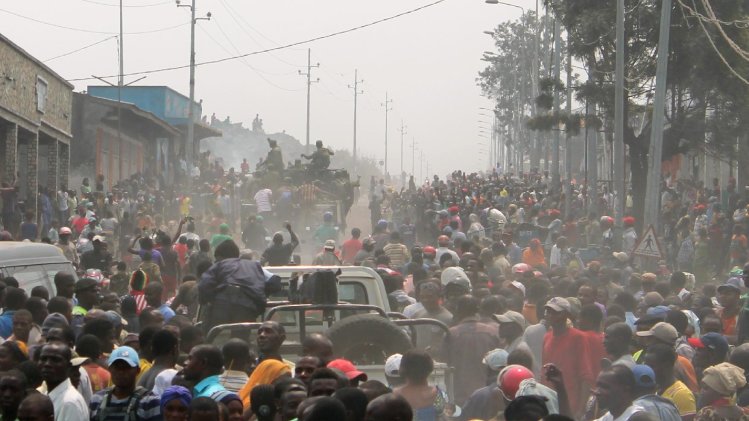
Carrying placards with slogans including "The UN is mocking us" and "Let our armed forces do their job," the marchers were dispersed by police before reaching the base, which is the headquarters for the U.N.'s 19,000-strong MONUSCO peacekeeping mission.
The protesters were angry about a statement issued by Ban on Wednesday amid fresh fighting between the military and the M23 rebel group, said Serge Sivya, a spokesman for the group.
The statement said Ban was "deeply concerned" over reports Congolese soldiers were desecrating rebel corpses, and that the U.N. peacekeeping mission was reviewing its support for army units suspected of being involved. Congo's government announced Thursday that a deputy commander had been arrested over his alleged role in the practice.
"We are protesting that the U.N. is asking for our troops to be put on trial, and we think they are targeting commanders who have shown their prowess in battle," Sivya said.
The same demonstrators took to the streets earlier in the week, before Ban's statement was issued, protesting a decision by the government to halt apparently successful military operations against the rebels north of Goma. Those protests were broken up by police firing tear gas and live ammunition into the air.
The U.N. peacekeeping mission was heavily criticized last year for standing by when the M23 rebels swept into Goma, the capital of North Kivu province, having routed government forces. The rebels withdrew in return for peace talks, which have repeatedly stalled.
In fresh fighting that began Sunday, the Congolese army pushed the rebels back and, according to the government, inflicted heavy casualties. The area around Goma fell quiet Thursday after four days of heavy fighting.
Civil society representative Nestor Bauma said he believed Ban had a right to express concern about rights abuses. "But he should not forget the realities on the ground. If people think the U.N. is trying to block an army advance you can imagine what can happen," he said.
A Congolese army officer, who insisted on anonymity because he was not authorized to speak to the press, said the army condemned the desecration of corpses but said the perpetrators' "combat stress" should be taken into account.
Colonel Makenga: the New Rwandan Proxy Warlord in DRC
by AfroAmerica Network on May 9, 2012
First there was the renegade General Laurent Nkunda, then the indicted war criminal General Bosco Ntaganda, and now the soon-to be General Colonel Sultani Makenga. What do they have in common?
All three are from Rwandan ethnic Tutsis, who fought within Rwandan Patritiot Front Army (RPA) from 1990-1997, became part of the Rwandan Defense Forces (RDF), were sent into Zaire, now the DRC, to fight for Laurent Desire Kabila, became Congolese rebels within the RCD Goma, then part of the Congolese army after the Pretoria Accord, and then rebelled against the Congolese authorities, and created a new rebellion called CNDP, then integrated the Congolese Army FARDC, and then rebelled again. Their story could only make the head spin.
Only a few costmetic differences: Laurent Nkunda followed this path to the letter. General Bosco Ntaganda made a quick stunt in Kisangani and Ituri Province on General Kagame's mission to support the Congolese warlord Thomas Lubanga. It is when on this mission that he massacred hundreds of thousand of civilians and earned the deserved nickname of "Terminator." Colonel Makenga kept a low profile, until recently.
There is one major similarity among the three warlords: all them are the creation of the Rwandan dictator and military junta commander, General Paul Kagame and have served as his proxy warlords in the DRC. These warlord and their militias are an extension of the Rwandan Defense Forces and their job is to make sure that the Congolese natural resources continue to flow to Rwanda and enrich the coffers of the small clique of cronies around the Rwandan dictator General Paul Kagame.
When these warlords are spent or becomes a hot potato, General Paul Kagame does not hesitate to bring them to Rwanda and replace them with a new convenient warlord.
That happened to General Laurent Nkunda in Januay 2009. He had been accused by the United Nations and the United States of being a nuisance in DRC and the US wanted him either sent into exile or arrested. General Paul Kagame had a better idea: he put him under house arrest in Rwanda. After all, General Nkunda was his employee and hit man with too many secrets. Recently, General Nkunda has been seen driving in expensive cars around Kigali and Gisenyi, with a heavy military escort. In Gisenyi, he is housed in beautiful lakeside mansion in Kigufi.
Recently, General Ntaganda become even more of a nuisance. Sought by the International Criminal Court, accused of multiple war crimes by several NGO and of mutiny and rebellion by the DRC Government, he was just too much of thorn in the back of General Paul Kagame.
The next step could already be predicted. Last week, the DRC and Rwandan government agreed on joint military operations against… the FDLR, not General Ntaganda. Rwanda sent three thousand troops into the DRC (see our article:Rwanda Sends 3 Thousand Troops in DRC ) and General Bosco Ntaganda, who was threatening teh FARDC from South-Kivu to Oriental Province, suddenly vanished.
The next day, a new warlord was born. Colonel Makenga, conveniently rebelled, left Bukavu, crossed Walikale, and Masisi and reached Rutshuru, where he created yet another armed group: The Congolese National Army (ANC), with M23 March 23 Movement, being the political branch. This is the new Rwandan Military proxy militia of General Paul Kagame that will take over from General Bosco Ntaganda. Actually sources said he left Bukavu, through the Rwandan border town of Cyangugu, then Kibuye, then Gisenyi, then Kibumba and reached Rutshuru. Most of his troops crossed at the same time as the 3000 Rwandan troops.
How about the whereabouts of General Ntaganda? Rumors have it that he has been captured, shot and killed, or has already reached Ituri with the help of Colonel Ruhorimbere, FARDC commander of Beni (see our article General Bosco Ntaganda Moving troops to Ituri and Masisi). Other rumors are that he is already under house arrest in Rwanda.
Meanwhile, sources in Goma informed AfroAmerica Network that the 3,000 troops from Rwandan that crossed into DRC last week have reached the farm belonging to General Bosco Ntaganda and unearthed a large cache os weapons, more than 2o tones according to other sources within MONUSCO. Yes, the Rwandan military has made sure than the weapons it supplied to General Ntaganda do not fall into the hands of MONUSCO!
One of our Congolese correspondents told us: "Do not be surprised. This is the Congo, where all kind of things can happen."
The coming weeks or months will inform us on the fate of the new Rwandan proxy militia and their new leader Colonel Makenga. As for General Bosco Ntaganda, General Paul Kagame must surely knows where he is.
©2012 AfroAmerica Network. All Rights Reserved.
Tagged as: Colonel Makenga, Congo, General Bosco Ntaganda, General Paul Kagame, MONUSCO, Rwanda
Comments on this entry are closed.
Previous post: Rwanda Sends 3 Thousand Troops in DRC
Next post: The Dilemma of Dictators Part V: When General Paul Kagame Feels the Noose
UN under fire over fall of Goma in DR Congo
21 November 2012 Last updated at 00:32 ET
By Barbara Plett BBC UN correspondent
 M23 rebels marched through the main streets of Goma unimpeded
 DR Congo Seeks Democracy
The UN's failure to confront insurgents who seized a strategic city in the Democratic Republic of Congo on Tuesday has raised questions about its largest and costliest peacekeeping mission.
The blue helmets gave up the battle for Goma in the eastern part of the country without firing a shot, standing aside as M23 rebels - widely believed to be backed by Rwanda - overran the frontier city of up to one million people.
For the French Foreign Minister, Laurent Fabius, it was "absurd" that the UN troops had allowed the rebels to parade past them. He urged that the mandate of the more than 17,000-strong force be reviewed.
The DR Congo peacekeepers - known by their acronym Monusco - are authorised to use force to protect civilians and support Congolese army operations against rebel groups and militias competing for control of mineral wealth in the lawless east of the country.
They have been criticised before for failing to respond adequately to atrocities against civilians committed by the rebels, notably a mass rape near one of their bases in 2010.
In their defence the UN emphasises that despite the relatively large size of the mission, troops are spread thinly over a vast and difficult terrain - 6,700 are deployed in North Kivu province where Goma is located, 1,500 in the city itself.
"Start Quote
End Quote Congo analyst Jason StearnsThe UN tends to be less successful with a purely military strategy that is not within the framework of a political strategy"
When it came to the rebel advance, the peacekeepers did back the army with attack helicopters, but the soldiers disappeared as M23 reached the city.
Protect civilians
The peacekeepers "cannot substitute" for the national army, said UN spokesman Eduardo del Buey, and in any case did not want to trigger gun battles in an urban area.
"It's impossible for Monusco to defend Goma single-handedly," agrees Congo analyst Jason Stearns.
"If the army crumbles it's difficult to do anything but assert a presence in the streets, to go and protect civilians when there are reports of abuse, but it's impossible to hold the town."
A senior UN official said that the Monusco patrols around Goma continued and were not being harassed by the rebels. He said the UN was still able to operate helicopters - but not fixed wing aircraft - at the airport because it controls the runway and air traffic.
But it is working in a vacuum, with the civilian authorities, police and army having fled Goma, and will have to find a way to co-exist with M23 if the rebels continue to dominate the city.
 Monusco says its peacekeepers are spread too thinly to take on a rebel army
 More broadly, Monusco is dealing with a weak state, still struggling with the effects of nearly 10 years of internal conflict that dragged in DR Congo's neighbours. After the war ended in 2003 the UN played a key role in shepherding the country to elections in 2006, but since then, says Mr Stearns, it hasn't had a political role.
"The UN tends to be less successful with a purely military strategy that is not within the framework of a political strategy," he said.
"I tell diplomats that the focus should not be on creating a better mission doing something almost impossible, but on re-politicising the mission, making it a political player. Right now it's the worst of both worlds, which makes it a target when things go wrong."
Perhaps the biggest complication is evidence that DR Congo's neighbours are still interfering.
The senior UN official said the Peacekeeping Department is looking at the possibility of Monusco using drones to step up its monitoring of the border shared with Rwanda and Uganda, although "monitoring and securing the border are very different things".
The flow of weapons into the country has greatly increased the military abilities of M23, as has external tactical advice and apparent troop reinforcements.
The Security Council expressed deep concern about such foreign support in a resolution adopted on Tuesday night, but it did not name and shame Uganda and especially Rwanda as the culprits, as did its panel of experts in a recent report.
Both countries have strongly denied the allegations and UN officials and diplomats say a political solution involving them is the only way to end the violence in eastern DR Congo.
But the United Nations Director of Human Rights Watch, Philippe Bolopion, questioned "the Security Council's failure to expose Rwanda for its well documented support to a murderous movement wreaking havoc amongst the civilian population of Goma and at times attacking UN peacekeepers".
If there is a clear UN failure in DR Congo, he said, this is it.

Dai Kurokawa / EPA
M23 rebel fighters rush from Goma to the town of Sake to reinforce positions as residents of Sake flee with their belongings on the road between Goma and Sake in eastern Democratic Republic of Congo, Nov. 22, 2012. Many of the fleeing residents stopped at an internally displaced person camp between Sake and Goma.
Reuters reports — Congolese troops fought back on Thursday against rebels who rejected calls from African leaders to quit the eastern city of Goma, captured earlier this week in a major upset that forced U.N. troops to withdraw.
Thousands of people fled the area of clashes around the town of Sake, as M23 rebel fighters rushed from Goma to reinforce their positions against an army counter-offensive.
Both sides claimed control of Sake as night fell on the troubled eastern area. There was no independent verification of who was holding the town.
The M23 rebel movement, widely believed to be backed by Rwanda, has vowed to "liberate" all of the vast, resource-rich country after taking Goma, a provincial capital on the Rwandan border, ramping up tensions in a fragile region. Full story…

Jerome Delay / AP
Women run after Congolese soldiers and rebel fighters battle over the eastern Congolese town of Sake, Nov. 22. The woman in orange, identified as Mamou, said she lost her husband by a fatal wound to the head from incoming mortar rounds. Thousands fled the M23 controlled town as the militants seeking to overthrow the government vowed to push forward despite mounting international pressure.

Phil Moore / AFP - Getty Images
Thousands of Congolese flee the town of Sake, about 16 miles west of Goma, following fresh fighting in the eastern Democratic Republic of the Congo, Nov. 22.

Phil Moore / AFP - Getty Images
Congolese children sit on a step in front of M23 rebels in Sake, Nov. 22, 2012. Rebels took the town yesterday, but were engaged in heavy gunfighting this afternoon as government-allied militia tried to retake it.

Dai Kurokawa / EPA
A woman who fled her home in Sake emerges from a shelter at an internally displaced person camp in Mugunga, between Goma and Sake, in eastern Democratic Republic of Congo, Nov. 22.
Related Articles:
- Congo suspends army chief after U.N. arms sale report
- Congo M23 rebel leader in Uganda for talks: source
- Congo demands sanctions on Rwanda, Uganda over rebels
•Sign up for the NBCNews.com Photos Newsletter
Rebels pledge to 'liberate' Congo after seizing city

James Akena / Reuters
A United Nations peacekeepers' armored vehicle drives past rebels patrolling a street in Goma in the eastern Democratic Republic of Congo after they captured the city from the government army on Tuesday.
GOMA, Democratic Republic of Congo -- Rebel forces in eastern Congo said Wednesday they planned to take control of the entire country after capturing the city of Goma as United Nations peacekeepers looked on.
A spokesman for the M23 rebels -- a group widely believed to be backed by Rwanda -- said they planned to "liberate" the country by marching on the capital, Kinshasa, nearly 1,000 miles away.
The rebels had previously said they were seeking talks with Democratic Republic of Congo's President Joseph Kabila.
"The journey to liberate Congo has started now ... We're going to move on to Bukavu and then to Kinshasa. Are you ready to join us?" Vianney Kazarama, spokesman for the M23 rebels, told a crowd of more than 1,000 in a stadium in Goma.
PhotoBlog: Congo police surrender as rebels take control of Goma
Goma fell Tuesday when hundreds of rebel fighters poured into the city and government troops melted away after sporadic gunfire.
Rebels used local radio and television stations to appeal for calm, but there are fears of human rights abuses and tens of thousands of people had already fled days of fighting between the rebels and U.N.-backed Congolese soldiers.
Rebel soldiers attack Goma in the Democratic Republic of Congo. The rebels are allegedly backed by Rwanda and threaten troops backed by United Nations peacekeepers. NBCNews.com's Dara Brown reports.
Rebel army seizes control of Congo city as UN peacekeepers do nothing
The M23 rebellion has aggravated tensions between Congo and its neighbor Rwanda, which Kinshasa's government says is orchestrating the insurgency as a means of grabbing the region's mineral wealth, which includes diamonds, gold and coltan, a metal used in mobile phones.
While conflict has simmered almost constantly in Congo's east in recent years, this is the first time Goma has fallen to rebels since foreign occupying armies officially pulled out under peace deals at the end of the most recent 1998-2003 war, dubbed "Africa's World War" because so many countries became involved.
Aid agencies have estimated that 5 million people have died from fighting and conflict-related disease since the 1998 war began.

Phil Moore / AFP - Getty Images
Twelve-year-old amputee Kakule Elie, who was hit by a stray bullet, lies in a bed in a hospital in Goma Tuesday.
Congo rebel clashes stoke fears of broader conflict
Diplomats at the United Nations and regional mediators in Central Africa have been seeking to prevent an escalation of hostilities in Congo, which is the size of Western Europe.
Kabila and Rwandan Paul Kagame were due to meet later on Wednesday after holding three-way talks with Ugandan President Yoweri Museveni late on Tuesday, sources in the Ugandan presidency said.
Rights group blasts Rwanda winning seat on UN Security Council
In New York, the U.N. Security Council unanimously adopted a resolution late on Tuesday condemning the seizure of Goma and demanding that M23's forces should withdraw and disband.
The council also expressed "deep concern at reports indicating that external support continues to be provided to the M23."
Hague war crimes court to finds Congo warlord guilty
The French government expressed frustration with U.N. peacekeepers, who gave up the battle for the city of a million people after Congo's army retreated, saying it was "absurd" that the U.N. force did not protect the city.
"MONUSCO [the U.N. force] is 17,000 soldiers, but sadly it was not in a position to prevent what happened," French Foreign Minister Laurent Fabius said of the U.N.'s Congo mission. "It is necessary that the MONUSCO mandate is reviewed."
Congo crisis exacerbated by heavy rains
But a senior U.N. official, who spoke on condition of anonymity, said the withdrawal of civilian and military Congolese officials had left a void it could not fill alone.
"We're not the army of any country, let alone the Congolese army, and it's not for us to take positions by ourselves to stop a rebel attack or the movement of rebels," the official said. "Our job is to protect civilians."
Reuters contributed to this report.
More world stories from NBC News:
- Americans tied to Israel caught in the chaos of Gaza conflict
- 'Army must invade': In southern Israel, support grows for action in Gaza
- Too much democracy? Apathy triumphs in UK's latest election
- Obama's visit a sign of Myanmar's dizzying pace of change
- Key players in the Israel-Gaza cross-border conflict
- French girl found tied up - but alive - in trunk after routine traffic stop
Congo rebel clashes stoke fears of broader conflict

Phil Moore / AFP - Getty Images
A soldier of the M23 rebel group stands atop a hill overlooking Bunagana in the east of the Democratic Republic of Congo on July 23, 2012. Several top commanders in the rebel movement were in Bunagana on Monday for a meeting, whilst a relative calm prevailed in the rebel-held territory.

Phil Moore / AFP - Getty Images
Colonel Sultani Makenga (seated inside vehicle), the commander of the M23 rebel group, drives through the town of Bunagana on July 23, 2012.
The U.S. State Department announced on Sunday that it was cutting military aid to Rwanda following accusations that it had given backing to rebel groups in neighboring eastern Congo, Agence France Presse reported.
More than 200,000 civilians have had to leave their homes and several hundred fighters have been killed in recent clashes between the M23 rebel group and the Congolese government, Reuters reports. Reports of support for rebel fighters from Rwanda have stoked fears of a slide into a broader central African conflict, although countries in the region last week agreed a plan to eradicate armed groups in eastern Congo.
Previously on PhotoBlog:
- UN condemns Congo attacks as rebel advance threatens Goma
- Rebels in Congo seize towns from government forces

Alissa Everett / Reuters
A displaced woman, who fled fighting near Walikale, holds her child at Magunga III camp, outside the city of Goma, on July 23, 2012.

James Akena / Reuters
A UN peacekeeping patrol drives through Goma on July 23, 2012.

James Akena / Reuters
Families fleeing fighting between the Congolese army and M23 rebels walk toward Goma on July 23, 2012.
Send Emails to wanabidii@googlegroups.com
Kujiondoa Tuma Email kwenda
wanabidii+unsubscribe@googlegroups.com Utapata Email ya kudhibitisha ukishatuma
Disclaimer:
Everyone posting to this Forum bears the sole responsibility for any legal consequences of his or her postings, and hence statements and facts must be presented responsibly. Your continued membership signifies that you agree to this disclaimer and pledge to abide by our Rules and Guidelines.
---
You received this message because you are subscribed to the Google Groups "Wanabidii" group.
To unsubscribe from this group and stop receiving emails from it, send an email to wanabidii+unsubscribe@googlegroups.com.
For more options, visit https://groups.google.com/groups/opt_out.
No comments:
Post a Comment