Thanks Ali Rashid, This underworld is mind boggling. It is unacceptable and things cannot go on like this; but they must be brought to a close. The world is falling apart if nothing will be done to bring this matter to an end......It is bad and innocent lives and blood are crying out aloud.........We will not just sit and watch.......God will not be happy. This matter of Private Merceneries if the mother of all problems we have in the world; it is the reason for economic crisis and Offshoring where Traders demand Free Trading and are fighting to eliminate existance of Governments and so, it is the reason why Governments finances goes to illegally organized groups fueling Terrorists and Pirates that are terrorizing the whole world........ We demand for an Extremely urgent and thorough investigation to this matter and we ask the UN and the the ICC Hague not to waste any more time but act urgently to embark and bring these Organizers and Engineers of Terror and the illegal Terrorist invasions before Legal Justice so acts of Dictatorships with excessive fear from such organized gangs would come to a close. Judy Miriga Diaspora Spokesperson Executive Director Confederation Council Foundation for Africa Inc., USA http://socioeconomicforum50.blogspot.com Check Out Foot-Note How America's Dollar & Wealth have wings Through Foundations and NGOs......Draining the Country dry.... --- On Sat, 11/24/12, Ali Rashid <kakaali200096@yahoo.com> wrote: From: Ali Rashid <kakaali200096@yahoo.com> Subject: Re: [uchunguzionline] ###Urgent: 45,000 IDPs, near Goma November 21, 2012. To: "uchunguzionline@yahoogroups.com" <uchunguzionline@yahoogroups.com>, "KISWAHILI yahogroup" <kiswahili@yahoogroups.com> Date: Saturday, November 24, 2012, 4:10 PM AHASANTE KWAKUTUJULISHA Ni hii habari hapa ambayo inatatiza. The UPDF of course denied Otunnu's claims. But the New York Times report also accused General Saleh and other top Ugandan army officers of using their ties to paramilitaries to plunder Congolese diamonds, gold and timber. But what exactly is Saracen International? Who really owns it? Our efforts to get a comment from Saracen International were futile by press time. So for the time being, it may be fair to say that no one really knows for sure what Saracen International is, and who owns it. What one can say however is that Saracen International is definitely a murky trade name that is shared by a number of private security companies across Africa, Europe, the Middle East and North America. A few have however been linked to the infamous South African mercenary firm called Executive Outcomes; the same company that allegedly tried to send mercenaries to overthrow the government of Equatorial Guinea in order to tap into the country's oil and mineral wealth. Saracen International has also been linked to a certain Erik Prince; the man whose company Blackwater is allegedly financing a "Counter-Piracy" mercenary squad in Somalia . Both the New York TimesandAssociated Press have carried similar allegations against Saracen International on the strength of"confidential" reports leaked from the African Union. Blackwater Founder Moves to Abu Dhabi, Records SayBy JAMES RISENPublished: August 17, 2010WASHINGTON — Erik Prince, whose company, Blackwater Worldwide, is for sale and whose former top managers are facing criminal charges, has left the United States and moved to Abu Dhabi, according to court documents. Related
Mr. Prince, a former member of the Navy Seals and an heir to a Michigan auto parts fortune, left the country after a series of civil lawsuits, criminal charges and Congressional investigations singled out Blackwater or its former executives and other personnel. His company, now called Xe Services, has collected hundreds of millions of dollars from the United States government since 2001. Current and former colleagues said Mr. Prince hoped to focus on security work from governments in Africa and the Middle East. They also said he was bitter about the legal scrutiny and negative publicity his company had received. "He needs a break from America," said one colleague, speaking only on the condition of anonymity about Mr. Prince's long-rumored move. Mr. Prince does not face any criminal charges, but five former top company executives have been indicted on federal weapons, conspiracy and obstruction charges. Two guards who worked for a Blackwater-affiliated company face murder charges from a 2009 shooting in Afghanistan, and the Justice Department is trying to revive its prosecution of five former Blackwater guards accused of killing 17 Iraqi civilians in 2007. Over the past several years, Congress has also conducted a series of investigations of Blackwater's activities in Iraq and Afghanistan, including an inquiry by the House Intelligence Committee into the company's involvement in a proposed Central Intelligence Agency assassination program. Mark Corallo, a spokesman for Mr. Prince, declined to comment about Mr. Prince's move. Richard L. Beizer, a Washington lawyer representing Mr. Prince in a civil case, did not respond to requests for comment. In documents filed last week in a civil lawsuit brought by former Blackwater employees accusing Mr. Prince of defrauding the government, Mr. Prince sought to avoid giving a deposition by stating that he had moved to Abu Dhabi in time for his children to enter school there Aug. 15. In the documents filed in federal court in Virginia, Mr. Prince's lawyers describe Abu Dhabi as Mr. Prince's place of residence. His deposition is now scheduled to take place there next week, lawyers involved in the case said. Mr. Prince made a name for himself during the height of the war in Iraq, when Blackwater became the most recognizable brand name in the booming field of private security contracting. The company, which Mr. Prince founded in 1997, expanded rapidly, winning a series of contracts with the State Department, the C.I.A. and the Defense Department. But Blackwater personnel in Iraq soon gained a reputation for cowboy tactics and the use of excessive force while guarding convoys of United States diplomats, leading to complaints from Iraqis and friction with the United States military. Blackwater's biggest public crisis came in September 2007, when its guards on a convoy in Nisour Square in Baghdad opened fire with machine guns, grenade launchers and other weapons, killing 17 Iraqi civilians. Five guards were indicted in the United States on manslaughter charges, but the charges were dismissed late last year by a federal judge. The Justice Department is appealing that ruling. The Nisour Square killings ultimately led the State Department to drop Blackwater from its diplomatic security contract in Iraq. But the Justice Department has been investigating whether Blackwater sought to bribe Iraqi government officials to allow the firm to operate in the country after the Nisour Square killings. In 2009, with scrutiny of Blackwater's activities intensifying, Mr. Prince changed the company's name and overhauled the management. He sold the company's aviation arm early this year, and finally placed the whole company, including its huge headquarters and training complex in Moyock, N.C., up for sale in June. COMMENTS: Blackwater Worldwide Ahmad al-Rubaye/Agence France-Presse — Getty Images Founded in 1998 by former Navy Seals, Blackwater Worldwide says it has trained tens of thousands of security personnel to work in hot spots around the world. The company, now called Xe Services, was once the United States' go-to contractor in Iraq and Afghanistan. It has been under intense scrutiny since 2007, when Blackwater guards were accused of killing 17 civilians in Nisour Square in Baghdad. The company and its executives and personnel have faced civil lawsuits, criminal charges and Congressional investigations surrounding accusations of murder and bribery. In April 2010, federal prosecutors announced weapons charges against five former senior Blackwater executives, including its former president, Erik D. Prince. Nearly four years after the federal government began a string of investigations and criminal prosecutions against company personnel, some of the cases have fallen apart, burdened by legal obstacles including the difficulties of obtaining evidence in war zones, of gaining proper jurisdiction for prosecutions in American civilian courts, and of overcoming immunity deals given to defendants by American officials on the scene. But in April 25, 2011, a federal appeals court reopened the criminal case against four former American military contractors accused of manslaughter in connection with the Nisour Square shooting in 2007. The Baghdad Shooting On Sept. 16, 2007, a convoy of four armored vehicles carrying Blackwater guards armed with automatic rifles rolled through Baghdad. Out on a day in which an explosion had the city on edge, a man was shot in the head while driving, yet his car kept rolling. The guards responded with a barrage of gunfire and explosive weapons, leaving 17 dead and 24 wounded. The shootings, in the middle of traffic, set off an anti-American political firestorm in Iraq and an international debate over the role of private security contractors in modern war zones. The Blackwater guards were accused of firing wildly and indiscriminately from their convoy into other cars and at Iraqi civilians. The guards defended their actions, saying they were responding to fire from insurgents. The Nisour Square shootings became a watershed event in the Iraq war, and led the Iraqi government to demand greater sovereignty and control over foreign contractors operating in the country. The Baghdad government later demanded and won the right to subject foreign contractors to Iraqi law, while the United States government grudgingly began to impose greater curbs on the freewheeling activities of the personnel guarding American diplomats in Iraq and Afghanistan. The former employees of Blackwater Worldwide were accused of manslaughter after the fatal shooting. But the charges were dismissed in December 2009 by a federal judge in Washington, who criticized the Justice Department for its handling of the case and ruled that prosecutors had relied on tainted evidence. In April 2011, however, an appeals panel ordered the case reopened. The three-judge appeals panel, disagreeing with the judge's decision, sent the case back, ordering Judge Ricardo M. Urbina of Federal District Court to review the evidence against each defendant individually. The appeals court ruling was a victory for the Justice Department, which had been bruised by Judge Urbina's ruling taking it to task for an overzealous prosecution. Blackwater itself never truly recovered from the shooting. It quickly became the subject of numerous Congressional and federal investigations and lawsuits for a broad range of activities in Iraq and elsewhere. Shell Companies After Blackwater was roundly condemned for its conduct in Iraq, Blackwater created a web of more than 30 shell companies or subsidiaries in part to obtain millions of dollars in American government contracts. While it is not clear how many of those businesses won contracts, at least three had deals with the United States military or the Central Intelligence Agency. Since 2001, the intelligence agency has awarded up to $600 million in classified contracts to Blackwater and its affiliates. The network of companies — which includes several businesses located in offshore tax havens — allowed Blackwater to obscure its involvement in government work from contracting officials or the public, and to assure a low profile for any of its classified activities. Senator Carl Levin, the Michigan Democrat who is chairman of the Armed Services Committee, has requested that the Justice Department investigate whether Blackwater officers misled the government when using subsidiaries to solicit contracts. The settlement with the State Department followed lengthy talks between Blackwater and the State Department that dealt with the violations as an administrative matter, allowing the firm to avoid criminal charges. It does not resolve other legal troubles still facing Blackwater and its former executives and other personnel. Those include the indictments of five former executives on weapons and obstruction charges; a federal investigation into evidence that Blackwater officials sought to bribe Iraqi government officials; and the arrest of two former Blackwater guards on federal murder charges stemming from the killing of two Afghans in 2009. Relationship With the C.I.A. In December 2009, The New York Times reported that private security guards from Blackwater participated in some of the C.I.A.'s most sensitive activities — clandestine raids with agency officers against people suspected of being insurgents in Iraq and Afghanistan and the transporting of detainees, according to former company employees and intelligence officials. The raids against suspects occurred on an almost nightly basis during the height of the Iraqi insurgency from 2004 to 2006, with Blackwater personnel playing central roles in what company insiders called "snatch and grab" operations. Instead of simply providing security for C.I.A. officers, several former Blackwater guards have said they at times became partners in missions to capture or kill militants in Iraq and Afghanistan, a practice that raises questions about the use of guns for hire on the battlefield. Separately, former Blackwater employees said they helped provide security on some C.I.A. flights transporting detainees in the years after the 2001 terror attacks in the United States. Blackwater's partnership with the C.I.A. has been enormously profitable for the North Carolina-based company, and became even closer after several top agency officials joined Blackwater. The C.I.A.'s continuing relationship with the company has drawn harsh criticism from some members of Congress, who argue that the company's tarnished record should preclude it from such work. Nonetheless, in June 2010 the State Department awarded Blackwater a $120 million contract to provide security at its regional offices in Afghanistan, while the C.I.A. renewed the firm's $100 million security contract for its station in Kabul. At the time, the C.I.A. director, Leon E. Panetta, defended the decision, saying that the company had offered the lowest bid and had "cleaned up its act." Company Founder Erik Prince For a time, the company's founder, Erik Prince, had ambitions to turn Blackwater into an informal arm of the American foreign policy and national security apparatus, and proposed to the C.I.A. to create a "quick reaction force" that could handle paramilitary operations for the spy agency around the world. He had hopes that Blackwater's military prowess could be an influential force in regional conflicts around the world. Mr. Prince, a former Navy Seal member and the heir to an auto parts fortune, has tried to shed his ties to Blackwater and its past activities. He overhauled the company's management in 2009, changed its name, and in later 2010 sold the privately held company. He also moved with his family to Abu Dhabi from the United States, a move that colleagues say was a result of his deep anger and frustration over the intense scrutiny he and his firm have received. While Mr. Prince stepped down from any management or operational role, he was expected to have a financial interest in his former company's future. The company was subject to an agreement it reached with the State Department in August 2010. Under the settlement, the company paid $42 million in fines over hundreds of violations of United States export control regulations, permitting it to continue to compete for government contracts. The new buyers hoped to recast the company as a military training organization instead of a private security service. The company's training center in Moyock has trained more than 50,000 United States government personnel and allied forces. The buyers hope to receive new contracts to train forces in Iraq, Afghanistan and Yemen, among other locations, especially as the United States withdraws troops and needs to train local forces. Somalia Operation In January 2011, Mr. Prince was said to be backing an effort by a South African mercenary firm to insert itself in Somalia's civil war. According to a report by the African Union, an organization of African states, Mr. Prince provided initial funding for a project by Saracen International to win contracts with Somalia's embattled government. The Somali government has been cornered into a small patch of Mogadishu by the Shabab, a Somali militant group with ties to Al Qaeda. The company, with corporate offshoots in Uganda and other countries, was formed with the remnants of Executive Outcomes, a private mercenary firm composed largely of former South African special operations troops that operated throughout Africa in the 1990s. According to a Jan. 12, 2011 confidential report by the African Union, Mr. Prince "is at the top of the management chain of Saracen and provided seed money for the Saracen contract." A Western official working in Somalia says he believes that it was Mr. Prince who first raised the idea of the Saracen contract with members of the Emirates' ruling families, with whom he has a close relationship. Mr. Prince could not be reached for comment. With its barely functional government and a fierce hostility to foreign armies since the hasty American withdrawal from Mogadishu in the early 1990s, Somalia is a country where Western militaries have long feared to tread. This has created an opportunity for private security companies like Saracen to fill the security vacuum created by years of civil war. Days after the disclosure of the African Union report, many of Somalia's biggest financial supporters, including the United States, have questioned the wisdom of the deal. Somali officials, in turn, cooled to the idea of working with Saracen. Erik PrinceFrom Wikipedia, the free encyclopedia For the English soccer player, see Eric Prince (footballer).
Erik Dean Prince (born June 6, 1969) is a former U.S. Navy SEAL notable for founding the world's largest private military company, Blackwater Worldwide, in 1997. He served as CEO until 2009 and later as chairman until Blackwater was sold in 2010 to a group of investors. Prince currently lives in United Arab Emirates.
[edit] Early life and careerErik Prince was born in Holland, Michigan to Edgar D. Prince and Elsa Broekhuizen. Prince is the youngest of four children.[4] Both his parents share Dutch heritage (the family name, Prins, was at some point anglicized to Prince) He graduated from Holland Christian High School.[citation needed] Prince and his father toured the world together, visiting the German concentration camp Dachau, a divided Berlin, and Normandy. According to his mother, these trips "made a big impression" on the young Prince.[5] Prince attended the Naval Academy for 18 months, before receiving a B.A. from Hillsdale College[6]. During his time at Hillsdale, Prince served as a volunteer firefighter and as a cold-water diver for the Hillsdale County Sheriff's Department.[7] Prince eventually became an emergency medical technician.[8] In 1990, Prince secured a low-level internship in the White House under George H. W. Bush,[9] but soon left to intern for California Congressman Dana Rohrabacher, Reagan's former speechwriter and ex-freedom fighter against the Soviets in Afghanistan. Rohrabacher described Prince as "a bright, driven young man." At the age of 21, Prince volunteered to search for a mass grave in Nicaragua, to expose killings under president Daniel Ortega and later claimed in an interview in Men's Journal that he found "...a mass grave: bones sticking out of the ground, hands tied with wire at the wrists."[10]. After Hillsdale College, Prince was commissioned as an officer in the United States Navy via Officer Candidate School in 1992. He went on to become a Navy SEAL and deployed with SEAL Team 8 to Haiti, the Middle East, and the Balkans. He credits the SEALS for being an outlet for his entrepreneurial spirit. Prince ended his Navy service prematurely in 1995 when his father died. Prince's mother sold the Prince Corporation for $1.3 billion in cash to Johnson Controls. He moved to Virginia Beach and personally financed the formation of Blackwater Worldwide in 1997.[11] He bought 6,000 acres (24 km2) of the Great Dismal Swamp of North Carolina and set up a school for special operations.[12] The name "Blackwater" comes from the peat-colored bogs in which the school is located.[13] [edit] FamilyPrince's father, Edgar D. Prince, began Prince Machine Corporation, an automobile supply company, in 1965. The business "exploded" and Prince began to invest some of the profits, through the Prince Group, into shopping malls and other types of car parts, creating a network of companies and real estate worth a billion dollars.[2] In the early 1970s, Edgar Prince's company patented a sun visor that could light up and sold 5,000 to General Motors. When the company was sold in the 90s, the company produced 20,000 a day.[14] In 1995 after the death of his father, Erik assumed control of daily operations, which was eventually sold for $1.35 billion in 1996.[15][16] Prince is the brother of Betsy DeVos, a former chairwoman of the Michigan Republican Party and wife of former Alticor (Amway) president and Gubernatorial candidate Dick DeVos. [11] Prince has seven children. His wife, Joan, died of cancer in June 2003.[17] His youngest, Charles Donovan, was named after William "Wild Bill" Donovan.[17] [edit] BusinessPrince credits the Rwandan genocide with his decision to start Blackwater. He told an audience in his native Holland, Michigan, "It really bothered me. It made me realize you can't sit back and pontificate. You have to act."[18] Since 1997, the firm has been awarded more than $1.6 billion in unclassified federal contracts and an unknown amount of classified work.[19] It became the largest of the State Department's three private security companies, providing 987 guards for embassies and bases abroad.[20] Since 2001, the Central Intelligence Agency (CIA) has awarded up to $600 million in classified contracts to Blackwater and its affiliates.[21] The Barack Obama administration awarded the company a $120 million United States Department of State security contract and about $100 million in new CIA work in 2010.[19] Prince takes great pride in the work Blackwater has done and points to its successes. According to him, out of 40,000 personal security missions, only 200 involved guards discharging their weapons. "No one under our care was ever killed or injured. We kept them safe, all the while we had 30 of our men killed."[18] Prince, according to Robert Young Pelton reportedly thinks of Blackwater's relationship to the military as something similar to FedEx's relationship to the U.S. Post Office "an efficient, privatized solution to sclerotic and wasteful government bureaucracy."[22] He credits his father's competitive streak in the automotive business with the inspiration to design a lighter, faster army.[23] In recent years Blackwater has come under criticism, but Prince believes that much of this criticism stems from politics. "I put myself and my company at the CIA's disposal for some very risky missions," Prince told Vanity Fair for its January 2010 issue. "But when it became politically expedient to do so, someone threw me under the bus."[24] Prince resigned as CEO of Blackwater on March 2, 2009 and remained as chairman of the board until he sold the company in late 2010 to a group of investors.[25] [edit] Disclosure as part of a covert CIA task forcePrince was part of a secret CIA task force created to kill terrorists. The House intelligence congressional committee leaked his name to the press.[26] Prince compared himself to the target of the similar government leak of Valerie Plame:
[edit] Philanthropy and political viewsPrince describes himself as a libertarian and practicing Roman Catholic.[24] He describes his political views as follows:
Prince credits his time as a White House intern with some of his views. He said that "Having that White House internship responsibility and badges, I walked around some of these other cavernous federal agencies, and you want to talk about depressing? Walk through HHS (Health and Human Services) or HUD (Housing and Urban Development) or Commerce, you name it. Leviathan realized."[27] Prince serves as vice president of the Edgar and Elsa Prince Foundation, which his family founded. Prince has donated heavily to both Christian and Islamic causes, building mosques at Blackwater's overseas bases, and supporting a Muslim orphanage in Afghanistan.[24] He financed the film The Stoning of Soraya M.[28] Salon reports that "between July 2003 and July 2006, the foundation gave at least $670,000 to the Family Research Council and $531,000 to Focus on the Family,"[29] headed by James Dobson. The foundation is a major donor to Calvin College,[30] a Christian institution in Grand Rapids, Michigan. Between 1998 and 2007, Prince donated over $200,000 to Republican and third-party causes.[31][32] In 2006 Prince contributed money to the Green Party of Luzerne County, Pennsylvania.[33] Prince has been an advocate of a leaner, more efficient military. He suggests several ways to make the military more efficient without compromising security. His suggestions are: greater accountability of costs, using appropriate equipment for each job, reduction of overhead, and operational and procurement reform.[34] In a televised interview with Charlie Rose, Prince discussed his offer to George Clooney of sending a humanitarian mission to Darfur. Prince expressed disdain for Western inaction in the face of the Rwandan genocide: "Who can watch the movie 'Hotel Rwanda' and not wish it had a different outcome? Who didn't wish that the UN would have sent troops or yank those Belgian commandos back there to secure that hotel and provide some safe havens? You let almost a million people in a country about the size of Maryland get killed by farm tools over four months". [35] [edit] After BlackwaterIn January 2011, the Associated Press reported that Prince had taken on a new role training a force of 2000 Somalis for anti-piracy operations in the Gulf of Aden. The program is reportedly funded by several Arab countries, including the United Arab Emirates and backed by the United States. Prince's spokesman, Mark Corallo, said that Prince has "no financial role" in the project and declined to answer any questions about Prince's involvement. The Somali force will also reportedly pursue an Islamist supporting warlord. The Associated Press quotes John Burnett of Maritime Underwater Security Consultants as saying "There are 34 nations with naval assets trying to stop piracy and it can only be stopped on land. With Prince's background and rather illustrious reputation, I think it's quite possible that it might work."[36] [edit] References
[edit] Further reading
[edit] External links21.Jan.2011 Who Is Saracen International? What Is It Doing In Somalia? "Saracen" is what the Crusaders used to call the Muslims, back in the day. "Saracen" is what the Crusaders used to call the Muslims, back in the day."Saracen International" is a trade name shared, coincidentally or not, by a number of private security companies across Africa, Europe, the Middle East and North America. These companies deny or downplay any financial or managerial relationships between them. A few, however, reportedly derive from the infamous (and pioneering) South African mercenary firm, Executive Outcomes. Yesterday, both The New York Times and the Associated Press carried a truly mind-bending story on Saracen International, based on a "confidential" African Union report that had apparently been leaked to both news organizations. The report claims that none other than Blackwater founder Erik Prince has been financing a "counter-piracy" mercenary squad in Somalia, through Saracen. Somalia, a chaotic demi-state, was the scene of an iconic American military defeat 18 years ago, not to mention a one-time home base for Osama Bin Laden. It appears that Prince, an evangelical American mercenary with longstanding ties to the Pentagon and the CIA, has partnered with a group of equally notorious South African guns-for-hire for a paramilitary mission in an Islamic nation, under a corporate banner harking back to the Crusades. But what does all that mean? Mercenaries don't work for freeIs this an American war by proxy? Notably, this Somali "counter-piracy" mission is advised by a former White House lawyer and by a former CIA official. However, it is also bankrolled in large part by someone in the government of Prince's new home, the United Arab Emirates. Reading between the lines of yesterday's news stories, the report connecting Prince and Saracen was most likely leaked by someone who felt, understandably, that the presence of mercenaries in Somalia undermines the African Union effort there, and persists on account of official corruption. Uganda is supplying troops to the uniformed African Union force in Somalia. And, according to AP reports, Saracen is "associated with" the younger brother of Uganda's president, Salim Saleh. That curious phrasing suggests a mutually beneficial financial relationship. Other African media sources say Salim Saleh is an "investor" or "major shareholder" in Saracen (Uganda). Salim Saleh's apparent conflict of interest highlights the key take-away from this incredibly complex story: The lines that separate government security officials and the leaders of private armies have become so fuzzy that you can never really be sure as to the motivations of any individual player. As mercenary forces become more and more prominent in armed conflicts around the world, the profit motive becomes difficult to separate from other casus belli. In other words, it's almost impossible to know the real reasons driving any conflict in which mercenaries play a leading role. Government connectionsThe Saracen-in-Somalia story started gaining notice after a Washington Times story revealed the role of a former George W. Bush administration official in coordinating Saracen's contract with the Somali government.  The former official, Pierre R. Prosper, is pictured here in a 2003 photo from his a former gig as an ambassador for "war crimes issues." Prosper and Michael Shanklin, a former CIA officer stationed in Mogadishu, previously told the AP they were being paid "paid by a Muslim nation [they] declined to identify" to advise the Somali government on "legal" and "security" matters. That unnamed "Muslim nation," it now appears, is the UAE. Late last year, the Washington Times and the AP reported that Prosper met with United Nations monitors over their concerns that Saracen may have violated a long-running (but ineffectual) arms embargo on Somalia. (Mogadishu, a city that has roughly the population of Houston, Texas, averaged 534 "weapon-related casualties" per month last autumn, according to the UN.) Prosper told the Times "that so far, no arms were shipped to the training camp, to the best of his knowledge." He told the AP that "Saracen is doing the military training" in Somalia. Yet the same story quotes Saracen (Uganda) chief executive Bill Pelser as disclaiming the company's training role in Somalia.
Sure. Got it.
Yesterday's AP story features quotes from Saracen (Lebanon) executive Lafras Luitingh—evidently a distinct entity from the Ugandan company of the same name that is also led by former employees of Executive Outcomes. Also, it's supposed to be completely irrelevant that Saracen (Uganda) goes around "ma[king] introductions" for Saracen (Lebanon). In the AP story, Luitingh says "the company had sought to keep the project secret to surprise the pirates." (Because the pirates don't know they might be attacked?) He "declined to say whether [Blackwater founder Erik] Prince was involved in the project and said [Prince] was not part of Saracen." Is your head spinning yet? If not, it will be soon. Keep reading. Saracen International, Not To Be Confused With Saracen InternationalThe AP turned up
Saracen (Uganda)'s website says the company has branches in South Africa, Tanzania, the Democratic Republic of Congo, Hong Kong, Angola, Zambia, Sudan and Botswana. My own research turned up two more "Saracen Internationals," not counting a Spanish real-estate firm with that name. One, Saracen International Ltd, is based in Manchester, UK.  The corporate address of record is at the Towers Business Park in Manchester. The website registration, however, returns both that address and another, one shared with a café in the southern suburb of Stockport.  An email to the Yahoo account of the listed website registrant, Sira Yaqub, bounced back undelivered. The woman who answered the phone at the UK Saracen in Manchester office suggested calling back on Monday. The other Saracen International I found is a limited-liability company based in Phoenix, Arizona. This Saracen International is registered to William G. Lawrence and Tjaart Andre Van Der Walt, both of Phoenix. Lawrence returned a call placed to the company's listed phone number. "I have no relationship to the UK company of the same name. I don't operate in Southern Africa," he says of Saracen (Arizona). Van Der Walt, Lawrence says, is a "friend" who has "never been part of the corporation," although records show the LLC is registered at Van Der Walt's home address. Lawrence says Van Der Walt, whose first name is also spelled in public records as "Thaart," emigrated from South Africa 16 years ago and is now an American citizen. I asked if Van Der Walt ever worked for Executive Outcomes. Lawrence says he doesn't know, and hadn't heard of that company. He has, however, heard of the other Saracens. "I got a call from Somalia asking them to train their coast guard to fight the piracy threat. Only then I became aware that there was another Saracen International," Lawrence says. Doesn't it seem strange, I suggested, that all these private security companies with an international client base—Lawrence's company has operations in Jordan and the UAE—seem content to share a business name, and aren't suing one another for copyright infringement? "I can't account for that except…[the name] has positive connotations in the Arabic world," Lawrence says. Positive because, after all, they fought the Crusaders.  Lawrence says his company sells a Chevrolet Suburban outfitted with a concealed six-barrel gatling gun that can pop out of the hood and fire 50 rounds a second in every direction. The car, called the Raptor, costs upward of $300,000. The Raptor is not something that you'd ever want to cut off in heavy traffic. You can watch its gunner blow up a hatchback on YouTube. Is this the next must-have vehicle for Arizona's soccer moms? "The people we do business with are national leaders. They are always subject to threats of one kind or another. King Abdullah [of Saudi Arabia] has had four assassination attempts on him," Lawrence says. "He doesn't ride in our car…but we're in his entourage." (Unlike the other companies that share its name, Saracen (Arizona) does not have an up-and-running website of its own. However, the marketing video for the Raptor contains a plug for saracen.org. That domain is currently listed as for sale.) Muddied (Black)watersYesterday's AP story on Prince's ties to Saracen (Uganda) connects another company to the dubiously funded "anti-piracy" mission there.
I found an "Afloat Leasing Ltd" registered in South Africa.  Records show this company owns a ship called the Seafarer, which departed Durban, South Africa roughly one month ago and was due to call last week in the UAE, a course that would take it past the pirate-plagued Horn of Africa. This may or may not be the same "Afloat Leasing" named by the AP. And as long as we're in the caveats department, it should be noted that Prince, who recently abandoned his "redneck mansion" for the UAE, has denied, through a spokesperson, having any "financial role of any kind in this matter" with Saracen. It should also be noted that Prince has ostensibly cut his ties with Blackwater, the company he built from nothing, although he's tight with the new owners, whoever they are. Did I say Blackwater? Of course, I meant Xe. Or whatever it is now. It's hard to keep all these companies straight, sometimes. Odd, isn't it? Most companies try so hard to come up with a memorable name. But with these companies and their constantly changing, generic-sounding brands—not to mention the roving headquarters and opaque registration—it's almost as though they're trying to confuse people. Like they don't want people to remember who they are, or something. Salim Saleh named in Somali 'mercenary' dealBy John Stephen Katende 31st January 2011
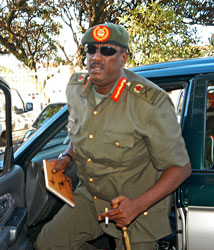 Gen. Salim Saleh: Is he a suspect? President Yoweri Museveni's young brother Caleb Akandwanaho aka General Salim Saleh may be linked to possible involvement in mercenary activities in war-torn Somalia, Uganda Correspondent can exclusively reveal. The details emerged after Saracen International; a company associated with Gen. Salim Saleh, lost a lucrative contract to undertake some work in Somalia. Our source in Mogadishu said the Transitional Federal Government [TFG] of Somalia declared last week, Thursday 27th January that it had severed its relationship with Saracen International. The decision, we are told, came after a closed door cabinet meeting chaired by Prime Minister Mohamed Abdullahi Mohamed in the capital Mogadishu. Somalia's Deputy Security Minister Ibrahim Mohamed Yarow confirmed that cabinet had indeed cancelled the agreement that the TFG government had signed with Saracen International to train Somali troops and to revive social services including building health facilities in Mogadishu. The decision, he said, was reached after Somalia's TFG government landed on evidence which suggested that Saracen International may have been involved mercenary activities. "…The cabinet has today overwhelmingly voted against Saracen International on the basis of mercenary acts. So the cabinet has revoked the agreement with this company", Ibrahim Mohamed Yarow said. The Deputy Security Minister added that while there is no doubt that his government requires assistance, as government, he said, the TFG will only enter into contractual agreements with distinguished and clean companies. He also said the cabinet's decision on Saracen International was "irrevocable". The TFG's decision to revoke Saracen International's contract follows widespread expression of concern by several foreign governments including the US. Philip J. Crowley, a US State Department Spokesman, said in December that the American government was "…concerned about the lack of transparency" of Saracen's financing and plans. According to a New York Times report of 20th January 2011, "…at least one of Saracen's past forays into training militias drew an international rebuke. Saracen's Uganda subsidiary was implicated in a 2002 United Nations Security Council report for training rebel paramilitary forces in Congo". Is war a lucrative source of business for powerful men? Other than Burundi, Uganda is the only other country in Africa that has contributed thousands of soldiers to the AU's AMISOM peacekeeping mission in Somalia. The same New York Times report identified one of Saracen Uganda's owners as Lt. Gen. Salim Saleh, the retired half-brother of Uganda's President Yoweri Museveni. Salim Saleh's possible conflict of interest also highlights some crucial things in this terribly complex story. One of the things is that the lines that separate government security officials and owners or leaders of private armies have become so fuzzy that you can never really be sure as to the motivations of any individual player. As mercenary forces become more and more prominent in armed conflicts around the world, the profit motive becomes almost impossible to rule out. In other words, it's almost impossible to know the real reasons that fuel the conflicts in which mercenaries play a role. UPC party President Dr. Olara Otunnu for example, has accused some UPDF soldiers of having had vested interests in prolonging the Kony war in northern Uganda. The UPDF of course denied Otunnu's claims. But the New York Times report also accused General Saleh and other top Ugandan army officers of using their ties to paramilitaries to plunder Congolese diamonds, gold and timber. But what exactly is Saracen International? Who really owns it? Our efforts to get a comment from Saracen International were futile by press time. So for the time being, it may be fair to say that no one really knows for sure what Saracen International is, and who owns it. What one can say however is that Saracen International is definitely a murky trade name that is shared by a number of private security companies across Africa, Europe, the Middle East and North America. Whether that is a coincidence or not, no one really knows. What we can confirm without fear of contradiction is that Saracen International is fully established in Uganda; see http://saracen.co.ug/index.php. Most of the other companies however deny or downplay any financial or managerial relationships between them. A few have however been linked to the infamous South African mercenary firm called Executive Outcomes; the same company that allegedly tried to send mercenaries to overthrow the government of Equatorial Guinea in order to tap into the country's oil and mineral wealth. Saracen International has also been linked to a certain Erik Prince; the man whose company Blackwater is allegedly financing a "Counter-Piracy" mercenary squad in Somalia. Both the New York Times and Associated Press have carried similar allegations against Saracen International on the strength of "confidential" reports leaked from the African Union. Somalia has been without a proper central government since 1991 when President Siad Barre was overthrown by armed warlords. That incident effectively condemned Somalia to decades of civil war. END. Please log into www.ugandacorrespondent.com every Monday to read our top stories and anytime mid-week for our news updates. SARACEN INTERNATIONAL IN SOMALIA WHAT IS NEXT? By Said Dualeh 24 dec 2010 (Mareeg.com) The TFG of Somalia is not achieving anything for the people of Somalia, it is only adding to the miseries of the people of Somalia proper. I have been a supporter of all types of governments in Somalia from The collapse of the Siad Barre regime1991 to the present. In my previous articles I have defended Sheikh Sharif and the parliamentary warlord Sharif Hassan thinking that they had a little interest in their heart for our people the people of Somalia who unfortunately do not know their rights as citizens of Somalia. We need a bill of rights for Somalia to get out of this corrupt and failed state status. We as Somalis can be successful in business, education and professions any other country in the world as proven by the Somali Diaspora except on our own country-Somalia, why? Go figure the answer and you may have solved the Somali Dilemma. The Somali people do not know that they do not have to put up with corrupt leaders, leaders who associate themselves with the enemies of the people of Somalia, they do not need to put up with un educated and unenlightened religious leaders who hide behind veils and brain washed youngsters who never grew up as people with rights and never seen a just government who cares about its people and their welfare. Somalis do not need to put up with International organizations and Non governmental agencies who live off destruction, mayhem and underdevelopment in less fortunate countries like Somalia where they can test their new medicines and unorthodox, untested theories of development and peacekeepers who look after their own interest. At First in Somalia after 1991 it was unstable government getting in contract with companies that dumped Nuclear Waste on our shores and contracting with companies who took every piece of metal out of the country and sold it as Salvage waste to Asian counties. We have seen Ambassadors trying to sell off Somali government properties overseas, and then we have seen presidents, prime ministers and regional authorities printing illegal currencies in a clandestine ways that made people wonder if this poor country had anyone who cares about it. We have seen where lack of transparency and accountability can lead to misunderstanding of MOU's memorandum of understanding which did not reference to the law of the sea- regulations spearheaded by the United Nations. We have seen Ethiopia trying to destroy Somalia using the old colonial adage (Divide them then Rule them). If anyone ever thought Ethiopia wants to see a unified Somalia or a strong Somalia think again as you may be living in a wonderland. The same goes for all of our neighbors and our Arab brethren. We have seen how corrupt the current Somali government officials are they sold the .SO protocol bestowed to Somalia as a nation among 192 others. The same people have contracted with Saracen International- one of the new private military companies(PMC's) such Executive Outcomes(EO), Sandline Co, Strategic Consulting International(SCI), KBR, Heritage Oil and Gas Co. The name and their symbol of Saracen International looks like a middle ages Templar Knight on horseback trying to show the "light"(Christianity) to heathens in sub-Saharan Africa. The company is run by shady characters from the former SADF- South African Defense Force and former employees of the now infamous but defunct Executive Outcomes. The current TFG Finance minister stated that the agreement was signed by Sheikh Sharif- through his trusted then chief of Cabinet Abdulkarim Jama, the current Minister of information and Post & Communication. On the other side it was signed by Lafras Luitingh aka Louis Yssel- member of the notorious Former South African law enforcement agency Civil Cooperation Bureau(CCB)- in some pulished reports the finger was pointed to him during the truth commission hearings in the new South Africa that he killed Dr. David Webster and Anton Lubowski (ANC Activists in the former South africa).Lafras Luitingh aka Louis Yssel has a checkered past that will scare anyone who reads about world intelligence reports. He had dealing with characters such as Tim Spicer, Tony Buckingham, Eeben Barlow and the late Former South Africa skin head chief of police Henrick Van der Bergh, the creator B.OS.S and later the CCB where Lafras Luitingh got his training in sabotage, political assassinations, and intelligence gathering on dissidents. He was later recruited by (Executive Outcomes) EO for their Angola, Mozambique, Malawi jobs and later Sierra Leone. The plane currently held in Hargeisa is the type used by these private armies especially Saracen and they buy their weapons from the former Soviet satellite countries. The two South Africans on the plane in Hargeisa were released as fake Journalist but they were Saracen International employees. They have connections with the British Foreign Office who called the Somaliland foreign minister. Why did they not allow pictures to be taken or invited the media to the kangaroo trail held in Hargeisa. South African intelligence has some clout over Hargeisa for different a reason, that is where the late Somaliland President Egal died in a hospital in South Africa. The contact is Mohamed Ibrahim Egal's former wife Edna who was at one time Foreign Minister of Somaliland and who owns a hospital that received assistance from South Africa. Soon there will be another mock trial in Hargeisa, Somalia Saracen will give the weapons on the plane to the Somaliland administration formatting it as confiscation by their court and they will release the plane and the crew intact. Saracen will once again continue the operations they were hired for. Sheikh Sharif of the TFG , Museveni of Uganda, Farole of Puntland, & Sharif's Ala Shiekh group led by Abdulkarim Jama( former VA mosques bookkeeper) and his prime minister (Formaggio) and his defense minister(Fiqi) (2 former Somali embassy bookkeepers from Washington) the Finance minister (Halane)& The Foreign Minister (Omaar) have no clue who they are dealing with at Saracen International. Museveni's half brother is just a cover up. This project is the deep throat of Somalia and we need transparency in these dealings with select members of the Somali parliament. Saracen guys and their friends have helped countries overthrew elected officials and everything they do is for money. These guys were so powerful at one time that they had The British navy servicing their Antonov and soviet type helicopters near the coast of Africa. If a country like Somalia does not have money these private military companies barter for oil and fishing rights and sell those rights at a premium to the highest bidder. They have close relationship with the leadership in the Emirates and even a stronger one with current Sultan of Oman whom they assisted in overthrowing his father off the throne. Both the UN and the OAU despise these private military companies because they want to put them out of business. Amisom is a cash cow for Uganda who does not want the current situation to end and they sustain a weak TFG government whose diplomatic failures include a drug dealing former Ambassador in China and they keep recycling former diplomats to the UN mission in NY who have publicly stated that he will join his clansmen back home to kill people and destabilize peaceful areas. TFG are not bringing to justice the ambassador who sold embassy property in Kenya. Will this government survive without peace keepers? I do not think so. Saracen International is a rented military company mostly comprised of former special forces, formerly known as "dogs of war", mercenaries and now they are known as security trainers and consultants (their sanitized PR name). Their specialty is to loot poor African countries who are led by corrupt individuals with no integrity. The Somali people have a choice to change their leadership, or else if they want to stand on the sidelines as always thinking that someone is going to come to rescue them or should we as Somalis get our hands dirty and come together and resolve our clannish divisions once and for all since we have seen that no clan in Somalia is able to subjugate the others and live in peace or wait for our destiny to be decided by organizations or private military companies who follow their interest.. Best Regards, Thank You, Said Hersi Dualeh *Freelance journalist* Anaheim, California- USA Erik Prince and Saracen International Doing Death's Business in Somalia
MilitaryMercenary / Private Military Companies (PMCs)Not all companies provide all services. Some of these companies are classical "merc" operations, while others are risk management firms that have nothing in common with privately contracted military support operations.
Scramble For Africa: Redux – Has Obama Just Kicked Off Another Oil War In Africa? This Time In Uganda?In Uncategorized on November 11, 2011 at 11:13 am Oldspeak:" 'African oil is of national strategic interest to us, and it will increase and become more important as we go forward.' - Walter Kantsteiner III, Assistant Secretary of State for Africa, 2002. On this Veterans Day 2011, Meditate on the fact that our Nobel Peace Prize winning President has initiated another barely reported military incursion into another oil rich region of Africa. Allying our troops with another murderous dictator who tortures and kills his own citizens, unscrupulous oil and natural gas corporations and private military corporations to protect oil production/exploration efforts. Once again being explained as a "humanitarian mission" with the supposed purpose of' stopping human rights abuses and 'furthering U.S. national security interests and foreign policy'. Never mind that this effort is all part of the new "Great Game", of keeping oil away from China, and securing it for U.S. use. 'One of the rationales Obama gave for sending JSOC troops to Uganda, was that the LRA recruits and uses child soldiers'. Nevermind the unabated recruitment of child soldiers throughout the horn of africa who'll likely be armed with U.S weapons as result of Obama's repeatedly waiving restrictions on military aid to 'Chad, Yemen, Sudan, and the Democratic Republic of Congo (DRC)–four countries with records of actively recruiting child soldiers…Any country even remotely close to the horn of Africa (like these distinguished four) is just too strategically important…So, for the time being, it's still guns for the kids' -Mother Jones. Nevermind the hypocrisy of partnering with maniacal dictators in Uganda, Bahrain, Yemen and Syria, but hunting and killing others in Iraq and Libya. In light of recent events, that guy should be very afraid. It's clear that when the U.S. no longer has use for you, you are very quickly cut loose, labeled a terrorist who kills and tortures your own people, and done away with exercising extreme prejudice. And the people of Uganda should be very afraid. When the U.S. deploys its military in your country, you can bet dollars to doughnuts, innocents will die at their hands. "Profit Is Paramount". Oldspeak:" 'African oil is of national strategic interest to us, and it will increase and become more important as we go forward.' - Walter Kantsteiner III, Assistant Secretary of State for Africa, 2002. On this Veterans Day 2011, Meditate on the fact that our Nobel Peace Prize winning President has initiated another barely reported military incursion into another oil rich region of Africa. Allying our troops with another murderous dictator who tortures and kills his own citizens, unscrupulous oil and natural gas corporations and private military corporations to protect oil production/exploration efforts. Once again being explained as a "humanitarian mission" with the supposed purpose of' stopping human rights abuses and 'furthering U.S. national security interests and foreign policy'. Never mind that this effort is all part of the new "Great Game", of keeping oil away from China, and securing it for U.S. use. 'One of the rationales Obama gave for sending JSOC troops to Uganda, was that the LRA recruits and uses child soldiers'. Nevermind the unabated recruitment of child soldiers throughout the horn of africa who'll likely be armed with U.S weapons as result of Obama's repeatedly waiving restrictions on military aid to 'Chad, Yemen, Sudan, and the Democratic Republic of Congo (DRC)–four countries with records of actively recruiting child soldiers…Any country even remotely close to the horn of Africa (like these distinguished four) is just too strategically important…So, for the time being, it's still guns for the kids' -Mother Jones. Nevermind the hypocrisy of partnering with maniacal dictators in Uganda, Bahrain, Yemen and Syria, but hunting and killing others in Iraq and Libya. In light of recent events, that guy should be very afraid. It's clear that when the U.S. no longer has use for you, you are very quickly cut loose, labeled a terrorist who kills and tortures your own people, and done away with exercising extreme prejudice. And the people of Uganda should be very afraid. When the U.S. deploys its military in your country, you can bet dollars to doughnuts, innocents will die at their hands. "Profit Is Paramount".Related Stories: By Steve Horn @ Alter Net: On Friday, October 14, President Barack Obama announced he would be sending 100 Joint Special Operations Command (JSOC) forces to Uganda to "remove from the battlefield" (meaning capture or kill) the leader of the Lord's Resistance Army (LRA), Joseph Kony. "I believe that deploying these U.S. Armed Forces furthers U.S. national security interests and foreign policy and will be a significant contribution toward counter-LRA efforts in central Africa," wrote Obama in a letter to U.S. House Majority Leader, John Boehner, R-OH. The LRA, whose horrific deeds have been have been well-documented by scores of human rights reports and the documentary film, Invisible Children, can best be described as a Christian cult militia engaged in violent armed rebellion against the Ugandan government, located primarily in northern Uganda, the Democratic Republic of the Congo, and South Sudan. An arrest warrant was issued in 2005 by the International Criminal Court against the LRA leadership for war crimes and crimes against humanity. Kony, the LRA ringleader, possibly has over 80 wives (i.e. sex slaves), according to a 2009 story by the Guardian, and has fathered over 40 children. It gets worse. According to a May 2009 article in Newsweek, "[H]e and the hundreds of forcibly conscripted children who serve as his killing squads are feared throughout the region for their horrific levels of brutality and the butchery of tens of thousands of defenseless civilians. Their swath of destruction has displaced well over 2 million people. Kony has forced new male recruits to rape their mothers and kill their parents. Former LRA members say the rebels sometimes cook and eat their victims." The mainstream media, at least those who have covered this new U.S. military adventure, have taken the Obama administration at face value on its stated claim that JSOC troops are necessary in Uganda and neighboring countries, for the purpose of murdering the elusive and brutal war criminal-at-large, Joseph Kony. But is this the true motive for sending JSOC troops into the region? A probe into the last several years of geopolitical posturing in Africa by the United States reveals another tale. It is the tale of a 21st century "scramble for Africa" for the procurement of oil, using imperial tools, such as drones, mercenaries and military bases, in a desperate effort to gain control of this valuable commodity. An African Scramble for Oil In October 2008, AFRICOM, the United States Africa Command, became the U.S. military's sixth regional Unified Combatant Command center, joining those already housed in South America (SOUTHCOM), North America (NORTHCOM), Europe (EUCOM), the Middle East (CENTCOM), and the Pacific (USPACOM). The Unified Combatant Command centers serve as regional strategic hubs for the U.S. military planners to plot and implement the ways in which the U.S. will dominate these various regions for whatever it might deem to be in line with the national interest or national security purposes. AFRICOM, though, did not come out of the blue and was years in the making before its realization. Not long after 9/11, in early January 2002, a key symposium titled "African Oil: A Priority for U.S. National Security and African Development" took place in Washington, DC; it was hosted by the neoconservative think-tank, the Institute for Advanced Strategic and Political Studies (IASPS). IASPS is most famous for its authorship of a paper called "A Clean Break: A New Strategy for Securing the Realm," a 1996 paper that, among other things, called for the overthrow of Saddam Hussein in Iraq, foreshadowing the 2003 invasion of Iraq by the neoconservative-lead Bush administration foreign policy team. At the symposium, then Assistant Secretary of State for Africa, Walter Kantsteiner III, stated, "African oil is a national strategic interest…[and] it's people like you who will…bring the oil home." Later, in May 2004, Kantsteiner chaired a congressionally funded Africa Policy Advisory Panel report titled, "Rising U.S. States in Africa," in which he stated, "African oil is of national strategic interest to us, and it will increase and become more important as we go forward." In the midst of these summits, the U.S. set up crucial military bases — in spring 2003 in Djibouti, a base called Camp Lemmonier, and in 2004 at Entebbe International Airport in Uganda. The U.S. was now firmly implanted in the region to begin an African safari, featuring, most prominently, tours of prospective and already existing oil rigs and pipelines spanning every contour of the continent. Oil Safari to Uganda Not long after AFRICOM became a reality, multinational corporations also flocked into Uganda to search for oil. The search was a flaming success story, with 2.5 billion barrels of oil now having been discovered, but still to this date, not yet procured. The royalties accompanying the oil's usage could reach up to $2 billion a year by 2015, reported the Economist in May 2010. This oil is located off of Lake Albert in northwest Uganda, a lake shared by both Uganda and the Democratic Republic of the Congo (DRC). Multinational corporations are required to sign something known as a Production Sharing Agreement (PSA) with the Ugandan government in order to drill for Uganda's oil. In essence, a PSA is a contractual agreement between a foreign corporation benefiting from a country's resources and the government of a country whose resources are being benefited from. In October 2006, according to a WikiLeaks cable, Tullow Oil, a British company, and Heritage Oil, a Canadian company, signed a PSA with the Ugandan government, led by President Yoweri Musveni. This particular PSA, though, was no ordinary one, and indeed, could serve, in part, as an explanation for the logic of Obama's October 14 announcement. For the first three years the PSA was signed, the details were kept secret from everyone but upper-level Tullow and Heritage executives and Museveni's inner circle. A February 2010 report written by PLATFORM, a British nonprofit organization, titled, "Contracts Curse: Uganda's oil agreements place profit before people," explains the PSA best and for the first time, made public its content. The PSA, PLATFORM explained, "contain[s] no clauses covering security provision[s]…There is no public agreement setting out the relationship between the oil companies and the military or police forces. Thus it is unclear what promises and guarantees the Ugandan government has made to ensure security and what rights the oil companies have been awarded." This raised numerous vital questions for PLATFORM, including, "Do oil company security or private military contractors have the right or authority to arrest, injure or kill those they perceive as a threat?" and "Is the Ugandan government incentivised to prioritise security interests over the human rights of local populations?" That same report also included revelations by PLATFORM that the Ugandan government had constructed a "new military base on ten square miles" near Lake Albert, where the oil was located. The report also disclosed that Museveni had created something called an Oil Wells Protection Unit (OWPU), which amounted to his own security forces, or mercenaries, guarding oil rigs. Concerned about the OWPU, PLATFORM wrote, "Apparently its mandate is 'to provide physical security for the oil and gas industry' and 'conduct strategic intelligence activities in all areas where oil will be processed and marketed.' However, the OWPU has no Web site and no clearly known structure or chain of command…In this context, the OWPU could easily be misused to repress opposition to oil extraction activities, further political gains by the government and commit human rights abuses without accountability." Enter Heritage Oil and Ties to Private Mercenary Armies Possibly the most crucial fact about the undisclosed clauses concerning security provisions in the PSA, was this vital detail: The Canadian oil company Heritage, which is owned by Tony Buckingham, who many credit for being the first innovator behind the modern-day private military corporation (PMC) (think Blackwater USA, now known as Xe Services), was formerly the main stakeholder in the Albertine Basin. In 2010, Heritage sold its stake in the project to the British company Tullow Oil for $1.5 billion. Though Heritage is no longer exploring for oil in the hopes of drilling for it in Uganda, Buckingham's background and business connections are still crucial to grasp. Buckingham is a former officer of the British Special Air Service (SAS) — a parallel to the U.S. JSOC forces sent into Uganda by Obama — according to a 1997 story. In 1992 Buckingham became the founder and CEO of Heritage Oil. A year later, in 1993, Buckingham founded a PMC called Executive Outcomes (EO). EO officially closed shop in 1998, but during its time of existence, it consistently followed in the footsteps of the locations that Buckingham took Heritage's oil rigs. And Buckingham's close ties to mercenary armies did not terminate with EO's fall. Instead, he formed a special relationship with a key figure, the half-brother of Ugandan President Yoweri Museveni, Salim Saleh. The special relationship between Saleh and Buckingham also goes a long way toward explaining the Obama decision to invade Uganda. Salim Saleh, Erik Prince, and Guns-For-Hire in the Horn of Africa Upon the eclipse of EO in 1998, rather than decay into oblivion, it instead morphed into a multi-tentacled machine of various PMC split-offs, the most crucial of which, at least as far as Uganda is concerned, is Saracen International. Salim Saleh owns a 25-percent stake in Saracen. "[Saracen International] was formed with the remnants of Executive Outcomes, a private mercenary firm composed largely of former South African special operations troops who worked throughout Africa in the 1990s," explained the New York Times in a January 2011 article. Saleh, now Museveni's military adviser, is a former high-ranking official for theUganda People's Defence Force, the military of the Ugandan government. He is also a well-connected mercenary, as seen through his ownership stake in Saracen. Saracen, in turns out, also maintains an important relationship with Blackwater USA founder and CEO, Erik Prince. The same article that revealed the ties between EO and Saracen International also revealed that Prince possesses an ownership stake in Saracen. The Times wrote, "According to a Jan. 12 confidential report by the African Union, Mr. Prince 'is at the top of the management chain of Saracen and provided seed money for the Saracen contract.'" Blackwater, under Prince's leadership, has been involved in the game of guns-for-hire in the Horn of Africa since February 2009, according to a WikiLeaks cable. The cable reveals that Blackwater won a contract to operate an armed ship, called McArthur, from a port in Djibouti, the country which is also home of the U.S. military's Camp Lemonnier base. The cable also reveals that McArthur "will have an unarmed UAV" (Unarmed Vehicle, aka a drone), "will likely engage…Kenya in the future," and that Blackwater "has briefed AFRICOM, CENTCOM, and Embassy Nairobi officials." In other words, this means the Prince and Blackwater mission had the blessing of top-level U.S. military and diplomatic officials. Could Prince's and Saleh's guns-for-hire be teaming up with JSOC forces in the Albertine basin to guard oil rigs? History provides some highly relavant precedent. Erik Prince, Blackwater USA and Oil: History Repeating Itself? Prince's Blackwater has been involved in such engagements before. Rewind to Azerbaijan and Iraq, where Blackwater was tasked with guarding crucial oil pipelines and oil wells for the world's wealthiest oil and natural gas corporations. Investigative journalist Jeremy Scahill, in his book Blackwater: The Rise of the World's Most Powerful Mercenary Army, revealed that "Blackwater USA was hired by the Pentagon…to deploy in Azerbaijan, where Blackwater would be tasked with establishing and training an elite…force modeled after the U.S. Navy SEALs that would ultimately protect the interests of the United States and its allies in a hostile region. "Blackwater joined a U.S. corporate landscape [in the region] that included…corporations such as Bechtel, Halliburton, Chevron-Texaco, Unocal and ExxonMobil … Instead of sending in battalions of active U.S. military to Azerbaijan, the Pentagon deployed…Blackwater…that would serve a dual purpose: protecting the West's new profitable oil and gas exploitation in a region historically dominated by Russia and Iran, and possibly laying the groundwork for an important forward operating base for an attack against Iran," Scahill continued. Azerbaijan, like Uganda, is home to a vast array of oil and natural gas, and also a key pipeline, the Baku-Tbilisi-Ceyhan pipeline, which, after reaching its respective coastal homes in Azerbaijan, Georgia and Turkey, ends up on the global export market. In Iraq, as revealed by the Guardian in a March 2004 article, Blackwater, via a Pentagon contract, recruited Chilean "commandos, other soldiers and seamen, paying them up to $4,000 a month to guard oil wells against attack by insurgents…many of [them] had trained under the military government of Augusto Pinochet." Pinochet, many will recall, was the brutal dictator who came to power after the CIA-initiated 1973 coup of Salvador Allende. Iraq, like Uganda and Azerbaijan, is home to vast amounts of oil. Major syndicates ranging from BP America, ExxonMobil, Shell, Chevron and ConocoPhillips have all flocked to Iraq in the mad dash for Iraq's resources since the 2003 onset of the ongoing U.S. occupation of Iraq. WikiLeaks Cables Reveal Ugandan Oil Bid Corruption ExxonMobil, teaming up with Tullow Oil, as seen through the lens of important Wikileaks State Department diplomatic cables, has also shown great interest in the economic opportunities surrounding oil exploration off of Lake Albert, as well as great concern over governmental corruption in the nascent Ugandan oil industry. A key December 3, 2009 cable, titled, "Uganda: Corruption Allegations Accompany Arrival Of Major Oil Firms," reads, "Executives from ExxonMobil visited Uganda on November 18-19, and met with Ambassador (Jerry) Lanier (the U.S. ambassador to Uganda), Mission Officers, the Ministry of Energy and Mineral Development (MEMD), Uganda's Petroleum Exploration and Production Department (PEPD), and Tullow (Oil)…ExxonMobil representatives who traveled to Kampala said they were 'very impressed' with…the Ugandan government oil representatives…" Roughly a month later, yet another important WikiLeaks-provided State Department diplomatic cable was produced on January 13, 2010, titled, "Uganda: Security Report Details Oil Sector Corruption," which discusses the impacts rampant corruption unfolding in the Ugandan oil industry would have on the U.S. if the ExxonMobil deal falls through. "A corrupt…agreement would undermine a potential multi-billion dollar deal between ExxonMobil and Tullow, and have serious long-term implications for U.S….in Uganda in terms of…economic development," the cable reads. The State Department's diplomatic cables make it quite clear that ExxonMobil and its partner, Tullow Oil, were both deeply interested in the Ugandan oil industry, but also gravely concerned about corruption. Yet, Tullow and ExxonMobil had little to worry about, based on both Prince's ExxonMobil ties during his days at Blackwater USA, as well as a crucial March 2008 meeting between the Salim Saleh-led Ugandan military and high-level Tullow Oil officials, as exposed by Wikileaks. Tullow's Mercenary Presence Long in the Making at Lake Albert Basin Tullow, as revealed by State Department diplomatic cables leaked to Wikileaks, has been building up a mercenary army presence in the Lake Albert area for over three years. A March 2008 State Department diplomatic cable reads, "…Tullow Oil, one of the four exploration companies operating in western Uganda, said that as the oil activity on Lake Albert increased, a security presence would be vital." The cable also mentions that U.S. Ambassador to Uganda Steven Browning and Combined Joint Task Force-Horn of Africa Rear Admiral Phillip Greene "met with representatives from Tullow Oil and the Ugandan People's Defense Force (UPDF), as well as local leaders…on March 4." The UPDF is lead by Salim Saleh, who also owns a 25-percent ownership stake in Saracen International, the private mercenary army also owned in part by Erik Prince. During the meeting it was also "noted that oil exploration and production would raise the profile of the area, which could lead to increased incidences of violence between Ugandan locals and security forces…" and the meeting concluded with a request for "an assessment team…to provide the Ugandan military with an organizational, doctrinal, training, and equipment needs assessment for a future lake security force." Toss into the ring the ongoing great power politics rivalry between the U.S. and China, and things become even more complex. Great Power Politics Posturing in the Works? Though ExxonMobil and Tullow Oil lost out on the corrupt oil bid in late 2009, while exploration has been done, drilling has yet to occur in Uganda. In that vein, 100 U.S. JSOC troops, likely teaming up with Erik Prince, Salim Saleh and Yoweri Museveni-backed mercenaries, have swooped into the Lake Albert area to secure the prize, oil, before its rival does. The opponent? China. On October 24, Tullow sold $2.9 billion worth of its shares of oil to France's Total Oil and the China National Offshore Oil Corporation (CNOOC), though it has yet to be approved by the Museveni government and requires his approval. Throughout all of this, it is vital to bear in mind the bigger picture, which is that the United States and China have been competing against one another in the new "African Scramble" for Africa's valuable oil resources. Serge Michel and Michel Beuret, in their 2009 book China Safari: On the Trail of Beijing's Expansion in Africa, write, "China's advances in Africa's oil-rich regions have been viewed with concern bordering on paranoia in the United States….[It] could…deteriorate into a a head-to-head clash between China and the United States, prompting the kind of open conflict that some see as inevitable by 2030." One has to wonder what will happen with regards to this recent oil deal, knowing the players involved, and seeing the geopolitical and resources maneuvering taking place in the Lake Albert region. If the United States and its well-connected guns-for-hire have any say, Tullow Oil, Heritage Oil, ExxonMobil will take home all the royalties, and CNOOC will be sent home packing. Another Piece of the Puzzle: Senate Bill 1067 of 2009 It appears that since the Lord's Resistance Army Disarmament and Northern Uganda Recovery Act of 2009, Senate Bill 1067, a bill that called for, among other things, to "apprehend or remove Joseph Kony and his top commanders from the battlefield…and to disarm and demobilize the remaining Lord's Resistance Army fighters," the United States has Lake Albert targeted in its crosshairs. An important provision squeezed into the bill was a section mandating that an official strategy be written up to "disarm and demobilize" the LRA. "Not later than 180 days after the date of the enactment of this Act, the President shall develop and submit to the appropriate committees of Congress a strategy to guide future United States support across the region," the bill reads. "The strategy shall include…a description of how this engagement will fit within the context of broader efforts and policy objectives in the Great Lakes Region." The Great Lakes Region includes Lake Albert and "broader efforts and policy objectives" translates into, based on State Department diplomatic cables and public statements made in the aftermath of the September 11 attacks, the control of precious oil resources in the Albertine Basin. Signed into law by Obama in May 2009, it is crucial to put when the bill was written into proper historical context. As revealed by State Department diplomatic cables, this was roughly a year after the special meeting between Tullow Oil representatives; U.S. Ambassador to Uganda, Steven Browning; and then head of the Combined Joint Task Force-Horn of Africa, Rear Admiral Phillip Greene near Lake Albert. It was also roughly half a year after the launch of AFRICOM. Some may have been surprised by this latest announcement to invade another country by the Obama administration, but based on recent history, there are no real surprises here. Still, despite evidence that seems to fly in the face of the reason offered by Obama to send troops to Uganda, it is still worth scrutinizing his rationale. Humanitarian Intervention for Kony? If there is one thing that is nearly for certain, it is that the Lord's Resistance Army and Joseph Kony, as awful as they are, likely have nothing to do with this most recent U.S. military engagement in Uganda. In the end, it all comes back to oil, even if top-level U.S. officials maintain that this has "nothing to do with oil." For one, days before this incursion, it was announced that the "the Obama administration quietly waived restrictions on military aid to Chad, Yemen, Sudan, and the Democratic Republic of Congo (DRC)–four countries with records of actively recruiting child soldiers…Any country even remotely close to the horn of Africa (like these distinguished four) is just too strategically important…So, for the time being, it's still guns for the kids," wrote Mother Jones. One of the rationales Obama gave for sending JSOC troops to Uganda, was that the LRA recruits and uses child soldiers, which, given this recent decision, made for the second consecutive year, is certainly not something high on the list of Obama's concerns. Furthermore, if human rights were actually the chief concern, why did the United States show interest in Kony only after the discovery of oil in the region? Not only that, but Kony, as many have made clear, is nowhere to be found in Uganda and is on the run or in hiding somewhere outside of the country. To top it all off, Yoweri Museveni and his brother, the gun-for-hire Salim Saleh, both have deplorable human rights records, and unlike the LRA, maintain state control over the people of Uganda. An article titled "Uganda's Tyrant," written in 2007 by the Guardian, sums up the human rights situation under Museveni:
Abhorrent as his human rights record may be, the United States sent a $45 million military aid package to the Museveni-lead government in July 2011, which included four drones. Do not be surprised if, months from now, ExxonMobil or another U.S. oil industry superpower walks away with drilling rights in the Lake Albert region and CNOOC, the current main possessor of Uganda's Lake Albert oil resources, is sent packing. Also don't be surprised if Erik Prince and Salim Saleh lead Saracen International, working alongside JSOC troops, who work closely with the Central Intelligence Agency, are working as "security forces" off of the Albertine oil basin. These are not only likely scenarios, but probable ones. Joseph Kony and his LRA allies might be taken down, but the people of Uganda, on the whole, will not benefit from this "humanitarian intervention." Things, unfortunately, will probably only worsen for the people of Uganda as time progresses. Steve Horn is a researcher and writer for DeSmogBlog. He lives in Madison, WI. The special relationship between ... www.africafiles.org, 8 Nov 2011 [cached] The special relationship between Saleh and Buckingham also goes a long way toward explaining the Obama decision to invade Uganda. Salim Saleh, Erik Prince, and Guns-For-Hire in the Horn of Africa Salim Saleh owns a 25-percent stake in Saracen. "[Saracen International] was formed with the remnants of Executive Outcomes, a private mercenary firm composed largely of former South African special operations troops who worked throughout Africa in the 1990s," explained the New York Times in a January 2011 article.Saleh, now Museveni's military adviser, is a former high-ranking official for the Uganda People's Defence Force, the military of the Ugandan government. He is also a well-connected mercenary, as seen through his ownership stake in Saracen. ... The UPDF is lead by Salim Saleh, who also owns a 25-percent ownership stake in Saracen International, the private mercenary army also owned in part by Erik Prince. ... In that vein, 100 U.S. JSOC troops, likely teaming up with Erik Prince, Salim Saleh and Yoweri Museveni-backed mercenaries, have swooped into the Lake Albert area to secure the prize, oil, before its rival does. ... To top it all off, Yoweri Museveni and his brother, the gun-for-hire Salim Saleh, both have deplorable human rights records, and unlike the LRA, maintain state control over the people of Uganda.Salim Saleh in the UNLA in ... blackstarnews.com [cached] Salim Saleh in the UNLA in early days of the Obote regime before he deserted to join NRA. In 1987, Saleh contacted UPDA for peace talks. ... In 1997, President Museveni appointed Salim Saleh as overseer of military operations in the north.Monitor Online www.monitor.co.ug, 31 Dec 2005 [cached] President Yoweri Museveni has dissuaded his younger brother, General Salim Saleh, from standing for mayor of Kampala in next year's elections, Daily Monitor has learnt. ... Impeccable sources at State House told this newspaper that Saleh met the President at State House on Thursday night to discuss his candidature. Nominations for mayor and LC III-LC5 chairpersons were set to end yesterday (Friday). Museveni reportedly told Saleh, who was officially discharged from the army last week, that his candidature would divide the NRM, which had already picked another candidate for Kampala. ... Observers say Saleh was the NRM's best chance of capturing Kampala from the opposition. ... During the last day of nominations yesterday, tensions were high at KCC headquarters as crowds anxiously waited for the arrival of Saleh. Saleh's philanthropic and controversial life has been dogged by a series of scandals and shady dealings. Earlier in 1998, Saleh resigned as senior presidential advisor on Defence and Security. At the time, his alleged opaque purchase of the Uganda Commercial Bank was in the limelight. On November. 11, 1998, Museveni claimed Saleh had left the army and was no longer commander of the Reserve Force. ... Early in 2002, Saleh turned down an appointment as a minister. He was supposed to appear before the Parliamentary Appointments Committee for vetting. In October, 2002, a report from the UN Panel of Experts on the Illegal Exploitation of the of Natural Resources and Other Forms of Wealth of the DRC pinned him as one of the perpetrators of the plunder. Saleh was last October, promoted to the rank of General and appointed senior presidential advisor for the reconstruction of Luweero Triangle, northern Uganda and the Rwenzori region. He has also been the Commander of the Reserve Force.Saleh's retirement from the army usually coincides with moments when the UPDF is under the spotlight.In Dec 2003, Saleh resigned as one of the 10 army MPs in Parliament. His resignation came at the height of the ghost soldier scam in the army where billions of shillings were swindled. Saleh who will be 46 years old, on January 14, has held high-ranking positions in the UPDF. He has been involved in several business ventures and once owned a company called Divinity Union.When it collapsed, Saleh claimed he was the poorest Ugandan. Saleh did not pick his phone yesterday when Daily Monitor called him. New Vision Online : Gen. Saleh campaigns for Museveni www.newvision.co.ug, 29 Dec 2005 [cached] General Caleb Akandwanaho alias Salim Saleh formally retired from the army yesterday, and immediately said he would join the National Resistance Movement (NRM) campaign trail. "One of my biggest plans in the outside world is to unify all NRM mobilisers so that we can deliver a big blow to the multipartyists in the general elections," said Saleh. He spoke as the army brassband played military tunes. He was cheered by friends, family members, men and officers of the army. Saleh, the senior presidential adviser on the construction of northern Uganda, Luweero and western Uganda, said his new job covers 35 of the 66 districts. He told the army, "I will be your face in the population, in the markets, capital markets, banks, etc. ... Saleh was retired with eight other soldiers: Capt. David Bashaija, Kooki county MP Capt. David Matovu, East African MP Capt. Richard Baker Dudu, MP for Kyotera county Lt.New Vision Online : Gen. Saleh quits army www.newvision.co.ug, 26 Dec 2005 [cached] Saleh quits army ... GENERAL Salim Saleh ... GENERAL Salim Saleh ... GENERAL Salim Saleh has retired from the Uganda People's Defence Forces (UPDF) after 25 years of service. Sources said the army's promotions and commissions board, chaired by the Chief of Defence Forces (CDF), Gen.Nyakairima Aronda, cleared Saleh's application last week. The sources said Saleh is expected to pick his retirement certificate yesterday. "Formal send-off ceremony for Saleh will be organised later," sources said.Saleh is now the Senior Presidential Advisor for the Reconstruction of the Luweero Triangle, Northern Uganda, and the Rwenzori region. Until recently, he was the Reserve forces commander in the UPDF. He was promoted to rank of General soon after a year's course in the Senior Command and Staff College in Kimaka, Jinja. Saleh was quoted in the local press yesterday as saying he wanted time to carry out his new responsibilities and that he could not carry out his new responsibilities under military rules. He said he wanted to be closer to the people. Saleh was a member of a committee set up by the army High Command to probe the ghost soldiers' saga. In December 2003 he reigned as one of the 10 army MPs. He first resigned in 1998 as senior presidential adviser on defence and security, but bounced back as the reserve forces commander. Saleh, 45, was the first army commander between 1986 and 1989 and a member of the Government's peace team in the talks with LRA rebels. by Doctor Masinde » Mon Jan 16, 2012 8:59 pm All, I have underlined/higlighted sections that you must read..
Executive Outcomes: An Elite Mercenary CompanyPublished by William Mattingly Mercenaries have been around since the dawn of time. They have been loyal combatants to the country or person that employed their expert services in the area of combat so long as their share of money is constantly rolled in. They have, in fact, been used in recent years, though recent history often discredits their abilities. This is most accurate for the majority of mercenaries but there is one company that is considered to be well funded, and quite impressive in force and equally effective. The company that I speak of is Executive Outcomes. In early 1989, South Africa was in a state of unrest. The state was in complete chaos with racism and neighboring civil war. During this tragic period, a man by the name of Lieutenant Colonel Eeben Barlow began to fund a private military unit of the South African Army known as Executive Outcomes. Eeben Barlow then became the commanding officer of the unit and began to branch out to other parts of Africa. [1] Lieutenant Colonel Barlow's timing could not have been better. Soon after his funding of Executive Outcomes, the South African government broke down their special forces units. The government no longer had the need of these men, who specialized in assassination and guerilla warfare. Like most Special Forces units, the South African, were highly specialized and trained. These men were immediately recruited by Executive Outcomes, giving them expert action in all areas of combat: sea, air, and land.[2] The mission of Executive Outcomes was simple: provide strong and professional military support to recognized governments only and provide them with expert military training of their troops. This mission statement was often argued by bystanders, saying that Executive Outcomes focused more heavily on the larger corporations in the countries because they were funded by them heavily. Many mine sites in Africa employed Executive Outcomes with the material they mined for protection. This earned Executive Outcomes a terrible reputation worldwide, and was a hot topic of debate for the United Nations during the 1990s.[3] Perhaps the most well known job performed by Executive Outcomes was the aiding of Sierra Leone in 1995. They were employed by the recently reclaimed Sierra Leone government to rid out the former and ineffective Revolutionary United Front (RUF), or the then rebels. This was something the Sierra Leone forces could not do on their own because of the RUFs funding from their diamond fields, which brought up "blood diamonds." The professional manner in which Executive Outcomes conducted itself allowed the majority of the RUF forces to be destroyed within a month but the funding of Executive Outcomes the Sierra Leone government stopped and they returned back to South Africa.[4] Executive Outcomes continued in operation throughout Africa for several more years. On January 1, 1999, South Africa issued a new military policy that prevented mercenaries from being funded. This act official dismantled the unit Executive Outcomes, the elite force of mercenaries.[5] [1] Executive Outcomes - Against all Odds, Eeben Barlow, 28 [2] Executive Outcomes - Against all Odds, Eeben Barlow, 45 [3] Executive Outcomes - Against all Odds, Eeben Barlow, 102 [4] Executive Outcomes - Against all Odds, Eeben Barlow, 127 [5] Executive Outcomes - Against all Odds, Eeben Barlow, 182 Executive OutcomesExecutive Outcomes, the mercenary firm based in Pretoria, South Africa, and manned mostly by former members of the South African Defense Force, has proven to be a decisive factor in the outcome of some civil wars in Africa. Involved in forcing rebels to the negotiating table in Sierra Leone and more well-known for contributing to the Angolan government's success in forcing UNITA to accept the Lusaka Protocol in 1994, Executive Outcomes reportedly has a web of influence in Uganda, Botswana, Zambia, Ethiopia, Namibia, Lesotho and South Africa. Even though the firm's expertise lies in fighting bush wars, it has diversified and reportedly operates 32 companies, whose interests range from computer software to adult education. The firm's tactic of quickly regaining control of a client country's mineral-rich regions is well-documented. Within a month of Sierra Leone's hiring of Executive Outcomes in May 1995, government forces had regained control of the diamond-rich Kono district, which produces two-thirds of Sierra Leone's diamonds. In Angola, oil- and diamond-producing regions were the first areas secured by government forces trained by Executive Outcomes. The firm also reportedly mines gold in Uganda, drills boreholes in Ethiopia and has a variety of interests in the other countries noted above. Executive Outcomes claims that its sole purpose is to bring stability to the region by supporting legitimate governments in their defense against armed rebels. Nevertheless, rumors persist that the firm is connected to either the South African DeBeers Diamond Corporation or the South African government. These claims are denied by all parties, and the South African government has tried to restrict Executive Outcomes' business ventures. The intermixing of paramilitary and commercial ventures makes it difficult to determine the number of mercenaries involved in various countries. Most reports indicate there were between 150 and 200 in Sierra Leone, while reports from Angola vary, indicating between 500 and 4,000 members in that country. At any rate, Executive Outcomes has proven to be a sound investment for the governments of Angola and Sierra Leone. Those successes may help to persuade other countries in the region to employ the firm's services. Increased involvement in regional security problems and an expanded portfolio of affiliated businesses suggest that Executive Outcomes will play a periodically visible role in sub-Saharan African affairs. Executive OutcomesFrom Wikipedia, the free encyclopedia
Executive Outcomes was a private military company (PMC) founded in South Africa by former Lieutenant-Colonel of the South African Defence Force Eeben Barlow in 1989. It later became part of the South African-based holding company Strategic Resource Corporation.[1] Executive Outcomes (EO) provided military personnel, training and logistical support to officially recognized governments only. Where assistance was given to corporations in conflict areas, EO had the host government's approval to provide such assistance. Mission statement Executive Outcomes' mission statement was described by the company as:[2]
[edit] BackgroundIn 1989, following the conclusion of South African Border Wars in Angola and Namibia, the apartheid regime in South Africa was beginning to dissolve. The South African Defence Force was looking at broad cuts in its personnel. African National Congress leader Nelson Mandela demanded that then South African President Frederik Willem de Klerk dismantle some of the South African and South-West African Special Forces units such as 32 Battalion and Koevoet. One of these was the Civil Cooperation Bureau (CCB), a unit that carried out covert operations which included assassinations of government opponents, and worked to bypass the United Nations apartheid sanctions by setting up overseas front companies. Only Koevoet — being part of the South West African Police (SWAPOL) — was disbanded as part of independence negotiations for South-West Africa (now Namibia). Many members of the other units, or simply former national servicemen, were recruited by Executive Outcomes (EO). [edit] FormationEeben Barlow, formerly in charge of the Western European section of the CCB,[3] established Executive Outcomes (EO) in 1989. Its aim was to provide specialised covert training to Special Forces members. Barlow was also awarded a contract by Debswana to train a selected group of security officers to infiltrate and penetrate the illegal diamond dealing syndicates in Botswana. When Debswana discovered EO was training the Angolan Armed Forces (FAA), it promptly cancelled EO's contact. Many of Barlow's Special Forces students would later join him at EO after he started recruiting men to assist with the training of the Angolan forces Say's Walter Halicki one of Eeben's associates in the FAA. The company also went on to recruit many of its personnel from the units President F. W. De Klerk disbanded. Within a short period, EO could boast of having 500 military advisers and over 3000 highly-trained military personnel at its disposal. Although EO was approached by many foreign soldiers for work, it only recruited men from South Africa who had either served in the SADF, Koevoet or the ANC's armed wing Umkhonto we Sizwe (MK). Barlow registered Executive Outcomes Ltd in the UK on the insistence of the South African Reserve Bank. [edit] ActivitiesExecutive Outcomes initially trained and later fought on behalf of the Angolan government against UNITA after UNITA refused to accept the election results in 1992. This contract was awarded to the company after EO had assisted Ranger Oil with an equipment recovery operation in the harbour town of Soyo. Dubbed by the South African media as an attempt to assassinate the rebel leader Dr. Jonas Savimbi, EO found itself under constant UNITA attacks where it lost three of its men. This action saw EO as being recognised by the FAA and a contract to train its forces was duly awarded. In a short space of time, UNITA was defeated on the battlefield and sued for peace. The Angolan government, under pressure from the UN and the USA, were forced to terminate EO's contract. EO was replaced by the UN's peacekeeping force known as UNAVEM. Angola returned to war shortly thereafter. In March 1995, the company contained an insurrection of guerrillas known as the Revolutionary United Front (RUF) in Sierra Leone, regained control of the diamond fields, and forced a negotiated peace.[2] In both these instances they are credited with rescuing the legitimate government in both countries from destabilizing forces. In the case of Angola this led to a cease fire and the Lusaka Protocol, which ended the Angolan civil war — albeit only for a few years.[4] In Sierra Leone, however, the government capitulated to international pressure to have EO withdraw in favor of an ineffective peacekeeping force, allowing the RUF to rebuild and sack the capital in Operation No Living Thing.[5] As is characteristic of one of the first Private Military Companies (PMCs), Executive Outcomes was directly involved militarily in Angola and Sierra Leone. The company was notable in its ability to provide all aspects of a highly-trained modern army to the less professional government forces of Sierra Leone and Angola. For instance, in Sierra Leone, Executive Outcomes fielded not only professional fighting men, but armor and support aircraft such as two Mi-24 Hind and two Mi-8 Hip helicopters, the BMP-2 infantry fighting vehicle and T-72 main battle tank.[6] It also possessed medevac capabilities for the wounded to airlift out of combat zones via Boeing 727 aircraft. These were bought from sources in the worldwide arms trade within Africa as well as Eastern Europe.[7] Executive Outcomes had contracts with multinational corporations such as De Beers, Chevron, JFPI Corporation, Rio Tinto Zinc and Texaco. The governments of Angola, Sierra Leone, and Indonesia were also clients. [edit] Key personnelApart from Eeben Barlow, other senior Executive Outcomes personnel were Lafras Luitingh and Nic van der Bergh.Col.Hore,of the R.B.M. [edit] DissolutionExecutive Outcomes actively encouraged the South African government to enforce a regulation of PMCs as several South African and international companies were masquerading for work under the banner of Executive Outcomes. Additionally, Executive Outcomes was actively engaged in providing input into the formulation of the bill which became known as "Regulation of Foreign Military Assistance Act" in 1998. Executive Outcomes was duly provided with a license stipulating that it met the requirements of the newly introduced Act. Executive Outcomes was dissolved on 31 December 1998. The aim of the Act was to stop mercenary activities by the dual actions of:
[edit] Sandline InternationalExecutive Outcomes was often loosely linked with the United Kingdom private military company Sandline International, but in 1997 Sandline directly subcontracted Executive Outcomes for their operation in Papua New Guinea to oust the rebels holding the Pangua mine on Bougainville Island which led to the so-called "Sandline affair" when news of the government's intention to hire mercenaries was leaked to the Australian press. The Commander of the Papua New Guinea Defence Force, Jerry Singirok – who reversed his support for the operation – ordered the detaining of all the mercenaries on their arrival, and forced the Prime Minister Sir Julius Chan to resign with Papua New Guinea coming close to a military coup.[1] [edit] Sterling Corporate ServicesA UN report from July 2012 criticised the South African security company Sterling Corporate Services for assembling a "private army" in defiance of international agreements and also of Somalian sanctions.[9] The report was conducted by the UN's Monitoring Group on Somalia and Eritrea (SEMG) and revealed strong links to Executive Outcomes.[9] [edit] See also[edit] References
[edit] External links
| ||||||||||||||||||||||||||||||||||||||||||||||||||||||||||||||||||||||||||||||||||||||||||||||||||||||||||||||||||||||||||||||||||||||||||||||||||||||||||||||||||||||||||||||||||||||||||||||||||||||||||||||||||||||||||||||||||||||||||||||||||||||||||||||||||||||||||||||||||||||||||||||||||||||||||||||||||||||||||||||||||||||||||||||||||||||||||||||||||||||||||||||||||||||||||||||||||||||||||||||||||||||||||||||||||||||||||||||||||||||||||||||||||||||||||||||||||||||||||||||||||||||||||||||||||||||||||||||||||||||||||||||||||||||||||||||||||


Ali Rashid, Museveni has a case to answer at the ICC Hague......and with all these evidence we must begin to push forward the cases of Crimes, Violation and Abuse against Human Rights........It is time the ICC Hague to catch up with Museven, Kagame and Kabila. Meles is dead but we know Meles and Somali Salim Saleh with Team including Kibaki, Moi with Team must follow suit. Museveni is a bully, he took Migingo by force and killed many Luo fishermen and confiscated their fishing tools. He brought his brother Saleh Somali Pirates to take and control Migingo, Lake Victoria and the sorrounding lakes; ready to enleash lethal attack to wipe out Luo Nyanza with his Somali Al-Shabaab joined with the Mungiki which is why Kibaki has to do some explaining at the ICC Hague why the 2007/8 he used Museveni to target and wipe out the Luos from Nyanza....it is what is under conspiracy why Al-Shabaab is in the offensive to create instability by killing people from Garrisa, Tana River, Mombasa, Eastleigh in Nairobi and Kisumu. ICC Must begin to engage these investigations while they are behind bars.....and this cannot wait any longer. Evidence are crystal clear and there is no excuse to wait for another day....... Museveni with the Somali Brother Salim Saleh with Kagame, engaged in extreme commando with Kibaki to destroy stability of East Africa and through COMESA took pride in distabilizing the region with utter invasion of Lake Victoria with the surroundings, killed and destroyed livelihood and survival of many. They forced people to a forceful re-location because they planned an illegal OCCUPATION. This is unaccepted. The Law must take precedence and ICC Hague must take the lead to create favorable and stable habitation of people in the region. Legal Justice is the way to peace in the Greater Region of COMESA and this cannot wait. How could the Rebel training go on in Congo and Kibaki, Kagame, Kabila and Museveni are quite pretending to be dumb. They must pay for the lives lost, human livelihood and survival that are destroyed. They must pay for the forceful Migration of of Victims of Circumstances. They must pay for causing insecurity because of illegal occupation there. No one is above the law.........!!! Connect the dots people and everybody to push for ICC Hague to take up this matter with the urgency it deserve........!!! Judy Miriga Diaspora Spokesperson Executive Director Confederation Council Foundation for Africa Inc., USA http://socioeconomicforum50.blogspot.com |
Support the completion of the film: http://congojustice.org/take-action/
Sign The Petition:http://www.change.org/petitions/fully-implement-public-law-109-456
Facebook: http://www.facebook.com/CrisisInTheCongo
Twitter: http://twitter.com/CongoCrisis
Congo Resources: http://friendsofthecongo.org

The Great Lakes Leaders meeting in Kampala has agreed to send a 4000-man joint force into Eastern DRC to fight rebels there including the M23. Tanzania pledged to contribute troops to be part of the proposed regional force at the conclusion of the two-day meeting. The size of the forces that Tanzania will commit to help fight the rebels in the vast mineral-rich country will be discussed at the regional ministerial meeting scheduled for next month. NTV's Chris Ochamringa reports.
Wayne Madsen: Will Obama change Congo policy or will it be business as usual? Pt 3 of 3
The footprints of the West are also quite prominent in some of the worst cases of misrule in Africa. The West killed Lumumba and installed Mobutu. How many years and people did the Congo lose? It decapitated Nkrumah's regime. How many years
and the people did Ghana lose? It waged a war against Angola through UNITA. How many years and people did Angola lose? It prolonged Apartheid in South Africa. How many years and people did South Africa, Angola, Mozambique, Lesotho, Swaziland, Namibia, Zambia, and Zimbabwe lose? It Installed Idi Amin in Uganda. How many years and people did Uganda lose? It installed Kagame in Rwanda and Kagame has plunged the Great Lakes Region into war with 8million dead. How many years and more people will that region lose? We have yet to know how Libya turn out. But Libya was one of Africa's best countries if not the best. Gaddafi's head is barely on his shoulders. How many years will Libya lose? The west invaded Ivory Coast and installed pupet as a leader how many more people will Ivorians lose?,U.S train military to tople democratic goverment in Mali for Al quida to invade mali how many people Mali will lose?What exactly is the monetary value of these costs to Africa?
Professor Willy Vangu, International Spokesperson for the UDPS - DRC Opposition Party
It is absurd that a country with more forests than Brazil, more minerals than Australia, more oil than Norway and more hydro-power potential than Finland can be home to over 52 million people (70 per cent of the population) who live on less than 80 pence a day. The Democratic Republic of Congo is a country with vast natural wealth and it suffers this paradox.
Secretive mining deals left unchecked by the international community are a major factor in the Congolese people's enduring misery.
Why does this happen? Who is behind it? Why does it matter to the UK and what can we do to stop it? Using evidence gathered from the Congo, and from off shore tax havens, Professor Willy Vangu, will explain to the world over the next few weeks the detailed workings behind BVI shell companies.
Failure of the UK and the IMF to enforce existing transparency obligations on the DRC Government is wasting taxpayers' money and political capital. As a result, the opposition party of the DRC is calling on aid and loans direct to the DRC Government to be cancelled in return for renewed focus on tackling secretive mining deals, which keep the Congolese people poor and make a few within the DRC very wealthy.
The background:
In December 2011 a UK Member of Parliament released details of 59 shell companies, mostly registered in the British Virgin Islands and overseen by a Gibraltar trust, that have been involved in purchasing DRC mineral and oil assets. Backed by Global Witness, the MP's analysis of just four of these transactions -- all occurring in the last two years - showed a loss to the Congolese people of over $5.5 billion.
This was supposed to change as part of a 2009 loan from the International Monetary Fund. This $551 million loan was conditional upon the DRC government implementing broad transparency and governance reforms in the mining sector: mining contracts were to be published, along with the details of those individuals who are behind companies that own mineral assets and state assets would be put up for public tender. None of this has happened, and the IMF has turned a blind eye. All four of the transactions resulting in the $5.5 billion loss -- 10 times the amount of the IMF loan - occurred after the IMF loan was made. That is, at the time when the IMF was supposed to be closely monitoring the DRC government's promised reforms.
Cancellation of aid and loans to the DRC Government:
Professor Vangu said recently, "UK Ministers should work to suspend all direct aid and loans to the Congolese government through the IMF and World Bank until it has fully complied with its obligations to the IMF. We are calling on all governments to suspend direct support of the DRC Government, including through futile transparency programmes like PROmines. UK Ministers should also seek guarantees from the DRC that secret sales of state assets to offshore 'shell' companies will be properly investigated."
Furthermore, summon the will to clamp down on matters connected to your jurisdiction. This will be cheaper for the British taxpayer and more beneficial to the Congolese people than continuing to pour aid into an unaccountable government. In short, keep your aid but help end the raid. The significant impact it will make to improve the lives of the Congolese is not to be underestimated."
Conservative MP and member of the International Development Select Committee, Pauline Latham has called for the suspension of direct loans to the DRC government through the IMF. She has said, "Until the IMF start enforcing the transparency caveats attached to their massive loan to the DRC Government, British taxpayers should stop their support of this regime."

Personal
Tribe Ankole. / Christian-Possibly Born again according to 1998 African News Article
Other Affiliations Brother of President Allegedly his mother is President's mother (Rwandese Tutsi disent) and his father was of Somali origin.
Marriage Status Married to: Joviah Saleh Currently expecting 2 grandchildren.
Hobby
Civilian Education
2006 Receives "A-Level" certification the minimum requirement to serve in parliament
Military Education and Training
2005 Uganda Senior Command and Staff College (pioneer class)
Promotional History
Joins his brother in the "bush war" until 1986
Appointments Held
1986 Commands NRA assault on Kampala-led to the demise of Tito Okello's regime Museveni becomes President
Commanding officer of NRA
1987-1989 Becomes Army Commander succeeding Elly Tumwine--sacked by brother because of allegations of corruption
1996-1998 Senior Presidential adviser on defense and security
1999-2001 Commander of the Army Reserve Force
2006 Minister of State for Micro-finance.
Awards
Views of US
According to Mr Johnnie Carson, senior Vice President at the National Defense University in Washington D.C., Museveni is only running for a third term to protect Saleh from prosecution. (4 May 2005 Africa News Uganda; Kisanja is for Saleh, Muhoozi-U.S. Envoy)
In response Saleh called Carson ignorant.(Ugandan general raps ex-US envoy over presidential term remarks source The Monitor web site, Kampala, in English 6 May 05 )
Involvement in Politics
Senior Military Adviser to President
Minister of Micro-Finance
In August 2010 The Ugandan Observer reports the President ordered him to NOT run for a newly created Parliament seat in the Nakaseke South district. President Museveni. ordered him to stand down because the district is in a Buganda area at a time when Bganda nationalism is at a high and Saleh is from Ankole.
In the News
2009 Story alleges he one of the wealthiest men in the country,; tabloids report he earns sh150m/month and that he is the proprietor of a private security firm,Saracen, Spencon Construction, Techno Relief Services and Effort Corporation. He denies the allegations and claims he has property including: 6sqm of land in Mbarara, 3sqm in Bulemezi, 10 acres in Njeru and 32 acres in Wakiso "I also have an external account in HSBC Bank in the UK, which has been holding £2,000 since 2001. I do not own any credit card Saleh also dismissed reports that he holds shares in The Red Pepper.
allegations that his personal aid Cpt. Juma Seiko smuggled in 300,000USD worth of narcotics from Pakistan; thus the US DEA is looking into both Saleh and his aid.
"The article further excoriated Salim Saleh for his involvement in privatization in Uganda, saying that he took a $1.5- million commission on a recent purchase of defective army helicopters. "
1996 "General Salim Saleh, half-brother of President Museveni, was appointed special military advisor to the president. There is growing resentment within the military amongst the Baganda, Tesso and other groups from Eastern and Central Uganda. They claim they are sent to the front lines of the war against the LRA and that Museveni's tribe, the Ankole, are never sent to the front."
Owns 25% of Branch Energy in Uganda.
Controversy
Source: http://docs.google.com/viewer?a=v&q=cache:VkXANyxMfKYJ:www.sed.manchester.ac.uk/research/events/conferences/documents/Redesigning%2520The%2520State%2520Papers/Amundsen.pdf+salim+saleh%2Bspare+time&hl=en&gl=us&pid=bl&srcid=ADGEEShHs9vaGt8InNeSEfjaFy43Bp36lAu7ePN3eiB_--694CxiBxNpX83qqAbLwkgL7vH0Qa8D8_Sj0JgWf3dDjrw-Aa-MNlg2FrtRj5ljR1zxPPAb9t8q-W9zBoFcB1bWi_R1d6tT&sig=AHIEtbQVrt84kNvcsvnMnRBheEJgp_m4hw
In 2002 a high profile Muslim accused Saleh and MoD. Dr. Crispus Kiyonga of hating Muslims. The accusations came after the two interfered with a Muslim venture in the country. (African News 10 December 2002)
In 2002 the UN wanted him blacklisted for his involvement with the DRC. 22 October Africa News
In 2008 a former aid was arrested in the UK on drug smuggling charges, no direct link to Saleh however given reports of his involvement in illegal drug trafficking it is interesting. (Africa News 2 march 2008)
Uganda Commercial Bank
His brother, President Museveni, later said he'd sacked Salim Saleh, not for his involvement in the scandal, but for "indiscipline and drunkenness" in the army.
As one of the consequences of the UCB deal Greenland Bank would later be closed by the government under still controversial circumstances.
Before this debacle, Saleh had controversially been involved in the privatisation of Uganda Grain Milling Company in which it was reported that the public interest was not served.
"Major-General Salim Saleh, who is a joint owner of "Efforte Corporation", which allegedly improperly took over in-flight catering services. The Uganda police have since opened files on the individuals mentioned in the parliamentary report to see if they "contravened the law". In a related report, the same Major-General Salim Saleh resigned from his post as presidential security adviser for using a Malaysian company, Westmont, as a front to buy the Ugandan Commercial Bank (UCB). In a three-page statement, he confessed that Greenland Investments, a company of which he was a major shareholder, used Westmont as a front to buy a 49 percent share in UCB after he failed to secure the deal through Greenland Investment directly because of long standing liquidity problems. Then he persuaded Westmont to sell the shares to Greenland Investments after which Greenland Investments received US $44 million in loans from UCB to bail it out of its liquidity problems of which US $1.8 million went to Efforte Corporation. The parliamentary select committee has ordered his investigation and prosecution for his illegal take over while several members of parliament have called for his imprisonment for corruption. Saleh has maintained that he acted without the knowledge of the president. Uganda's Central Bank has placed Greenland Bank under statutory management and is attempting to formalise its irregular loans. Saleh has since disclosed that he will sign a multi-million-dollar business deal contract in Burundi concerning the export of beef. The timing of Saleh's confession and the parliamentary probe is linked to the upcoming foreign donors' conference in Kampala, which has corruption high on the agenda. Meanwhile, President Museveni has reiterated his commitment to fighting corruption."
Junk Helicopters
A subsequent commission of inquiry on this junk chopper scandal and a Cabinet white paper recommended that all persons involved in this deal be prosecuted. However, in 2005 the Director of Public Prosecutions dropped all charges citing lack of evidence. The middleman in deal, businessman Emma Katto was momentarily charged and held before the matter was quietly settled.
Involvement in DRC
The government of Uganda dismissed the report, and no punitive actions were taken against those involved. A commission of inquiry set up by the Uganda government and chaired by Justice Porter exonerated him of any wrong doing.
Saleh illegally exported cotton and gold from the DRC.
Saleh is a shareholder in Catalyst Corporation (Canada) which holds (held) substantial gold reserves in North East Uganda and has taken over adjacent concession from Branch Energy. And there are links Between Saleh and Barrick Gold which subcontracted Caleb International to export the gold .
Salim Saleh is a shareholder in Catalyst Co. of Canada, who has a 100% interest in Uganda's Kaabong gold fields; and is part owner of Saracen, a private military company created by the mercenaries-for-hire firm Executive Outcomes. The U.N. Panel of Experts on Illegal Exploitation of Congo Mineral Resources recommended Salim Saleh be put on a travel ban and have his assets frozen, but nothing was done. Further reports indicate Saracen is a subsidiary of Executive Outcomes (EO) a South African Private security company founded by Eeben Barlow a former LT-Col in the South African Army. Saleh owns 45% of Saracen.
SlideShare Presentation on Saracen International
Other Significant Links
Wealth Declaration from African News 8 September 2009P
"President Museveni's brother, Gen. Caleb Akandwanaho, yesterday declared what he called his modest wealth, referring to himself as "broke". Addressing a press conference he called yesterday afternoon to dispel media reports that he is among the top 10 richest Ugandans, Gen. Akandwanaho, who is more popularly known as Salim Saleh, said amassing of wealth by a few individuals in "a poor" country like Uganda was "dangerous".
Gen. Saleh, a senior presidential advisor on defence, castigated what he described as "primitive accumulation of wealth" and said listing him among the country's richest individuals was "not only unfair, but also ridiculous"
"I am a poor man. I am just Gen. Saleh. I am not super rich like people have said. I am a lumpen," he told journalists at the Media Centre.
Gen. Saleh however admitted that he belonged to the "super rich" class between 1994 and 1999. "But I got saved. It [the quest for riches] almost swallowed my revolutionary background. I was involved in many companies including ENHAS (Entebbe Handling Services) and others but I took a declaration to go back to my revolutionary background," he said.
He said reports had insinuated he was corrupt. "I am not corrupt. I am a revolutionary. In fact over 90 per cent of corruption is among the intellectuals - those who speak good English, not in the military. It's wrong to put me in the group of Sudhir (Ruparelia), Karim (Hirji) and Patrick Bitature," he said.
His declarations yesterday included nine square miles of land in Bulemezi and Kiruhura, 42 acres of land in Njeru and Entebbe and £2,000 in HSBC a UK bank, shares in security company Saracen. He said he earns a consolidated salary of Shs9.5 million as a presidential advisor.
While Gen. Saleh denies owning mansions in Kampala and investments abroad, Daily Monitor could not readily verify whether the former microfinance state minister's public declaration is in conformity with what he declared to the Inspector General of Government.
He said yesterday: "I am oscillating between peasants and middle class. For those who say I have a lot of riches, I don't. I even rent in Kampala. In terms of liquidity, I have an account that has been running at HSBC bank with only pounds2,000 since 2001".
However, Gen. Saleh's wife Jovia is known to be a wealthy businesswoman. Gen. Saleh is no stranger to controversy. In the late 1990's Gen. Saleh's string of businesses ranging from real estate to aviation, raised a lot of controversies as he got involved in several corruption scandals.
In 1998, he was forced to resign his position as presidential advisor, following allegations that Greenland Investments, a company in which he was a major stakeholder, had used the Malaysian company, Westmont, to illegally purchase shares in Uganda's largest bank, the now defunct Uganda Commercial Bank.
In 1998, Gen. Saleh was named in the junk helicopter scandal that the army purchased from Russia at $12 million. President Museveni later said Gen. Saleh had confessed to him that the suppliers of the junk helicopters had promised Gen. Saleh a commission of $800,000.
In 2001, Gen. Saleh was also one of the several Ugandan military officials implicated in a UN Security Council report for being involved in the illegal exploitation of natural resources from Congo."
http://kjohnah.instablogs.com/entry/president-musevenis-brother-declares-wealth-calls-self-poor/ blog site but some interesting things on his finances
Biographical Information Source: http://salimsaleh.com/about.php
Who is Gen. Salim Saleh?
Posted Tuesday, February 9 2010 at 19:24
In 1976, aged 16, he left Kako Secondary School in Masaka to join the Front for National Salvation (Fronasa) based in Tanzania, a rebel group formed and led by his brother to fight against the regime of Idi Amin.
Saleh proceeded to command the army against rebel groups that were remnants of the UNLA, including Uganda People's Defence Army (UPDA), in northern Uganda.
In 1998, Saleh resigned from his post as presidential advisor following allegations that Greenland Investments, a company in which he was a major stakeholder, had used the Malaysian company, Westmont Land, to illegally purchase shares in Uganda's's largest bank, the now defunct Uganda Commercial Bank (UCB).
In 1998, acting as individual, Saleh helped in the procurement of attack helicopters for the army, for which it is alleged that he received a commission of $800,000. The helicopters turned out to be junk. As the scandal unfolded, Saleh confessed taking the commission to his brother.
Saleh was specifically implicated in a UN Security Council report for being involved in the illegal exploitation of natural resources from DR. Congo during the second Congo war.
In 2005, Saleh, then a Lt. Gen., was one of the pioneer classes to graduate from the new Uganda Senior Command and Staff College at Kimaka in Jinja. Following that course, he was promoted to the rank of General in the UPDF. Prior to the 2006 general elections , Saleh went back to school and obtained an A –level certificate , the minimum requirement to become a member of parliament in Uganda or President of Uganda Following the elections, he was appointed Minister of State for Microfinance and then subsequently Senior President5ial Adviser on Defence a post he holds today.
 | Transcript Providers |


ANDERSON COOPER 360 DEGREES
AC360 Special Report: The Battlefield at Home
Aired November 22, 2012 - 19:00 ET
THIS IS A RUSH TRANSCRIPT. THIS COPY MAY NOT BE IN ITS FINAL FORM AND MAY BE UPDATED.
VICTOR BLACKWELL, CNN ANCHOR: Good evening, I'm Victor Blackwell. Happy Thanksgiving. Here's what's happening.
Tonight, police in Israel say they've arrested a person in connection with yesterday's bus bombing in Tel Aviv that injured 24 people. We're told the suspect has ties to Hamas and detonated the bomb using a cell phone.
In Gaza City today, Palestinians celebrated the ceasefire that has held for more than 24 hours now. In a speech today, the leader of Hamas declared Israel had, quote, "raised the white flag." He also thanked Iran for its support during that eight day conflict.
And President Obama is spending a quiet Thanksgiving at the White House with his family and some friends. He spoke with ten members of the armed forces deployed in Afghanistan by phone to thank them for their service and wish them a happy Thanksgiving. The President also met with members of the Oregon State mens' basketball team. His brother-in-law coaches that team.
I'm Victor Blackwell. Up next, an AC 360 SPECIAL REPORT: THE BATTLEFIELD AT HOME.
(BEGIN VIDEOTAPE)
ANDERSON COOPER, CNN HOST: Welcome to this 360 special report, "The Battlefield at Home." The challenges facing America's returning combat vets, including a tough economy, questionable charities and more. First, let's look at the charities, organizations promising to help wounded warriors, taking in tens of millions of dollars from well- meaning Americans.
What's happening to some of that money though? There are a lot of good charities out there, but after what we've found and what you'll see tonight, you may think twice the next time somebody asks you for a donation. And that is a shame, and that's why we're "Keeping Them Honest."
Starting with the group, the Disabled Veterans National Foundation, the DVNF. That's their seal you're looking at. According to their own tax filings they raised nearly $56 million in the past three years, a huge amount of money. Of that $56 million, we haven't been able to find even one dime that's gone directly to help disabled veterans.
Instead, the foundation sends tons of stuff, stuff they get for free, to veterans groups. Now the stuff they sent, it hasn't been even requested by these veterans groups. It's not even stuff the group can use, thousands of bags of coconut M&Ms, for example. The stuff the DVNF gets for free sits in boxes until the various veterans groups can figure out what to do with them.
What do you do with that, you know, 11,000 bags of M&Ms, hundreds of pairs of surplus Navy dress shoes this organization sent to a veterans group. The group that got the shoes actually tried to sell them at a yard sale to try to raise money for the things they actually needed.
CNN's Drew Griffin has tracked down the president of the DVNF to try to get some answers. Here's how that went.
PRECILLA WILKEWITZ, PRESIDENT, DISABLED VETERANS NATIONAL FOUNDATION: You're the one from CNN that's we've been talking to --
DREW GRIFFIN, CNN SPECIAL INVESTIGATIONS UNIT CORRESPONDENT: That's right.
WILKEWITZ: I really didn't think you'd do something like this. And we've agreed to talk to you and --
GRIFFIN: Nobody has agreed -- so here is the question.
WILKEWITZ: Question only in writing.
(CROSSTALK)
GRIFFIN: It's $64 million raised over three years and none of the money has gone to any veterans. Ma'am?
WILKEWITZ: Thank you so much.
COOPER: They haven't agreed to talk to him. He's been trying for years. Still no answer. And that's not all. The courts have been investigating the DVNF, we uncovered yet another charity that asks you to help veterans by opening your wallet but then uses only a very small percentage of it to actually help veterans. They call themselves the National Veterans Foundation but there's a connection to the DVNF.
They both use the same fundraising company and in both cases that's where the trail of your money seems to lead.
Drew Griffin is on that trail.
GRIFFIN (voice-over): The 27-year-old National Veterans Foundation would like you to believe it takes your money and puts it right back into its unique program, a national hotline to help veterans with anything. But CNN's investigation has found something the NVF likely doesn't want you to know. Most of your contributions went to pay the private fundraisers they hired.
DANIEL BOROCHOFF, CHARITYWATCH.ORG: Charity Watch gives the National Veterans Foundation an F grade. They're only spending 12 percent on charitable programs. And it's costing them $91 to raise $100.
GRIFFIN: Daniel Borochoff runs a non-profit charity watchdog group that grades charities based on those charities' own tax filings. Those filings show over the past three years the NVF has taken in $22.3 million in donations and paid out $18.2 million to its fundraisers Brickmill and the parent company Quadriga Art. But Borochoff says the filings also show a common tactic used by charities.
Part of the money paid Brickmill and Quadriga Art was designated in tax filings to pay for educational awareness promotional materials. Those solicitations for donations that tell you all about the struggles vets have and why you should donate? That's the educational awareness and promotion material.
BOROCHOFF: The accounting is somewhat confusing to the public and so they could get tricked if they look at these tax forms or look at these superficial reviews of charities on the Internet because what they're doing is they're calling that solicitation that makes you aware of the injured veteran a charitable program, but that's not what people want to pay for. People want to pay to offer substantial aid or assistance to injured veterans. And that's what's happened in this group.
GRIFFIN: The National Veterans Foundation is hotline is run out of fourth floor office in this building near Los Angeles's international airport. The group told us they wouldn't speak on camera. We decided to go see them anyway.
(On camera): Hey, Rich.
UNIDENTIFIED MALE: Hello. You Drew?
GRIFFIN: Yes.
UNIDENTIFIED MALE: All right.
GRIFFIN: Just wanted to ask you one more time if we can chat.
UNIDENTIFIED MALE: As we said, we've told you, we've made our statements we've given you and we're not going to be doing any interview on camera.
GRIFFIN: So you won't tell me what you told me on the phone on camera? That you're disappointed in this Brickmill and Quadriga?
UNIDENTIFIED MALE: I believe if you read our statements it will cover everything that I've said and anything that you were -- any questions you have.
GRIFFIN: Well, it didn't. That's why I'm here. Can we take some --
UNIDENTIFIED MALE: We prefer not on this subject.
GRIFFIN (voice-over): Rich Rudnick is the operations director for NVF and over the phone told us the charity hired Brickmill and Quadriga Art in 2008 to start a new donations campaign. "We were told for two years it would be very expensive, then we'd be going into the black. That never happened," Rudnick told us over the phone. But in person, neither Rudnick nor its president, Shad Meshad, a man paid $121,000 a year, would tell us anything.
(On camera): Can we take some photos of the guys just answering the phone? This is -- I mean this is where the toll free line comes?
UNIDENTIFIED MALE: Yes, this is the toll free line but they are busy right now and we prefer not -- on this trip.
GRIFFIN: OK. All right. Well, listen, thanks a lot. And Shad -- he's not around?
UNIDENTIFIED MALE: He's not -- never here in the mornings. GRIFFIN (voice-over): Shortly after the door closed on our cameras, CNN received this statement from the National Veterans Foundation saying, "Knowing what NVF knows now, it would not have entered into a six-year contract with Quadriga and Brickmill."
The National Veterans Foundation says it's now trying to terminate that contract which doesn't end for another two years.
What does Quadriga Art say? Well, it did just what it was supposed to do, increasing the charity's donor base by 700,000 people. But even Quadriga Art admitted to CNN the fundraising efforts did not prove as financially viable as the client had hoped. Quadriga Art says it, too, now wants to end the contract.
And Despite Brickmill and its the parent company Quadriga Art getting paid more than $18 million, Quadriga Art says it actually lost money.
Daniel Borochoff says baloney.
BOROCHOFF: We really have to ask, why is this going on? What the point? Who's benefiting here other than the fundraising company?
COOPER: Drew Griffin joins me now, also Ken Berger, the president and CEO of Charity Navigator, a charity watchdog group.
I've got to say I just find this unbelievable.
And, Drew, I mean I applaud your reporting on this because this is outrageous. If people knew that these organizations -- first of all, that first organization has not sent any money directly to disabled veterans and this one -- how much did that guy say, 81 cents on the dollar, goes to the fundraising organization?
GRIFFIN: That's absolutely right. And that's what is heartbreaking here because behind all these donations are Americans who really want to help these veterans. That's why this is so disheartening. They're opening up their wallets, thinking they are doing good and putting money directly into the hands of a for-profit money that is making a killing off of this.
COOPER: And you go to that often, they have an American flag, they have a POW/MIA flag. I mean if they really cared about veterans, they should shut that organization down. If they're not happy with this contract that they stupidly signed with this fundraising company, shut it down. I mean how do they sleep at night? That -- I mean, I know you can't answer that question, but that's what I would like to know.
How do these people sleep at night? The kinds of contracts, Drew, signed by NVF and in the other instance, Disabled National Veterans Foundation, they're long, it seems like they're hard to break. So why did they go down that road? Is it simply to expand their mailing list? GRIFFIN: Here's what we've found out in our reporting. Some of Quadriga Art and Brickmill's contracts with really big charitable organizations are specifically detailed with money amounts included, all kind of contract obligations that both sides have to meet, very specific. These contracts with these two groups that we're talking about, they're rather loose, not too much specific. It seems like Quadriga Art is driving the legal paperwork here and these charities are simply -- I don't want to put words in their mouth, but they look to me like they've been duped.
COOPER: Ken, you monitor these charities. Do you agree that these are folks who've maybe been duped? Or -- I mean do you advise that charities sign these contracts with a marketing firm like Quadriga Art?
KEN BERGER, PRESIDENT AND CEO, CHARITY NAVIGATOR: We say avoid them like the plague. We see this happening over and over again.
COOPER: This is not a surprise to you.
BERGER: No. In fact, we have plenty of zero rated group, veterans, police, firefighters, the people who risk their lives in this country. And the charities that are associated with them, we see a preponderance of this in those kind of groups, that they sign these kind of contracts and whether it's consciously or whether that they're ignorant and they've made up of volunteers that are well intentioned, and they figure, well, even if it's 99 cents to raise a dollar, well, that's still a penny that I've --
(CROSSTALK)
COOPER: I mean, even if somebody is naive and -- well, I just wonder, I question how well intentioned anybody can be if they are spending 99 cents to raise $1. I mean that's just outrageous.
BERGER: It is. It's horrific. It's -- there's no excuse for it. And that's why our advice is to avoid these kind of arrangements like the plague. And if you're a donor, you should -- you should run with fear.
COOPER: How much should a charity be if their charity has a marketing firm? How much should they be paying out of $1 that they've raised?
BERGER: Well, we generally say 10 cents on a dollar is a reasonable amount. And the best charities, whether it's internal or through an external source, 10 cents on the dollar is what we see as the highest performance.
COOPER: I mean, look, there are so many good-hearted people. I mean the fact that DVNF was able to make $56 million over three years from people's donations show you how good-hearted and how much people want to help veterans. What should people look for before giving money? BERGER: Well, first thing is to make sure that the group is transparent. I mean one of the things right away we say is, if you contact a group, if you call a group and they refuse to talk to you, in any regard whether it's the media or an individual, be very afraid.
COOPER: I want to -- anybody out there who wants to give money should go to Charity Navigator and really just you'll get a sense of what other good groups that are out there that help vets or help police or firefighters or any other kind of charity.
BERGER: Absolutely. Yes.
COOPER: All right. Well, I appreciate, Ken, the work you're doing.
Drew, again, we're going to keep on this. I just it's unbelievable. It's mind-boggling to me.
Again, if you're looking for reputable veterans charities you can donate your money, go to our Web site, ac360.com, or to Charitynavigator.org. We'll have a link to Charity Navigator on our Web site as well.
We should add that the National Veterans Foundation' contract with the fundraiser Quadriga Art, it ends next year and they say they do not plan on renewing it.
When our special report continues, a charity that gets at your purse strings by tugging at your heartstrings. After all, what could be more heart warming than reuniting combat vets and their service dogs. Well, there's a catch. A big one. And we'll tell you about it, next.
(COMMERCIAL BREAK)
COOPER: "The Battlefield at Home," a 360 special report, continues. I want to introduce you now to a woman who's been making money by tugging at your heartstrings and playing to your patriotism. Her name is Terri Crisp. She runs a charity that claims to reunite military dogs with personnel they served with overseas.
And what could be more heartwarming and patriotic in than that? Well, she said the program called Baghdad pups and her charity SPCA International were all about helping the troops. This is what she told CBSNews.com about her charity work.
TERRI CRISP, PROGRAM MANAGER, SPCA INTERNATIONAL: We've become real attached to the fact that military personnel love their animals and we want to do everything we can to keep them together.
COOPER: Sounds great. She sounds like a nice person, right? A noble thing to do, right? Well, that would be if in fact that is what Terri Crisp is doing. Instead, "Keeping Them Honest," Drew Griffin discovered that only a slim fraction of the $27 million she raised could even possibly have gone toward rescuing dogs.
GRIFFIN (voice-over): It is the televised appeal on CNN's HLN --
MEADE: So how is it that they fall through the cracks and get stranded there? That's unthinkable to me.
CRISP: It is unthinkable. And that's why SPCA International is making sure that these dogs don't get forgotten. And that they get brought home.
GRIFFIN: It turns out Ivy and Nugget were not abandoned. They were donated. Taken from their adoptive homes in Iraq, a military contractor tells CNN. After Terri Crisp asks for them. The military contractor, Reed Security, told CNN they had no idea Crisp would use Ivy and Nugget as fundraising tools in the United States.
For weeks, CNN has been trying to track down Crisp. First we were told by her spokesperson she was unavailable. This week, we drove to Crisp's rural home, down this dirt road in the foothills of California's Sierra Nevada, and found Crisp driving straight towards us.
(On camera): Miss Crisp, it's Drew Griffin with CNN. We'd sure like to talk to you.
(Voice-over): Terri Crisp, dog in hand, got out of her car and walked right up to our camera and acted like she was about to answer our questions.
CRISP: This is not the place to do an interview.
GRIFFIN (on camera): Well, what is the place to do an interview? Because we've been trying to get an interview with you for a long, long time. Specifically to ask you about Operation Baghdad Pups.
CRISP: Yes, Stephanie Scott, our director of communications, has communicated with you directly --
GRIFFIN: Yes, I understand that, but can you tell us why you came on CNN and basically lied to our viewers about Ivy and Nugget?
CRISP: You need to talk to Stephanie --
GRIFFIN: I -- I think you need to talk to our viewers and explain to us what Operation Baghdad Pups is all about because it appears to be just a fundraising effort for your lifestyle and Quadriga Art, quite frankly.
CRISP: Well, like I said, again, you just need to contact Stephanie. All of our interviews are coordinated through her. We've offered to do them with you.
GRIFFIN: You've been on our air, ma'am. You've told our viewers that Ivy and Nugget were abandoned military contract dogs which we've confirmed they were not. Basically lying to our viewers. And I know you got an outpouring of support and most likely money after that appearance. I mean our viewers feel like they -- and so do we, CNN feels like we were lied to.
Do you have any explanation for how that happened? CRISP: This, like I said, is not the time and place. We're happy to talk to you. Everything has to be coordinated through our director of communication.
GRIFFIN (voice-over): Crisp is part of SPCA International. A group raising millions of dollars with its sympathetic fundraising campaign called Baghdad Pups. According to these IRS tax filings, SPCA International has taken in more than $26 million in donations over the past three years, $23 million of that money has gone right into the coffers of the direct mail company Quadriga Art, not towards rescuing military dogs.
What has it done with the rest of the remaining $3 million? SPCA International says it rescued about 447 soldiers' pets from Iraq and Afghanistan. But Bob Ottenhoff, the president of the charity watchdog group Guide Star, says the numbers just don't seem to add up.
BOB OTTENHOFF, PRESIDENT, GUIDESTAR: I can't understand how to connect the dots between how much money is spent on fundraising to how much money is spent on programming and what the sources of those revenues are, and I also can't really measure the impact of this organization. What difference are they really making?
GRIFFIN: And this isn't the first time Terri Crisp has been at the center of a questionable charitable fundraising drive involving animals. In 2005, after Hurricane Katrina, she showed up on TV stations and networks, including CNN, claiming to be rescuing stranded animals as part of her animal rescue charity called Noah's Wish.
This is a former bookkeeper for Noah's Wish who wants to conceal her identity unrelated to her work at the charity. She says she watched soon after Katrina as the donations came pouring in.
UNIDENTIFIED FORMER BOOKKEEPER: There was cash. There were checks. There were cashier's checks. There were letters, heartbreaking letters, from kids, that instead of having birthday parties, they wanted all the money to go to Noah's Wish to help those poor little animals. On a given day we would have, oh, my gosh, easily, $20,000.
GRIFFIN (on camera): Wow.
UNIDENTIFIED FORMER BOOKKEEPER: Yes. Just in checks.
GRIFFIN (voice-over): And, she says, suddenly Terri Crisp changed. Hiring her daughter and acting as if the money was hers to keep.
UNIDENTIFIED FORMER BOOKKEEPER: They did. They did. Terri at one time said that I've worked so hard for so many years doing animal rescue. I am entitled to this money.
GRIFFIN (on camera): Salaries?
UNIDENTIFIED FORMER BOOKKEEPER: Yes. Six-digit salaries.
GRIFFIN: For mom and daughter?
UNIDENTIFIED FORMER BOOKKEEPER: For mom and daughter.
GRIFFIN (voice-over): The bookkeeper and others went to California's attorney general, which investigated. The Noah's Wish organization signed a settlement agreement with the state, agreeing to forfeit $4 million. And Terri Crisp was banned from being an officer or director of any charity for five years.
(On camera): Let me ask you about Noah's Wish which you're no longer with but I understand --
CRISP: And I can't talk about that either.
GRIFFIN (voice-over): Terri Crisp politely refused to talk about anything.
(On camera): When you were the director of Noah's Wish, did you pay yourself a six-figure salary, along with your daughter?
CRISP: I'm not going to talk about that.
GRIFFIN: You did, didn't you?
CRISP: I didn't pay -- I didn't set up my salary, it was done by the board of directors.
GRIFFIN (voice-over): Crisp maintains she is now just an employee of SPCA International, not a director, and by not talking, she's just following orders.
(On camera): So one -- I'll give you one more opportunity to explain why you came on CNN and basically lied about those two, quote/unquote, "military contract dogs."
CRISP: Well, like I said, we would be happy to do an interview, but we have procedures in place and everything has to go through Stephanie and we have been in communication with you. We've provided you with lots of information and you've taken a lot of that information and not reported it correctly.
GRIFFIN: Now's your chance, ma'am. Now is your chance.
CRISP: I would love to but I said, you know, I'm an employee of SPCA International --
GRIFFIN: How much do you make?
CRISP: Not a lot for what I do.
GRIFFIN: Well, can you give me a figure?
CRISP: No. I'm not going to reveal that. None of it. I can't answer any of your questions right now. Believe me, I would love to.
GRIFFIN: Drew Griffin, CNN, Placerville, California.
COOPER: Well, up next, we're going to follow the trail of money and coconut M&Ms to the source, and ask the supplier how he would thinks these are actually vets. We're "Keeping Them Honest."
(COMMERCIAL BREAK)
COOPER: We're talking about the challenges in America's combat veterans face when they get home and some of the questionable charities raising money, they said to help. "Keeping Them Honest," thought it is an empty problem. Following the money and the donated goods. Remember those coconut M&Ms and those useless knickknacks we mentioned at the top? Well, the outfit that supplied them to the Disabled Veterans National Foundation also counts SPCA International as a client.
You heard about them a moment ago. When Drew Griffin paid them a visit, he found some items that could help vets. He also found a lot of useless so-called gifts in kind, including the candy that doesn't melt in your hand but might just leave a bitter taste in your mouth.
GRIFFIN (voice-over): Roy Tidwell runs Charity Services International. A for-profit warehouse and distribution center in Fort Mill, South Carolina.
ROY TIDWELL, PRESIDENT, CHARITY SERVICES INTERNATIONAL: We send out to hundreds of different organizations. We sent on behalf of our charities out to these organizations. We just handle the shipping.
GRIFFIN: Among his 50 clients are the SPCA International and the Disabled Veterans National Foundation. One supposedly helping pets. The other vets. And both, as we previously reported, taking in millions in donations while giving out almost nothing in cash.
What they do give away is stuff. Like this stuff J.D. Simpson showed us. The Disabled Veterans National Foundation sent his homeless veterans shelter in Alabama. He got hundreds of pairs of shiny Navy dress shoes. Some emergency blankets. Some broken furniture. And lots and lots of coconut M&Ms.
J.D. SIMPSON, SAINT BENEDICT'S VETERANS CENTER: Didn't have a lot of use for 11,520 bags of coconut M&Ms.
GRIFFIN: U.S. Vets, a charity in Prescott, Arizona, got an even stranger shipment from DVNF. Chefs coats and football pants.
TIDWELL: Makes a real -- GRIFFIN: Roy Tidwell says he arranged the shipments and insists both of these charities knew what he was sending and they wanted it.
(On camera): The group that got the chefs coat has no idea why they got chefs coat. Zero idea. And football pants?
TIDWELL: Well, they got them because --
GRIFFIN: You think there's a homeless veterans football team out there?
(LAUGHTER)
TIDWELL: Absolutely.
GRIFFIN: You do?
TIDWELL: Absolutely. There's 300-bed --
(CROSSTALK)
GRIFFIN: In Prescott, Arizona? What is it, a minor league of homeless veterans running around playing football?
TIDWELL: I don't doubt that homeless vets play football, basketball --
GRIFFIN: I'm sure you don't doubt it.
(CROSSTALK)
TIDWELL: Because you --
GRIFFIN: But if you know I've talked to those people. They said they didn't need this stuff.
TIDWELL: They didn't need it and they shouldn't have approved the inventory when they got it. It doesn't just show up.
GRIFFIN (voice-over): Actually, according to U.S. Vets, the vets group out in Arizona, those football pants and everything else did just show up.
"We did not request chefs coats, hats, football pants or anything from Charity Services International," the group tells CNN. And U.S. Vets says, "Officially requested DVNF and Charity Services International not to ship to us any more gifts in kind."
As for the coconut M&Ms, J.D. Simpson says he did get an e-mail that candy was on the way. He didn't think much of it. Until 11,000 bags. One-half ton of coconut M&Ms, arrived.
Chef coats and football pants and coconut M&Ms may be just about worthless to a bunch of homeless vets. But to the charities that sent them, they have real value. A value that seems incredibly inflated when they are written down on charity tax returns. Take the SPCA International. A group that's raised $27 million to supposedly help soldiers and their pets. The group's manager wouldn't tell us anything about the money.
CRISP: No, I'm not going to reveal that, none of it, I can't answer any of your questions right now. Believe me, I would love to.
GRIFFIN: But on its tax returns, we did learn about a certain shipment of animal medicines the SPCA International donated to an animal welfare group in Nepal. CNN was provided with the invoice. It shows an itemized list of drugs that the charity values at $816,000. A huge gift in kind. But when the gift arrived in Nepal, the charity receiving the drugs valued them for customs purposes at a mere $2500.
Tidwell arranged the shipment. (On camera): How can it be $816,000 here and $2500 there?
TIDWELL: The value that's placed on something according to law is placed according to the exit market. It would be what you would have to pay for it in the place that it's exiting. And the -- the fact that they might be able to purchase similar medicines made in a back room in Nepal for a far lower price doesn't change the value of the medicines that are U.S. produced.
GRIFFIN: But $816,000 versus $2500? That seems --
TIDWELL: Yes, that's outrageous.
GRIFFIN: Crazy, out of what.
(Voice-over): That didn't sound right. So we cross-checked the bill of lading against the International Drug Pricing guide which values drugs for nonprofit donation. According to our calculation, the charity in Nepal had it just about right. $2,600. Each pill worth less than 2 cents.
TIDWELL: How can I explain that? I can't. But I could -- I could go in and dig into it and try to explain it.
GRIFFIN: He never got back to us. But in an e-mail SPCA International told us it follows industry standards in accounting regulations in placing values on donated goods.
Lou Hingson, who runs a charity based in Pittsburgh called Brother's Brother, says he's seen many charities inflate values of gifts in kind. Why? To trick donors.
LUKE HINGSON, PRESIDENT, BROTHER'S BROTHER: That means that they can declare a lower overhead cost. They can claim more. That they're more effective to the public than the real dollars might indicate.
GRIFFIN: And here are the numbers. In its 2011 tax return, DVNF reported $29 million in cash donations, but also said it received, and then donated, nearly $9 million of gifts in kind. SPCA International received $14 million in cash donations and received and then shipped $5 million of gifts in kind. The only actual cash money involved in the gifts was the $500,000 Roy Tidwell was paid to arrange the shipment.
TIDWELL: It's a very simplistic answer to say, why don't they give away money?
GRIFFIN (on camera): But when they're collecting tens of millions of dollars of it, it seems to be a logical question.
TIDWELL: Well, my portion of it is getting goods to help people who are suffering. Goods that I can deliver for pennies on the dollar. And most places that get them are very appreciative.
GRIFFIN (voice-over): Even if it is 11,000 bags of coconut M&Ms. COOPER: Drew, it just defies logic to me that this guy can gone on the air, and say that he's providing a valuable service by shipping things like M&Ms to charities that clearly don't need or want them.
GRIFFIN: Doesn't make any sense to the state of South Carolina either, Anderson. And that's where Tidwell's company is based. The secretary of state's office is now investigating that business, specifically asking him to provide all the contracts that he has with these charities and spelling out what he's doing.
COOPER: Well, also because your reporting the Senate finance committee is actually opening an investigation into some of these charities, right?
GRIFFIN: Yes. And there's been a huge development there, it's focusing on the for-profit end of this, the fund-raising company connected with so many of these charities, quadriga art. We've told you about them before, the company that actually is making tens of millions of dollars in the charity business.
Well, the Senate Finance Committee which began looking into these charities after our reporting is expanding its investigation looking right at Quadriga Art.
Anderson, you know, that company has refused to talk to us. We've learned they're going to be called on to answer questions from the Senate investigators who want to know just what we all want to know -- how can so much money be donated and hardly any of it go to veterans, animals, or the people it was intended for?
COOPER: It's unbelievable. Drew, stick around.
Just ahead, what Drew found when he went looking for answers at a charity called Help Hospitalized Veterans. It claims its mission is to help sick and wounded warriors. But it's accused of misleading the IRS and donors -- where its funds actually go.
(COMMERCIAL BREAK)
COOPER: A 360 special report, a battlefield at home is a window into how some charities are cashing in by exploiting the plight of veterans and those who wants to help them. The charity we're going to tell you about next does a good job raising money and great job paying the people thin.
As for actually helping the people, they're claiming to help America's Wounded Warriors. That's another question. Once again here's Drew Griffin:
GRIFFIN (voice-over): Help Hospitalized Veterans says it's all about raising the morale of our wounded and sick by handing out these craft kits in hospitals. Kits designed to challenge the mind and help pass the time while vets recover. But now California authorities are seeking to make their own recovery. The civil penalties of more than $4 million for misrepresentations in soliciting. California says this charity paid excessive salaries, perks and conducted illegal deals with donated money, all for the benefit of some board members and officers.
BRIAN NELSON, SPECIAL ASST. TO CALIFORNIA AG: It is a shell game. And what you -- I think what we've seen at the end of the day is that instead of focusing their intellectual efforts and energies and the energies of the corporation on getting money to help the folks who are in need of help, our injured veterans, instead they spend all of their energy, effort and time on these shell games to move money around in order to benefit themselves.
GRIFFIN: According to the charity's latest filings, the president of HHV, Michael Lynch, was paid a salary of $389,000, and that's just the start. In its complaint, California authorities say money donated for Hospitalized Veterans also paid for memberships in these two country clubs near Lynch's home. A cost of $80,000. Donated funds paid for this condominium near Washington, D.C., for the use of charity executives. According to the complaint, while Help Hospitalized Veterans has been raking in millions of dollars, 65 million in just the past two years, according to tax returns, the charity has misled the IRS and its donors about where the funds actually go. We know 44 million has gone to fundraising, the charity says it spent 16 million on these kits for veterans, but the California attorney general's office questions the charity's accounting.
NELSON: There have been a number of misstatements to the IRS and other -- regulators in order to suggest that the corporation is much more efficient than it in fact is.
GRIFFIN: And it's not the first time the allegations have been made. California Congressman Henry Waxman has been trying to sound the alarm on Help Hospitalized Veterans since 2008.
REP. HENRY WAXMAN (R), CALIFORNIA: As far as I'm concerned, they ought to be put in jail. It's so terrible what they're doing, using the plight of our veterans to make themselves rich, and playing upon the good, well-meaning Americans who want to help veterans and are willing to contribute to that kind of cause.
GRIFFIN: The state of California now wants all of the charity's board members fired, including the president Mike Lynch.
(On camera): Hello. Mr. Lynch.
GRIFFIN (voice-over): We approached Lynch at his rural home near his operation's headquarters. He told us we were the first to bring him the news of the California compliant and said he would have something to say the next day.
(On camera): All right, we'll see you tomorrow.
UNIDENTIFIED MALE: OK.
GRIFFIN (voice-over): In the morning, Mike Lynch was at his office, telling us as soon as he talks with his lawyers he'd be happy to answer questions.
(On camera): Mr. Lynch, Drew Griffin.
MICHAEL LYNCH, PRESIDENT, HELP HOSPITALIZED VETERANS: Hi, how are you?
GRIFFIN: I'm sure you're aware of the serious charges being waged against you.
LYNCH: Not yet. I'm waiting to talk to the attorneys. So I haven't spoke to anybody about this.
GRIFFIN: Really?
LYNCH: So as I sit in as speak with Joe and them when they call me this morning, be happy to speak with you.
GRIFFIN (voice-over): Four hours later, Michael Lynch said this.
LYNCH: I have a statement that I have prepared. It says, "We hope that these unproven allegations will not diminish the more than 40 years of service HHV has provided to our nation's most valuable treasure, our veterans. HHV looks forward to the chance HHV looks forward to the chance to tell its story and hopes that this action will not impede its ability to provide vital support to hospitalized veterans nationwide." Thank you very much.
GRIFFIN (on camera): Well, what about -- I got to ask you about the money, though. I mean that doesn't answer any of the questions about the money that they're -- that's it? That's all you're -- you guys are going to say?
(END VIDEOTAPE)
COOPER: Drew, so the California attorney general has filed a civil complaint against this group saying that the leaders in the charity engage in fraudulent fundraising and other unlawful activities. Have they responded to the complaint?
GRIFFIN: They have. Since walking away from us in his office, Michael Lynch and the other defendants in this complaint with the state of California have denied the allegations against them. The case moving through California's courts, and get this, Anderson, Help Hospitalized Veterans continues to accept donations.
COOPER: It's unbelievable. Drew, thanks.
"The Battlefield at Home" continues. Ahead, vets who've risked their lives for the country find themselves facing another battle on the home front. Their fight to get the disability benefits they say they're entitled to. Their doctors have vouched for them, the paperwork has been filed. So what's the holdup? Well, we're "Keeping Them Honest."
(COMMERCIAL BREAK)
COOPER: Welcome back to "Battlefield at Home." We've been telling you in this special about charities accused of lining their own pockets at the expense of the veterans they purport to help. Well, now another "Keeping Them Honest" report about veterans having to fight for the disability benefits they say they're entitled to. They've risked their lives for their country but now find themselves doing battle with the very agency that's supposed to take care of them.
Here's Randi Kaye.
RANDI KAYE, CNN CORRESPONDENT (voice-over): Mike Rioux can't go to the grocery store without making a list even for just one item. He can't drive without gripping the steering wheel so hard his knuckles turn white. And he can't stand longer than 30 minutes because of severe back pain. This is Mike Rioux's life post-Afghanistan.
MIKE RIOUX, VETERAN: I need to discover who I am again. I'm not asking for help for the rest of my life. I want to feel like I matter.
KAYE: Mike's wife Maggie says her husband returned from war a shell of the man he once was. Gone was the fun loving, free-spirited, laid-back guy he used to be. War, she says, changed him. He still has ringing in the ears from explosions. He also suffers from vertigo, headaches and has terrible anxiety. We saw it firsthand during our interview. Mike was so anxious he could hardly sit still.
We met at Mike Rioux's mother's house near Phoenix, Arizona, where he, his wife and daughter have been living for the last year and a half. Maggie and their daughter share a bedroom, and Mike sleeps every night on the living room couch.
(On camera): What is it like for you at 51 to be sleeping on your mother's couch?
RIOUX: Ashamed. I feel low. I feel how can I support my family, let alone get them a house.
KAYE (voice-over): Mike doesn't have the money for a place of their own. He can't work. Fire fights and an IED blast in Afghanistan left him with a traumatic brain injury and post-traumatic stress disorder. Maggie isn't working either so she can look after him.
The money is running out, and they find themselves like hundreds of thousands of other veterans fighting a battle they never expected. One they frankly can't believe. They're fighting for benefits from the Department of Veterans Affairs.
RIOUX: I thought they were there to help us. You know, I -- if it wasn't for my wife, I'd be in the fetal position. I'd be curled up in a ball. I couldn't do it.
KAYE: Mike has been trying to get his disability claim processed for nearly two years. There has been lost paperwork, long wait times for appointments, and erroneous lab results. When Mike was prescribed some medication, it was for a bladder infection he didn't have.
(On camera): Mike first filed his claim in January 2011, right after he got back from Afghanistan. In August that same year, he learned his claim was finally in review. Then in December 2011 he was told to expect a decision by the end of the year. That deadline came and went.
(Voice-over): "Keeping Them Honest," we asked Veterans Affairs assistant Secretary Tommy Sowers why veterans who risked their lives for this country are waiting months, even years, for disability. Despite VA Secretary Eric Shinseki's promises for a quick turnaround on claims. (On camera): Secretary Shinseki said that his goal was to have claims resolved in no more than 125 days with 98 percent accuracy. Why hasn't that happened yet?
TOMMY SOWERS, DEPARTMENT OF VETERANS AFFAIRS: Well, again, this is -- this is a problem that has been decades in the -- in the making. We're transitioning from a paper-based system to an electronic system. And it's -- it is a huge amount -- it's a huge under taking and task.
KAYE: Is the current backlog of claims acceptable?
SOWERS: It is unacceptable, and we know that. We do.
KAYE (voice-over): Unacceptable, yet more than a year after Mike Rioux filed his claim, he was still waiting.
(On camera): We interviewed 16 other veterans for this story. All of them told us they waited many months to get a simple disability claim resolved. In some cases more than a year. Many of them also told us they weren't helped quickly enough with serious mental health issues related to PTSD. In one case, a veteran told us he'd called the VA suicide hotline and was told they would call him back. They never did.
(Voice-over): Right now, according to the VA, there are close to 900,000 claims pending. And of those 66 percent of them have been waiting longer than Secretary Shinseki's goal of 125 days. Worse, more than 228,000 claims have been pending one year or more. On average, the VA says veterans wait 256 days before their claim is resolved.
Paul Rieckhoff, the founder of Iraq and Afghanistan Veterans of America, says troops are tired of the rhetoric.
PAUL RIECKHOFF, IRAQ & AFGHANISTAN VETERANS OF AMERICA: There's a difference between the speak you get out of the bureaucrats in Washington and the reality of what you see on the ground. The guys and the gals on the ground don't care about how many bureaucrats there are, how many pilot studies there are, how much money is being spent. They care if they've gotten a decision back from the VA.
KAYE (on camera): There is a saying among veterans about the VA. You might have heard it. They say the VA's policy is delay, deny until we die. What is your response to that?
SOWERS: I would say that there are many veterans out there who love their VA care, that absolutely love it.
KAYE (voice-over): Assistant Secretary Sowers says the VA is on track to process one million claims this year and that it paid out nearly $5 billion in compensation last year. Adding to delays, the VA says many veterans are returning with severe and complex mental injuries and sometimes file incomplete paperwork. The backlog also increased when thousands of vets were finally allowed to file claims for Agent Orange and Gulf war syndrome. On June 27th this year, Mike finally got word his disability claim had been processed 18 months after he'd filed. But Mike was awarded only 40 percent disability, which works out to $659 a month. He got credit for his PTSD, but even though he'd been diagnosed with a mild traumatic brain injury by a doctor at the VA, he was dense denied coverage for it.
(On camera): But he has it, but it's zero.
(Voice-over): Like so many others, Mike and Maggie plan to appeal their disability rating, a process that could set them back another two years in getting their case resolved.
MAGGIE RIOUX, WIFE OF VETERAN: And he could have been killed. Every time I spoke to him on the phone, I thought this might be the last time I hear his voice. And our relationship has had to -- had to take a hit.
RIOUX: That's another dimension, yes, to our relationship.
M. RIOUX: You know, we -- I'm married to a different man now. I love him as much as I've always loved him, but he's different.
KAYE: Different in a way Maggie and Mike hope to make the VA understand. That $659 a month in disability certainly doesn't cover the price they've paid for war.
COOPER: And, Randi, what about Mike Rio and his wife Maggie, what's happened to them?
KAYE: Well, some good news actually for them and their case. Within days of our story airing, the VA actually turned around and awarded Mike full disability, and they are now working out details on how the family will receive more financial help.
What's more, though, is that some viewers who watched our story decided to personally help Mike and Maggie, and have offered them some small funds as well. So the couple is now beginning to process all of this and to try to find a house on their own.
COOPER: Well, we wish them the best. Randi, thanks. We'll be right back.
(COMMERCIAL BREAK)
COOPER: That does it for this 360 special report, "The Battlefield at Home." Thanks for watching.
(END VIDEOTAPE)
Anderson Cooper 360 - Disabled Veterans National Foundation, Santa Claus
http://www.youtube.com/watch?v=NYY_DbzenAo
Published on Aug 31, 2012
Fort Mill, South Carolina (CNN) -- Standing amid pallets of bottled water, suntan lotion and boxes of candies, Roy Tidwell says he is providing a service that can't be duplicated: shipping needed goods to dozens of charities at a low cost.
"Well, my portion of it is getting goods to help people who are suffering, goods that I can deliver for pennies on the dollar," he said. "And most places that get them are very appreciative."
Tidwell runs Charity Services International, which he says has 50 clients, all charities, including the Disabled Veterans National Foundation and SPCA International.
His business is in the middle of a debate over how charities put a monetary value on the items they donate.
In one instance, the Disabled Veterans National Foundation, using Tidwell's organization as a broker, shipped what it claimed were more than $800,000 worth of goods including chef's coats, hats and football pants to a small charity called U.S. Vets in Prescott, Arizona, in 2009.
But a U.S. Vets spokesman told CNN the total value of the goods was a fraction of that amount. U.S. Vets officials also told CNN that they neither asked for nor wanted the shipment and that it arrived without their knowledge.
Tidwell insisted U.S. Vets knew in advance exactly what was in the shipment.
Last year, the veteran's foundation -- again using Charity Services International as a broker -- sent what it claimed was more than $500,000 worth of goods to a Veterans Administration facility in Little Rock, Arkansas.
Miles Brown, a spokesman for the VA in Little Rock, questioned whether the donations were worth that much. He said the donations, sent in two shipments, consisted of hand sanitizer bottles, bottled water and tote bags.
"At no time did we provide (Disabled Veterans National Foundation) with any documentation regarding the 'fair market value' (or) our assessed value of the donations," he wrote.
The foundation is under congressional investigation to determine whether it deserves its tax-exempt status after doling out millions of dollars to a direct-mail company.
There's an even bigger opportunity to overvalue donations provided to other countries. That's because of the different market values of items from one country to another, particularly when one of the countries is impoverished.
"If a product can be purchased at one level and the charity, for whatever reason, or the intermediary raises the value significantly, then one can say there's a potential for overstatement of value," said Luke Hingson, president of Brother's Brother, a Pittsburgh-based charity that ships donated goods worldwide.
Hingson says he believes some charities are purposely overinflating much of what they distribute to help their bottom line.
Charities accused of overvaluing donations

http://www.cnn.com/2012/07/27/us/charities-overvalued-donations/index.html
"Well, my portion of it is getting goods to help people who are suffering, goods that I can deliver for pennies on the dollar," he said. "And most places that get them are very appreciative."
Tidwell runs Charity Services International, which he says has 50 clients, all charities, including the Disabled Veterans National Foundation and SPCA International.
His business is in the middle of a debate over how charities put a monetary value on the items they donate.
In one instance, the Disabled Veterans National Foundation, using Tidwell's organization as a broker, shipped what it claimed were more than $800,000 worth of goods including chef's coats, hats and football pants to a small charity called U.S. Vets in Prescott, Arizona, in 2009.
- Several charities have valued donations much higher than their actual worth
- A charity said it sent $816,000 worth of medicine, but customs put the value at $2,500
- Some charities say there's no uniform standard for reporting values
- But CharityWatch says charities should report the amount they paid for donated items
 Ask questions before donating


 '
'But a U.S. Vets spokesman told CNN the total value of the goods was a fraction of that amount. U.S. Vets officials also told CNN that they neither asked for nor wanted the shipment and that it arrived without their knowledge.
Tidwell insisted U.S. Vets knew in advance exactly what was in the shipment.
Last year, the veteran's foundation -- again using Charity Services International as a broker -- sent what it claimed was more than $500,000 worth of goods to a Veterans Administration facility in Little Rock, Arkansas.
Miles Brown, a spokesman for the VA in Little Rock, questioned whether the donations were worth that much. He said the donations, sent in two shipments, consisted of hand sanitizer bottles, bottled water and tote bags.
"At no time did we provide (Disabled Veterans National Foundation) with any documentation regarding the 'fair market value' (or) our assessed value of the donations," he wrote.
The foundation is under congressional investigation to determine whether it deserves its tax-exempt status after doling out millions of dollars to a direct-mail company.
There's an even bigger opportunity to overvalue donations provided to other countries. That's because of the different market values of items from one country to another, particularly when one of the countries is impoverished.
"If a product can be purchased at one level and the charity, for whatever reason, or the intermediary raises the value significantly, then one can say there's a potential for overstatement of value," said Luke Hingson, president of Brother's Brother, a Pittsburgh-based charity that ships donated goods worldwide.
Hingson says he believes some charities are purposely overinflating much of what they distribute to help their bottom line.
"They can declare a lower overhead cost (and) they can claim that they are more effective to the public than their real numbers might indicate," Hingson said.
SPCA International - also a client of Tidwell's Charity Services International -- claimed it sent $816,000 worth of de-worming and antibiotic medicines to an elephant charity in Nepal. But the customs declaration for the shipment, obtained by CNN, showed that its total stated value was $2,500.
Little of charity's money going to help animals
While agreeing that the difference in the price of the medicines is "outrageous," Tidwell explained that the value of the shipment varies depending on the "exit market."
"It would be what you would have to pay for it in the place that it's exiting," Tidwell explained. "And that fact that they might ... be able to purchase similar medicines made in a back room in Nepal for a far lower price doesn't change the value of the medicines that are U.S. produced."
SPCA International told CNN it follows "industry standards and accounting regulations" in placing values on donated goods.
De-worming medication has proven very tricky for many nonprofits because they say there is no uniform standard for determining their fair market value.
Operation Blessing International, a charity run by Pat Robertson and the Christian Broadcasting Network, decided to stop including the value of anti-parasite medications in its donations "until industry standards for the recognition and valuation of these medications become clearer," the charity said in its most recent IRS tax filing.
But CharityWatch president Daniel Borochoff says determining the worth of gifts-in-kind donations is simple: Charities should report what they paid for the items.
"Rather than wasting ten thousand dollars to purchase 'market data' in order to come up with inflated valuations of pharmaceuticals, charities need to value the drugs that they purchase at the price they paid for them," Borochoff wrote.
Last year, CharityWatch spotlighted the issue of how and why many charities overvalue their non-cash donations, or gifts-in-kind, in an article titled "The Alice in Wonderland World of Charity Valuation."
That article called out charities that "place high values on GIK (gifts-in-kind) donations" in order to "falsely appear to be spending a higher percentage of their funds on programs than other groups that receive mostly cash contributions."
On top of that, many times these charities "do not buy drugs but actually receive them as a donation" and then "wildly overstate their value," Borochoff notes.
And then, Borochoff said, charities are allowed to "hide ... what specific drugs they claim to be distributing and at what price they value them."
That, he said, is the heart of the problem.
"Until charities start disclosing this information, the public and media should rightfully continue to doubt the reported values of in-kind goods," he said.
And it's not just a few errant charities. The issue of overvaluing donations is "industry-wide," Borochoff told CNN. He said the executives of different nonprofits actually work together to determine how certain gifts-in-kind should be valued.
"They conspire and say, 'Oh let's value it this way ... we'll come up with this rationale' ... and then they'll say it's an industry standard," he explained. But Borochoff said things are starting to change now that the IRS is becoming more aware of the problem.
Why do charities purposefully overvalue their donations? Pretty much because everyone else is doing it, Borochoff said. He compared the situation to sitting in the audience at a baseball game or concert. When one person stands up and blocks your view, you have to stand up, and then the person behind you stands up.
"It's all gotten so out of hand because in order to compete you need to exaggerate," he said. "They have to exaggerate their revenues so they look good... 'Hey we're in the philanthropy 1000 or on the Forbes list... like somehow bigger is better... which it's not if the numbers are exaggerated."
Editor's note: A previous version of this story incorrectly said that Operation Blessing International made the decision to stop including the value of anti-parasite medications in its donations "as the IRS investigated its finances." CNN's reporting was inaccurate, since no IRS investigation was launched. CNN regrets the error. This is the latest in CNN's ongoing investigation into national charities as part of the Keeping Them Honest series on "AC360°."
Watch Anderson Cooper 360° weeknights 10pm ET. For the latest from AC360° click here.
| Transcript Providers |
Jobs in Africa - www.wejobs.blogspot.com
nafasi mpya za Kazi www.kazibongo.blogspot.com
Habari na Picha www.patahabari.blogspot.com
DELL LATITUDE D 620 & D30
80 GB HardDisk
CORE 2 DUO
2.0 GHZ CPU
2 GB RAM
DVD/CD - RW
WINDOWS 7 /WINDOWS XP
WIRELESS , BLUE TOOTH .
TSHS : 380,000 , 1 YEAR WARRANTY
CALL : 0718 637905
0786 806028
Kujiondoa Tuma Email kwenda
wanabidii+unsubscribe@googlegroups.com Utapata Email ya kudhibitisha ukishatuma
Disclaimer:
Everyone posting to this Forum bears the sole responsibility for any legal consequences of his or her postings, and hence statements and facts must be presented responsibly. Your continued membership signifies that you agree to this disclaimer and pledge to abide by our Rules and Guidelines.
No comments:
Post a Comment